

What if improving your health in 2026 had less to do with finding the perfect plan and more to do with repeating a few useful behaviors?
Health advice can easily become overwhelming. One week the answer seems to be a new diet. The next week it is a complicated workout, a new wearable, a supplement stack, an early-morning routine or an extreme digital detox. The result is often the opposite of what we wanted: too many rules, too much effort and a routine that collapses as soon as ordinary life becomes busy.
A better approach is to build a small health system. That means choosing a handful of behaviors that support each other and making them easy enough to repeat. The goal is not to become a different person overnight. The goal is to make tomorrow’s healthy choice slightly easier than today’s unhealthy default.
The best healthy habit is not the most impressive one. It is the one you can keep doing when life gets busy.
This guide brings together practical habits around movement, food, sleep, stress, attention, relationships, environment and preventive care. It is designed for ordinary adults with jobs, families, responsibilities and imperfect schedules.
Important: This is general wellness information, not individualized medical advice. If you have a medical condition, take medication, are pregnant, have significant symptoms, or are unsure whether a particular activity or dietary change is appropriate for you, speak with a qualified health professional.
Why Healthy Habits Matter More Than a Perfect Routine
Most people do not need another heroic 30-day challenge. They need a routine that survives a difficult Tuesday.
WHO describes self-care as actions people can take to promote and maintain health and wellbeing, including healthy eating, physical activity, enough sleep and connection with others. Its current guidance makes an important point: healthy living is not one isolated behavior. It is a collection of choices that work together.
That changes how you should think about your goals. Instead of asking, “What is the fastest way to become healthier?”, ask:
- What can I make easier to repeat?
- What unhealthy default can I make slightly harder?
- Which habit would improve several areas of my life at once?
- What can I do even on a low-energy day?
For example, a 20-minute walk can be movement, a break from sitting, a mental reset and an opportunity to talk with someone. A consistent bedtime can support sleep, concentration, mood and the ability to make better choices the following day.
The power is in the system effect.
The 12 Healthy Habits Worth Building in 2026
1. Make Daily Movement Non-Negotiable
You do not need to become an athlete to become more active. Start by treating movement as a normal part of the day rather than something that only happens during a formal workout.
WHO recommends that adults accumulate at least 150–300 minutes of moderate-intensity aerobic physical activity per week, or 75–150 minutes of vigorous activity, or an equivalent combination. It also recommends muscle-strengthening activity involving the major muscle groups on at least two days each week. Importantly, WHO emphasizes that some activity is better than none.
That gives you a useful starting point, not a reason to feel guilty.
Try building a movement floor: the smallest amount you promise yourself on a difficult day.
- Walk for 10–20 minutes.
- Take the stairs when practical.
- Stand up regularly during long work sessions.
- Do a short mobility routine.
- Schedule two simple strength sessions each week.
Then create a higher target for good days. This two-level system is more sustainable than expecting maximum performance every day.
2. Build Meals Around Real, Nutrient-Dense Food
Healthy eating does not have to mean eliminating every enjoyable food. A more useful strategy is to make nutritious food the default and highly processed, sugary or heavily salted foods less automatic.
WHO’s current healthy-diet guidance emphasizes adequacy, balance, moderation and diversity. It recommends a wide variety of foods, with vegetables, fruits, legumes, nuts and whole grains forming important parts of a healthy diet. For people older than 10, WHO recommends at least 400 grams of fruit and vegetables per day.
A simple plate-building system can be easier than counting everything:
- Protein: choose a sensible source that fits your dietary pattern.
- Plants: include vegetables or fruit in most meals.
- High-fibre carbohydrates: favor whole grains, pulses and less-refined choices where appropriate.
- Healthy fats: include foods such as nuts, seeds, fish or suitable plant oils.
- Water: make water an easy default beverage.
You do not need a perfect plate at every meal. Think in terms of the pattern across the week.
3. Protect Your Sleep as a Core Health Habit
Sleep is often treated as leftover time. That is a mistake.
CDC guidance says adults need 7 or more hours of sleep per night. A 2026 CDC analysis of U.S. data found that 30.5% of adults slept less than seven hours on average in 2024, showing how common short sleep remains.
The practical lesson is not simply “sleep more.” It is to protect the conditions that make adequate sleep possible.
- Keep your wake time reasonably consistent.
- Give yourself enough time in bed rather than trying to survive on minimum sleep.
- Reduce stimulating work immediately before bed when possible.
- Keep the bedroom comfortable, dark and quiet enough for you.
- Use a predictable wind-down routine.
- Do not let your phone become an automatic midnight entertainment machine.
If persistent insomnia, loud snoring, breathing pauses, severe daytime sleepiness or another significant sleep problem is affecting you, do not treat it as a simple habit failure. Discuss it with a healthcare professional.
4. Create a Daily Stress-Reset Ritual
Stress cannot be eliminated from adult life. The aim is to improve how you respond to it and to prevent every stressful event from becoming a full-day physiological and mental load.
CDC guidance published in 2026 recommends practical coping strategies such as taking breaks from news and social media, making time to unwind, breathing or stretching, journaling, spending time outdoors, practicing gratitude, connecting with trusted people and maintaining healthy basics such as sleep and physical activity.
Create a reset ritual that takes 5–15 minutes. For example:
- Put the phone away.
- Take several slow breaths.
- Move your body gently.
- Write down what is actually worrying you.
- Identify one action you can take next.
- Let the rest wait until it is actionable.
The point is not to pretend that problems are small. It is to stop carrying every problem at maximum intensity all day.
5. Treat Your Attention as Part of Your Health
In 2026, health is not only about food and exercise. Your information environment matters too.
A day filled with notifications, endless scrolling, constant news and fragmented work can make you feel mentally exhausted even when you have done very little physically demanding work.
This is where the ideas in our Digital Minimalism in 2026 guide become useful. You do not need to abandon technology. You need to decide what deserves access to your attention.
Try these rules:
- Turn off notifications that do not require immediate action.
- Keep social apps away from the first minutes of the morning.
- Schedule deliberate times for news and social media.
- Use your phone intentionally instead of reaching for it whenever you feel bored.
- Create periods of uninterrupted work.
- Keep your bedroom as low-distraction as realistically possible.
Attention management is a wellness habit because it changes how much mental space you have left for work, family, learning and recovery.
6. Use AI to Reduce Friction, Not to Fill Every Quiet Moment
AI can become part of a healthy lifestyle when it removes unnecessary effort. It can also become another source of noise when every small decision turns into a screen interaction.
Use AI for tasks such as:
- turning a vague goal into a practical checklist;
- creating meal-planning ideas from foods you already use;
- organizing a weekly schedule;
- summarizing information you need to review;
- generating ideas for exercise or walking routines that you can then evaluate appropriately;
- helping you reflect on habits and identify patterns.
But keep an important boundary: AI can assist with planning, but it should not replace professional medical judgment. It should also not become another reason to stare at a screen for hours.
For a broader look at using AI as a practical tool rather than a distraction, see our Deep Work in 2026 guide.
7. Build Relationships Into the Calendar
People often schedule exercise, work and appointments while leaving relationships to chance.
That is backwards.
CDC says social connection is important for mental and physical health and notes that supportive relationships can help people manage stress and are associated with healthier behaviors and better sleep. The practical implication is simple: connection deserves a place in your routine.
You do not need a huge social circle. Start with consistent contact.
- Have one phone-free meal with someone you care about.
- Call a friend instead of only reacting to social media posts.
- Walk with someone.
- Check on an older relative.
- Join a community, sports or interest group.
- Offer help instead of waiting for someone to ask.
A healthy life is not merely a body-maintenance project. It is a life you actually experience with other people.
8. Spend More Time Outdoors
Going outdoors does not need to become an elaborate wellness ritual. A walk outside, gardening, sitting in a shaded area or simply changing your environment can create a useful break from indoor and digital routines.
Combine outdoor time with another habit:
- walk while making a phone call;
- take a short walk after a meal;
- do light gardening;
- read outside;
- take children or family members outside instead of defaulting to another screen activity.
Habit stacking makes the behavior easier because you are not creating an entirely new block of time.
9. Make Your Home Support Your Habits
Willpower is unreliable. Environment is powerful.
If the healthiest option is difficult to access and the least healthy option is always visible, you will repeatedly have to fight the environment.
Instead, redesign the defaults:
- Keep fruit and convenient healthy foods visible.
- Keep exercise equipment where you can see it.
- Put walking shoes somewhere accessible.
- Charge your phone away from the bed if that helps you.
- Keep distracting apps off the first screen.
- Prepare tomorrow’s essentials before going to sleep.
This is one of the most underrated principles of behavior change: make the desired action obvious, easy and convenient.
10. Use a “Minimum Day” for Difficult Days
One reason people abandon healthy routines is all-or-nothing thinking.
They miss a workout, eat a poor meal, sleep badly or have a stressful day and decide that the whole routine has failed.
Instead, create a minimum healthy day.
- Move for at least a short period.
- Eat one genuinely nutritious meal.
- Drink water regularly.
- Take a few minutes to reset your mind.
- Connect with one person.
- Protect tonight’s sleep opportunity.
That is not your ideal day. It is your continuity plan.
When life becomes chaotic, the objective is to preserve the identity of someone who takes care of themselves. You can rebuild intensity later.
11. Track Behaviors, Not Just Outcomes
Weight, blood pressure, fitness scores, sleep scores and other measurements can sometimes be useful, but they are outcomes influenced by many variables.
For habit building, track the behaviors you can actually control.
| Habit | Simple weekly measure |
|---|---|
| Movement | Number of active days |
| Strength | Strength sessions completed |
| Food | Meals that followed your basic food framework |
| Sleep | Nights with enough sleep opportunity |
| Stress reset | Days you used your reset ritual |
| Connection | Meaningful contacts or shared activities |
| Digital wellness | Phone-free or notification-free periods |
Keep the tracking lightweight. If tracking becomes another source of stress, simplify it.
12. Keep Preventive Health on Your Calendar
Healthy habits are not a substitute for appropriate healthcare.
CDC’s healthy-aging guidance includes maintaining balanced nutrition, regular physical activity, enough sleep, social and emotional wellbeing, injury prevention and keeping up with appropriate health checkups, vaccines, screenings and management of chronic conditions.
The exact schedule depends on your age, sex, family history, risk factors and country. That is why a generic internet checklist should not replace advice from your healthcare provider.
A useful habit is simply to maintain a personal health calendar:
- routine appointments;
- recommended screenings;
- vaccinations;
- dental care;
- eye care where appropriate;
- follow-up for known health issues.
Prevention is easier when it is scheduled instead of remembered at the last minute.
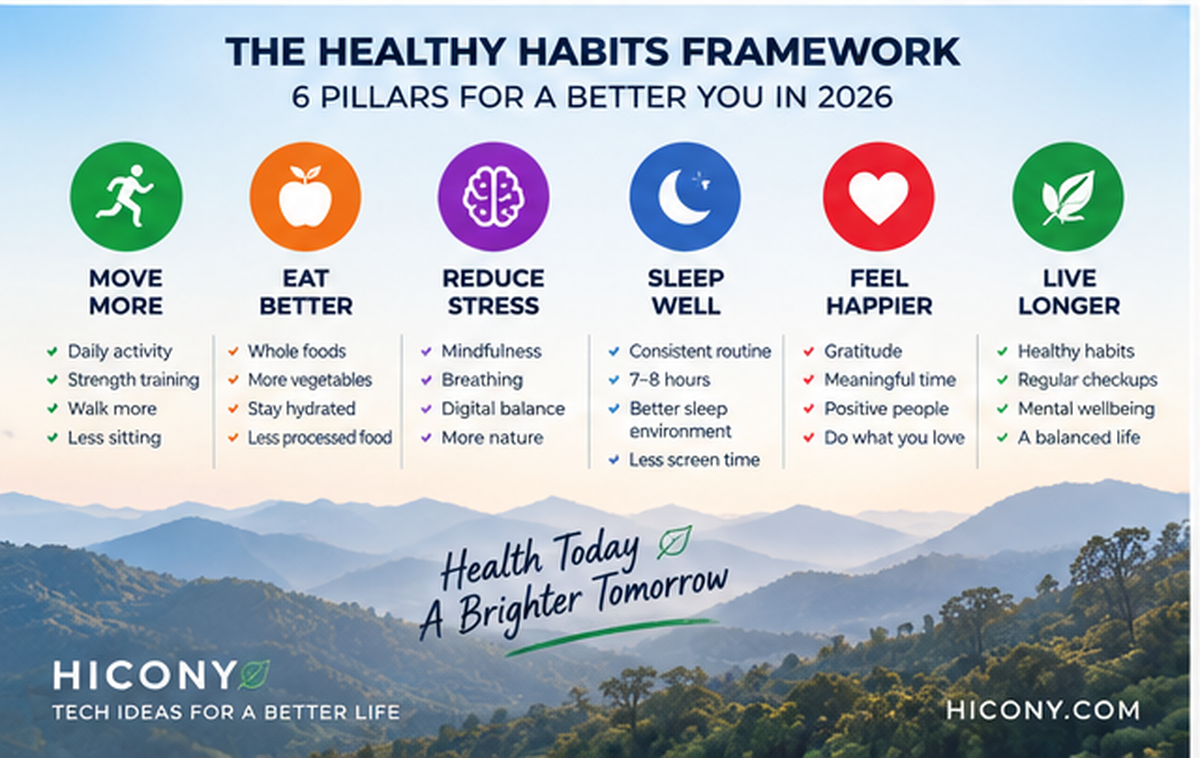
The 2026 Healthy Habits Framework
If twelve habits feel like too many, reduce them to six pillars:
- Move: make regular physical activity normal.
- Eat: make nutritious food the default.
- Sleep: protect enough time for recovery.
- Reset: manage stress before it accumulates.
- Connect: maintain meaningful relationships.
- Protect: manage attention, environment and preventive care.
The six pillars are deliberately broad. They allow you to build a routine that fits your culture, work, family, budget and physical abilities.
A Simple 7-Day Healthy Habits Reset
Do not try to rebuild your entire life on Monday morning. Use one week as an experiment.
Day 1: Observe
Do not change anything yet. Notice when you move, eat, scroll, work, rest and sleep.
Day 2: Add Movement
Take one intentional walk or activity break and decide where two weekly strength sessions could fit.
Day 3: Upgrade One Meal
Choose one meal you eat frequently and make it more nutritious without making it complicated.
Day 4: Protect Sleep
Set a realistic bedtime routine and remove one evening distraction.
Day 5: Reduce Digital Noise
Turn off nonessential notifications and create one phone-free block.
Day 6: Connect
Spend intentional time with someone instead of merely exchanging online reactions.
Day 7: Review
Ask three questions:
- Which habit felt easiest?
- Which habit gave me the biggest benefit?
- What obstacle should I redesign rather than simply fight?
Keep the easiest high-value habits. Drop unnecessary complexity. Then repeat the experiment next week.
How to Make Healthy Habits Stick
Use the “After X, I Will Y” Rule
Attach a new habit to something you already do.
- After morning tea, I will walk for ten minutes.
- After lunch, I will stand and move for a few minutes.
- After brushing my teeth, I will prepare tomorrow’s essentials.
- After closing my laptop, I will take a short transition break.
This removes the need to remember a completely new routine.
Lower the Starting Cost
If a habit requires twenty steps before you can begin, you will avoid it when tired.
Prepare the environment in advance. Put the shoes by the door. Keep healthy food available. Put the exercise equipment somewhere accessible. Decide your walking route beforehand.
Use the Two-Level Goal
Every important habit can have:
- Minimum: what you do on a difficult day.
- Target: what you do when circumstances are good.
This protects consistency without demanding perfection.
Never Let One Bad Day Become Two
Missing a habit is normal. The danger is turning one miss into an identity.
Do not say, “I have failed.” Say, “The system broke yesterday. What needs to change so tomorrow is easier?”
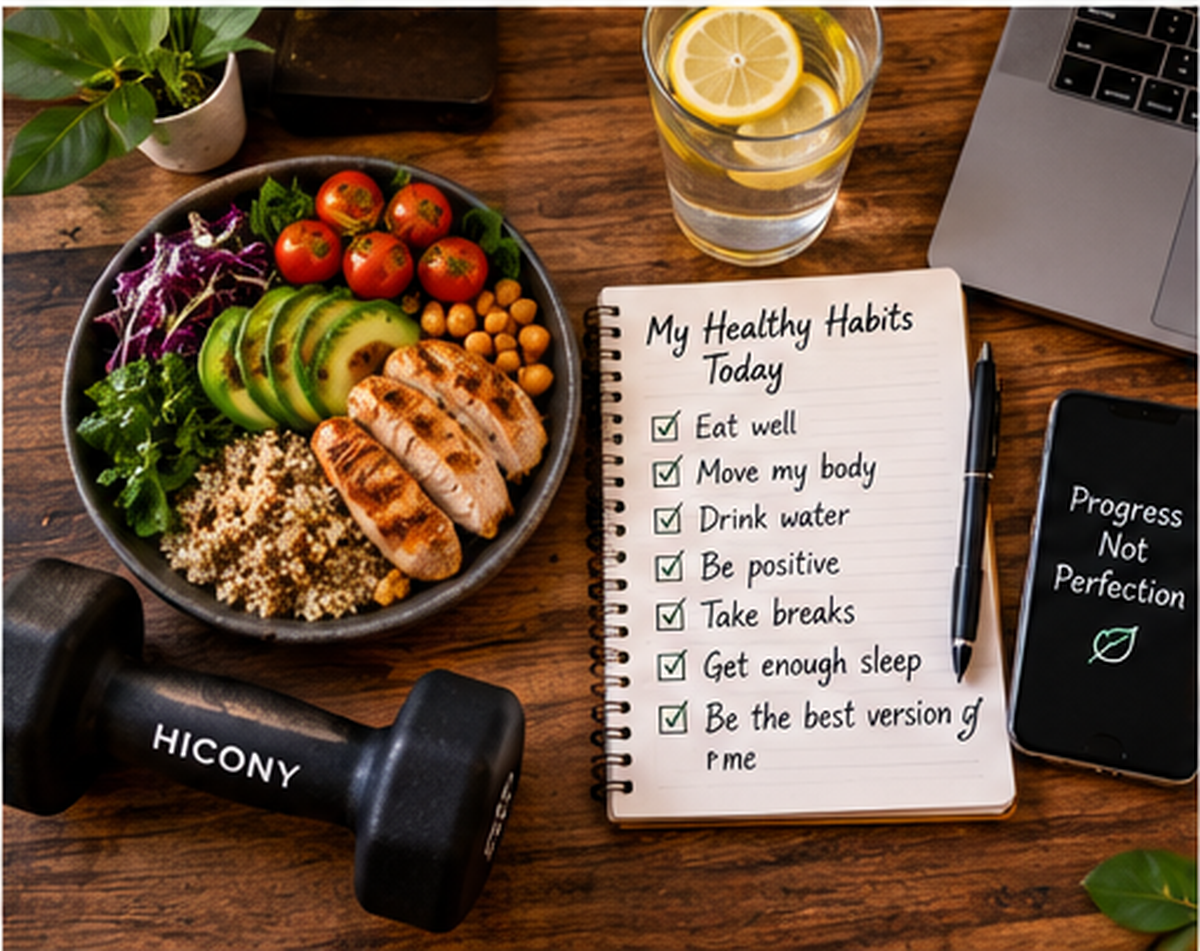
Healthy Habits and a Busy Working Life
Many wellness plans fail because they assume unlimited free time.
A realistic working adult may have deadlines, children, commuting, household responsibilities, unexpected problems and periods of poor sleep. Your health system should therefore be built around friction reduction.
Use small transitions:
- walk during one phone call;
- prepare food before hunger becomes urgent;
- keep a water bottle nearby;
- take short movement breaks between focused work sessions;
- use a fixed time to stop work;
- create a short evening shutdown routine.
This is also where productivity and wellbeing meet. Our guide to deep work explains how protected focus can reduce fragmented work, while digital minimalism explores how to reduce unnecessary digital noise. Healthy productivity is not squeezing more work into every minute. It is having enough energy and attention for the things that matter.
What Not to Do in the Name of Health
Healthy habits can become unhealthy when they turn into rigid rules.
Be cautious about:
- extreme diets that eliminate major food groups without a sound reason;
- punishing exercise after eating;
- trying to sleep perfectly every night;
- obsessive tracking of every calorie, step or biological metric;
- buying supplements before fixing basic lifestyle habits;
- following social-media health trends without checking the evidence;
- using AI as a substitute for professional medical care;
- believing that one bad day has ruined your progress.
A healthy system should make your life more sustainable, not more frightening.
Frequently Asked Questions
What is the most important healthy habit to start with?
Start with the habit that is both valuable and realistic for your current life. For many people, regular movement, adequate sleep or improving the quality of everyday meals can provide a strong foundation. You do not need to start with everything at once.
Do I need a gym to be healthier?
No. Walking, cycling, household activity, recreational movement and home-based strengthening can all contribute to an active lifestyle. A gym can be useful, but it is not a requirement.
How much exercise should adults aim for?
WHO recommends 150–300 minutes of moderate-intensity aerobic activity per week, or 75–150 minutes of vigorous activity, or an equivalent combination, plus muscle-strengthening activity on at least two days per week for adults. If you are currently inactive, starting with smaller amounts and gradually building up is often more realistic.
Is healthy eating expensive?
It can be made affordable by emphasizing simple foods, seasonal produce, legumes, whole grains and other foods that fit your local market. Healthy eating is a pattern, not a requirement to buy premium “health” products.
Can technology help with healthy habits?
Yes. Reminders, calendars, activity tracking, meal planning and AI-assisted organization can reduce friction. But technology should serve the habit rather than become another source of distraction.
How long does it take to build a habit?
There is no universal number of days that guarantees a habit will become automatic. The time depends on the behavior, context, person and consistency. Focus on making the behavior repeatable rather than chasing a particular day count.
Your Personal Healthy Habits Constitution
One of the strongest ways to turn this article into action is to write a one-page personal constitution.
Complete these sentences:
- I protect my health by __________.
- My minimum movement habit is __________.
- My usual sleep window is __________.
- My easiest healthy meal is __________.
- When stressed, I reset by __________.
- I protect my attention by __________.
- I stay connected by __________.
- My weekly health review happens on __________.
- When I miss a habit, I restart by __________.
Keep it visible. The purpose is not motivation. It is clarity.
The Real Goal for 2026
The goal of healthy habits is not to create a life where nothing difficult ever happens. That life does not exist.
The goal is to build enough physical, mental and social resilience that ordinary difficulties do not completely destroy your wellbeing.
Move your body. Eat mostly nourishing food. Protect sleep. Take stress seriously. Put boundaries around digital noise. Spend time with people who matter. Use technology and AI as tools rather than masters. Keep appropriate preventive healthcare on the calendar.
And above all, make your healthy routine small enough to survive real life.
You do not need a perfect year. You need thousands of ordinary decisions that gradually point in a better direction.
Small habits do not look powerful on the day you perform them. Their power appears when you look back after months of repeating them.
Save this guide: Choose just three habits for the next seven days: one for movement, one for recovery, and one for attention or connection. Once those feel stable, add another.
Sources and Further Reading
- World Health Organization — Self-care for health and well-being (2026)
- World Health Organization — Healthy diet
- World Health Organization — Physical activity
- CDC — Managing Stress (2026)
- CDC/NCHS — Short Sleep Duration and Sleep Difficulties Among Adults: United States, 2024 (2026)
- CDC — Social Connection
- CDC — Healthy Aging at Any Age
- U.S. Dietary Guidelines — 2025–2030