
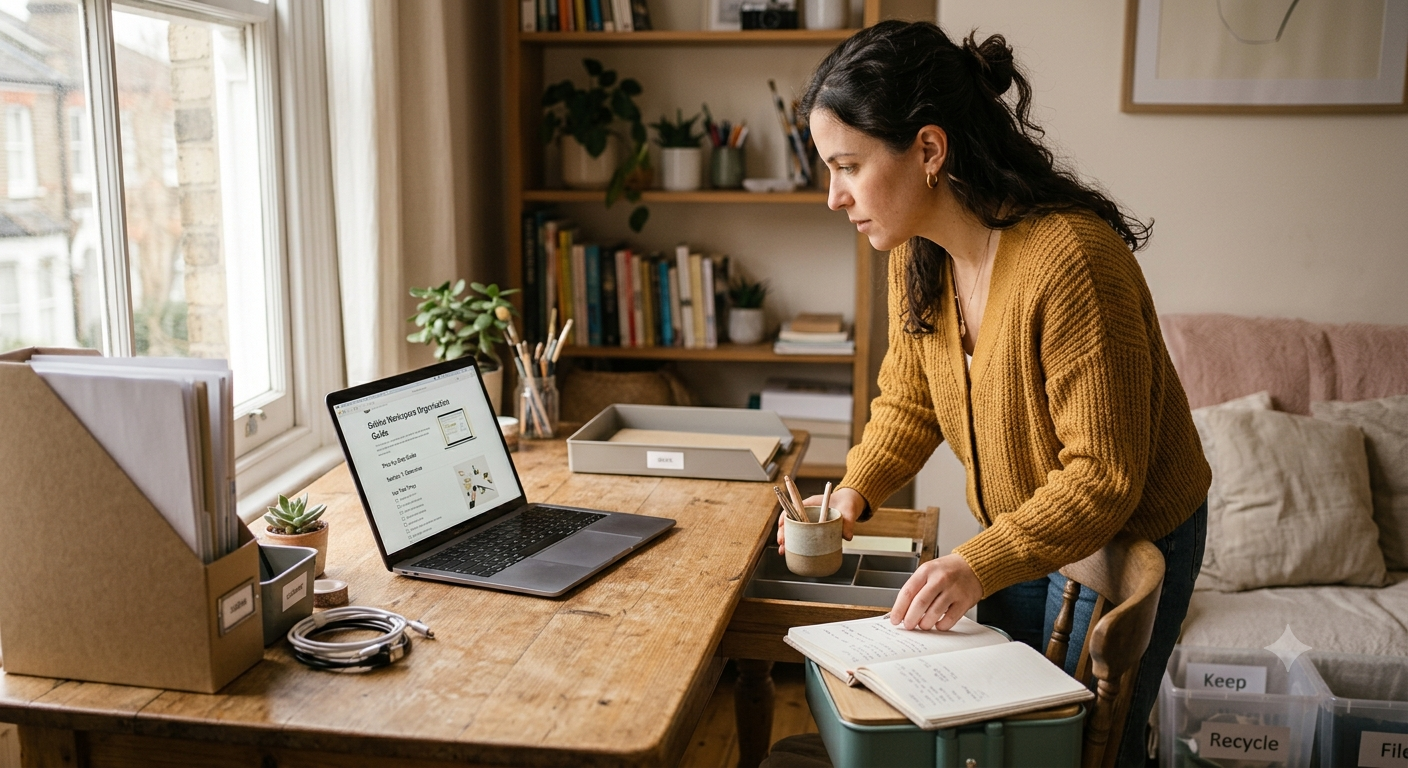
Paper has a strange way of taking over a home.
A few bills arrive. Then there are bank statements, receipts, insurance documents, school papers, medical records, warranties, letters and documents you aren’t quite sure whether you should keep.
Before long, a drawer becomes a pile, the pile becomes a box, and the box becomes something you promise yourself you’ll sort “one day.”
If that sounds familiar, you’re probably wondering what papers to keep and what to throw away.
The answer isn’t to keep everything. It’s also not to throw away everything that looks old.
A better approach is to separate documents according to their purpose, importance and how difficult they would be to replace.
This guide will help you work through common household papers and decide what deserves permanent storage, what can be kept temporarily and what can usually be discarded safely.
Before You Throw Anything Away, Ask These Questions
When you’re sorting paperwork, don’t make the decision based only on how old a document looks.
Ask:
- Do I need this document to prove something?
- Could I need it for taxes, legal matters or financial records?
- Is it evidence of ownership?
- Does it contain information that would be difficult to replace?
- Is there a digital copy stored somewhere safe?
- Is the information still relevant?
- Could throwing it away create a problem later?
If you’re unsure, put the document into a temporary “review” pile rather than making a rushed decision.
For important legal, financial or property records, check the retention requirements that apply in your country and circumstances before disposing of them.
What Papers Should You Usually Keep Permanently?
Some documents are worth keeping for the long term because replacing them can be difficult or because they establish an important legal or financial fact.
Examples can include:
- Birth certificates and equivalent vital records
- Marriage or divorce records
- Passports and important immigration documents
- Property deeds and ownership records
- Major loan and mortgage documents
- Important wills and estate documents
- Adoption or custody records
- Professional qualifications and important certificates
- Major insurance policies and related documentation
The exact documents you need to retain will depend on your personal circumstances and local laws.
For especially important documents, consider storing the originals somewhere secure and maintaining protected digital copies as a backup.
What About Tax Documents?
Tax records deserve more care than ordinary household paperwork.
Depending on your circumstances, you may need records showing income, expenses, deductions, payments or other financial information.
Don’t throw away tax-related documents simply because the tax year has ended.
Instead, determine how long you’re legally required to retain the relevant records.
If you’re self-employed or run a business, your record-keeping requirements may be different from those of an employee.
A useful system is to create a dedicated tax folder for each financial year and keep supporting documents together.
How Long Should You Keep Bank Statements?
Bank statements are a good example of paperwork that can accumulate quickly.
You may not need to keep every paper statement forever, particularly if your bank provides reliable digital records.
However, statements can be useful for proving payments, tracking financial history or supporting tax and legal matters.
Before discarding older statements, consider whether:
- You need them for tax records
- They relate to a disputed transaction
- They document a major purchase or payment
- You need them for a loan, legal matter or financial claim
- You can retrieve an accurate digital copy later
When digital statements are available, make sure you know where they are stored and how you would access them if your banking account changes.
Receipts: Which Ones Are Worth Keeping?
Receipts are one of the easiest types of paper to accumulate.
Most everyday receipts have little long-term value once the return period has passed and the transaction no longer matters.
But some receipts are worth retaining.
Consider keeping receipts for:
- Expensive electronics
- Appliances
- Furniture
- Vehicles and major repairs
- Items covered by warranties
- Business purchases
- Major home improvements
For ordinary groceries and small everyday purchases, keeping years of receipts usually creates unnecessary clutter.
What About Warranties and Manuals?
Don’t automatically keep every instruction manual that comes with a product.
Many manufacturers now provide manuals online.
Instead, consider keeping information that is actually useful:
- Warranty documents
- Proof of purchase for important items
- Serial numbers
- Service records
- Installation information
If you can reliably access a manual online, the paper copy may not need valuable storage space.
Insurance Documents
Insurance paperwork can be important, particularly when it relates to a current policy, claim or valuable asset.
Keep current policy documents and important claim records in an organized location.
Older policies may still have value if they relate to a past claim or potential dispute, so don’t automatically discard them just because the policy has expired.
If you’re uncertain about an old insurance document, check with your insurer or adviser before disposing of it.
Medical and Health Records
Medical paperwork can become complicated because different records have different purposes.
Important records may include:
- Major medical reports
- Imaging reports
- Vaccination records
- Records relating to ongoing treatment
- Important prescriptions or treatment history
- Documents needed for insurance or legal purposes
You don’t necessarily need to keep every appointment reminder or routine administrative letter forever.
Focus on retaining records that could be important for future care, insurance or other legitimate purposes.
School and Education Documents
Some school papers have sentimental value, while others have practical value.
Important certificates, qualifications, examination results and transcripts are generally worth preserving.
But you probably don’t need to keep every worksheet, permission slip and routine school notice for years.
For children’s artwork and school memories, consider choosing a small number of favourites rather than filling multiple boxes.
What About Utility Bills?
Old electricity, water, internet and telephone bills can quickly create a mountain of paper.
Once a bill has been paid and is no longer needed for tax, legal or dispute purposes, you may not need the physical copy.
If your provider offers an online account with accessible billing history, digital storage can reduce the amount of paper you need to keep.
However, don’t assume every online record will remain available forever. For documents that matter, save your own copy where appropriate.
How to Deal With Old Mail
Mail is one of the biggest causes of household paper clutter because new documents arrive faster than many people process them.
Instead of creating a permanent “mail pile,” give incoming paperwork a destination.
Try a simple system with three categories:
- Action: Something you need to deal with.
- Keep: Something that belongs in your records.
- Discard: Something you no longer need.
Process the action pile regularly so it doesn’t become another permanent storage area.
How to Know What Papers You Can Throw Away
When you’re deciding what papers to throw away, look for documents that have lost their practical value.
Examples may include:
- Expired promotional flyers
- Duplicate copies
- Old shopping lists
- Outdated event information
- Receipts for insignificant everyday purchases that are no longer needed
- Old envelopes without useful contents
- Instructions that are easily available online and no longer needed
Again, the key is not simply age.
The question is whether the document still serves a useful purpose.
Don’t Forget Personal Information
Throwing paperwork into the normal rubbish bin can create an unnecessary privacy risk.
Documents containing personal information should be disposed of appropriately.
Pay particular attention to papers containing:
- Bank account information
- Identification numbers
- Addresses
- Financial information
- Medical information
- Passwords or security information
Use a shredder or another appropriate secure-disposal method for sensitive documents where practical.
Should You Scan Important Documents?
Digital copies can be extremely useful, but they shouldn’t automatically replace every original document.
For documents you may need frequently, scanning can make them easier to find and protect against loss.
A simple digital filing structure might look like:
- Personal
- Property
- Finance
- Insurance
- Medical
- Education
- Business
- Tax
Within each category, use clear filenames and consistent dates.
For example:
2026-08-15-Home-Insurance-Policy.pdf
is much easier to locate later than a file named:
Document123.pdf
Keep Your Digital Documents Safe
Digitizing paperwork creates another responsibility: protecting the digital copies.
Use strong account security and consider maintaining backups.
For particularly sensitive records, think carefully about where they’re stored and who can access them.
A digital filing system is useful only if you can actually find the documents when you need them and keep them protected.
Create a Simple Paper Filing System
You don’t need a complicated filing cabinet with dozens of categories.
A small number of broad categories is often easier to maintain.
For example:
- Important Documents
- Finance & Tax
- Property & Insurance
- Medical
- Family & Education
- Business
- To Action
Adjust the categories according to your household.
The best filing system isn’t the one with the most folders. It’s the one you’ll actually continue using.
A 30-Minute Paper Decluttering Method
If the thought of sorting your entire home feels overwhelming, don’t try to finish everything in one day.
Set a timer for 30 minutes.
- Collect loose paperwork from one small area.
- Remove obvious rubbish and duplicates.
- Separate important documents.
- Create a temporary review pile for anything uncertain.
- File the documents you are keeping.
- Securely dispose of sensitive paperwork you no longer need.
- Stop when the timer ends.
You can repeat the process another day.
Small sessions are often easier to maintain than waiting for the mythical “free weekend” when you will supposedly organize the entire house.
What to Do With Papers You’re Not Sure About
Uncertainty is one of the biggest reasons people keep everything.
Instead of putting questionable documents back into your main filing system, create a temporary review folder.
Write a date on it.
Then review the folder later.
For documents with possible legal, financial or tax significance, get appropriate professional advice rather than guessing.
This prevents both unnecessary clutter and accidental disposal of something important.
Final Thoughts
Learning what papers to keep and what to throw away isn’t about creating a perfectly minimalist home.
It’s about making your paperwork manageable.
Keep documents that establish important rights, ownership, identity or financial information. Keep other records for as long as they are genuinely useful. Dispose of unnecessary papers securely, particularly when they contain personal information.
And remember that your filing system doesn’t need to be complicated.
A simple system that you actually use is better than a perfect system that becomes too difficult to maintain.
Quick Takeaway
When deciding what papers to keep and what to throw away, focus on usefulness rather than age. Keep important legal, financial, property, insurance and personal records, retain temporary documents only as long as necessary, and securely dispose of paperwork that no longer serves a purpose.
Want a More Organized Paperwork System?
If you’re trying to reduce paper clutter and create a simpler system for managing household documents, a practical organization guide can help you turn the ideas above into a repeatable routine.
Explore the relevant organization resources from ZelGio if you’d like a ready-made digital resource to help with your organization project.
Explore ZelGio’s digital resources →https://zelgio.com/declutter-papers-and-mail-a-practical-guide-how-to-declutter-papers-and-mail-digital-download-guide-for-paper-organization-home-office-simplification/
A little paperwork organization now can save you from searching through an entire box of documents when you urgently need one piece of paper later.