
It is scattered across old documents, browser bookmarks, emails, notebooks, PDFs, saved messages, project folders, unfinished ideas, meeting notes, research papers and lessons you learned the hard way.
That creates an unusual problem in the age of AI: we now have powerful systems that can reason over enormous amounts of information, but much of the information that matters most to us remains badly organized.
This is where the idea of an AI second brain becomes interesting.
An AI second brain is not simply a chatbot with a large prompt. It is a personal knowledge system in which your useful information is captured, organized, retrieved and connected so that AI can help you work with it.
The important word is system.
You are not trying to make AI remember everything. You are building a trusted external knowledge layer that AI can consult when appropriate while you remain responsible for judgment, priorities and important decisions.

Why the AI Second Brain Is Becoming More Important in 2026
Generative AI has dramatically reduced the cost of producing an answer. The bottleneck is increasingly the quality of the context behind the answer.
If two people use the same powerful AI model but one gives it a carefully maintained knowledge base containing years of useful notes, project history, research and decisions, their results can be very different.
That does not mean the second person has a smarter AI model.
They have a better information environment.
Recent research supports the growing importance of personal knowledge management in working with generative AI. A 2026 study published in Discover Education examined personal knowledge management as a mechanism for helping lifelong learners make better use of generative AI. Another 2026 research paper explored a local-first, retrieval-grounded personal knowledge system for an LLM assistant. [1][2]
The concept is also moving beyond individuals. In September 2026, Meta described an “organizational second brain” designed to preserve specialist knowledge, combine structured knowledge with expert reasoning procedures, and turn expert corrections into reusable improvements. [3]
That suggests an important direction:
AI becomes more useful when it can work with a reliable body of knowledge rather than operating only from a blank conversation.
Your AI Is Powerful. Your Context May Be the Weak Link.
Imagine asking an AI assistant:
“Help me prepare for this client meeting.”
It can produce a useful generic checklist.
Now imagine the system also has access to:
- your previous meeting notes;
- the client’s public information;
- your previous proposals;
- questions you asked during earlier calls;
- the client’s stated priorities;
- your own notes about what worked and what did not;
- relevant research;
- your preferred communication style; and
- the decisions already made.
The AI is no longer starting from zero.
That is the practical value of a second brain.
What an AI Second Brain Is – and Is Not
| It is | It is not |
|---|---|
| A structured external knowledge system | A magical AI memory |
| A source of personal context | A replacement for judgment |
| A retrieval layer for useful information | A dumping ground for every file you own |
| A way to connect old knowledge with new work | A guarantee that AI answers are correct |
| A system that improves through deliberate maintenance | A one-time setup that never needs attention |
The distinction matters because people often make the same mistake: they collect enormous amounts of information and assume that AI will automatically turn the collection into intelligence.
It will not.
A pile of information is not a knowledge system.
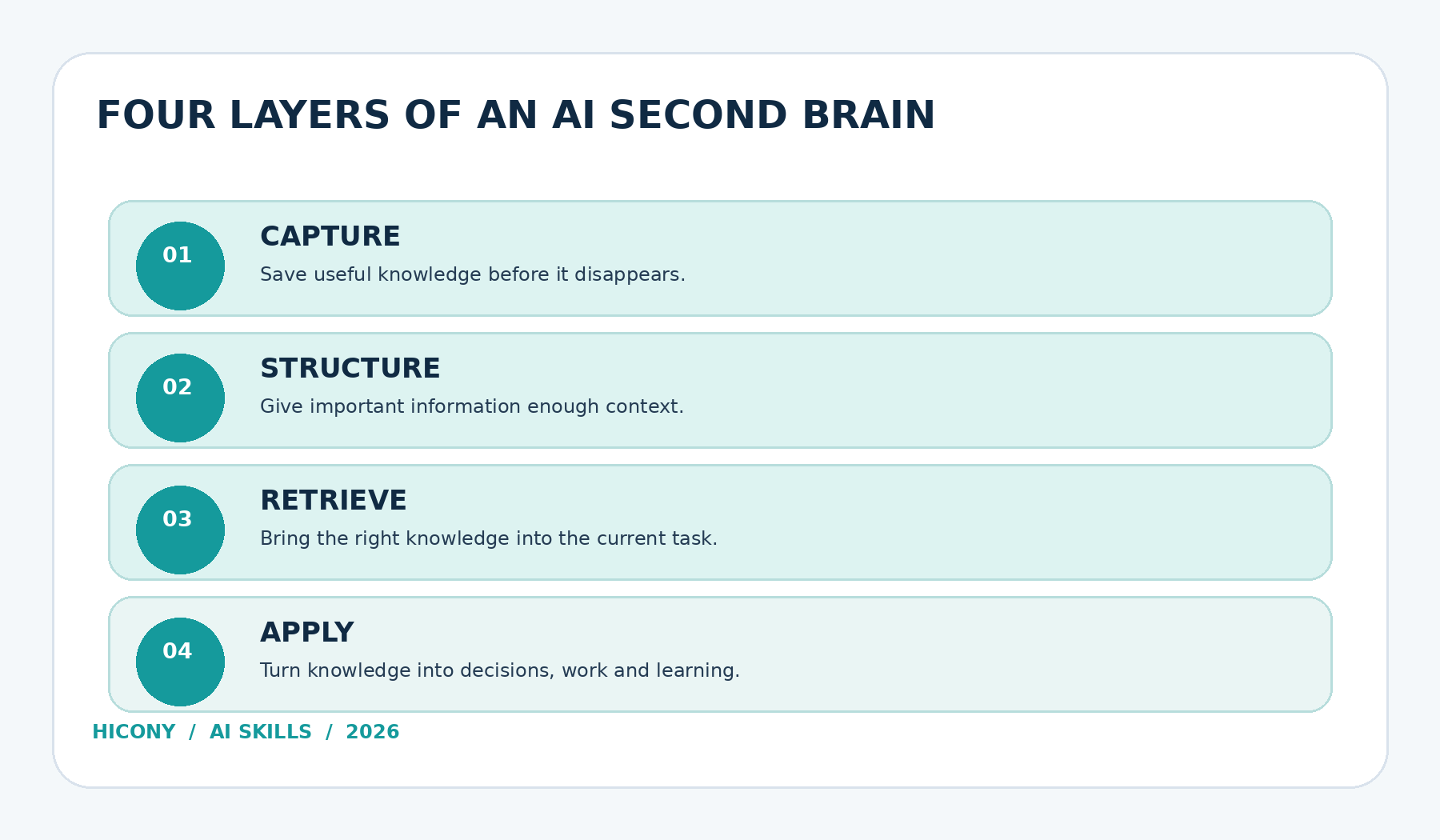
The Four Layers of a Useful AI Second Brain
Layer 1: Capture
This is where information enters the system.
Examples include:
- notes;
- research findings;
- meeting summaries;
- project decisions;
- useful articles;
- books and PDFs;
- lessons learned;
- customer questions;
- ideas;
- templates; and
- checklists.
The goal is not to capture everything.
The goal is to capture information that you are likely to use again.
Layer 2: Structure
Information needs enough structure to remain understandable later.
You do not necessarily need an elaborate folder hierarchy. A simple structure can be powerful:
- Projects – things you are actively doing.
- Areas – responsibilities that continue over time.
- Knowledge – reusable information.
- Resources – useful reference material.
- Archive – material you want to retain but rarely use.
You can adapt this to your own work. The important thing is consistency.
Layer 3: Retrieval
This is where AI becomes extremely useful.
Instead of manually searching hundreds of notes, you ask a question and allow the system to retrieve relevant material.
For example:
“What did I learn from the last three projects involving this type of client?”
Or:
“Find previous decisions related to this issue and show me where they conflict with the current proposal.”
The quality of the answer depends heavily on the quality of retrieval.
Layer 4: Application
This is the part many people overlook.
Your knowledge should help you do something.
AI might use the retrieved material to:
- prepare a briefing;
- compare alternatives;
- draft a document;
- identify contradictions;
- prepare questions;
- summarize lessons;
- suggest next actions;
- create a checklist; or
- connect an old idea with a new problem.
The second brain becomes valuable when knowledge moves back into action.
The Difference Between Storage and Intelligence
Suppose you have 10,000 notes.
That sounds impressive.
But if you cannot find the right note when you need it, the practical value may be close to zero.
Now imagine you have only 1,000 carefully maintained notes, each with enough context for you or an AI system to understand why it matters.
That smaller collection may be dramatically more useful.
This leads to a simple principle:
Optimize for retrieval and reuse, not collection volume.
What Should You Put Into Your AI Second Brain?
A useful starting point is to prioritize information with one or more of these characteristics:
1. You will use it repeatedly
A good template, checklist or research framework can save time repeatedly.
2. You spent significant effort learning it
If you spent ten hours solving a difficult problem, document the lesson before the details disappear.
3. It influences future decisions
Record the reasoning behind important decisions, not just the decision itself.
4. It represents your working method
Document how you approach recurring tasks.
5. It is difficult to reconstruct
Some information is easy to find again. Other information represents years of accumulated experience. Preserve the latter.
Do Not Store Just Facts – Store Decisions
This may be one of the most powerful upgrades you can make.
Most note systems preserve what happened but lose why it happened.
For example:
Weak note: “Changed advertising strategy in August.”
Useful note: “Changed advertising strategy in August because campaign A produced strong traffic but weak conversion. We decided to reduce spend until the landing-page problem was fixed. Revisit if conversion improves.”
The second note contains decision context.
Decision context is extremely valuable to AI because it allows the system to reason about future situations instead of merely retrieving isolated facts.
A Simple Decision Record Template
DECISION
What was decided?

DATE
When?

CONTEXT
What problem were we solving?

OPTIONS
What alternatives were considered?

REASONING
Why was this option chosen?

ASSUMPTIONS
What did we believe to be true?

RISKS
What could make this decision wrong?

REVIEW DATE
When should we reconsider it?

OUTCOME
What actually happened?

LESSON
What should be remembered next time?
Over time, these records become a valuable map of your own thinking.
How AI Can Turn Old Notes Into New Value
Your historical information becomes particularly powerful when AI can compare it with current circumstances.
Consider these requests:
- “What mistakes have I repeatedly made in similar projects?”
- “Which decisions produced the best results?”
- “What assumptions in my current plan have been contradicted by previous experience?”
- “What topics do I keep researching without converting them into action?”
- “Find three ideas from my older notes that could improve this current project.”
- “What unanswered questions appear repeatedly across my notes?”
These are much more interesting than asking AI to summarize a folder.
You are asking it to find patterns across your own accumulated experience.
The AI Second Brain Workflow
A practical system can follow this loop:
Capture → Clean → Connect → Retrieve → Apply → Review → Improve
Capture
Save useful information while it is fresh.
Clean
Remove duplicates, obvious junk and contextless fragments.
Connect
Link related projects, concepts, decisions and lessons.
Retrieve
Bring relevant knowledge into the current task.
Apply
Use the knowledge to make something, solve something or decide something.
Review
Check whether the result was actually useful.
Improve
Update the underlying knowledge when you discover something new.
This final step is critical. A second brain should evolve.
Build a “Knowledge Inbox” Instead of Organizing Everything Immediately
One reason personal knowledge systems fail is excessive organization.
People spend hours deciding which folder a note belongs in.
A better approach is to have a temporary knowledge inbox.
Capture first. Organize later.
Then, during a weekly review, ask:
- Is this worth keeping?
- Where might I use it?
- Does it duplicate something else?
- Does it need context?
- Should it become a permanent principle, checklist or reference?
AI can assist with this cleanup, but you should retain final control over what becomes trusted knowledge.
Why “Garbage In, Garbage Out” Becomes Even More Important
An AI system can make bad information easier to retrieve.
That is not the same as making it true.
If your knowledge base contains outdated instructions, contradictory decisions or unverified claims, an AI assistant may confidently combine them into a polished answer.
Therefore, a mature second brain needs provenance.
Whenever practical, keep:
- the source;
- the date;
- the author or origin;
- the status of the information;
- your interpretation; and
- any known uncertainty.
This allows you to distinguish between a verified source and something you wrote three years ago after a stressful afternoon.
Create Knowledge Status Labels
A very simple status system can dramatically improve reliability:
| Label | Meaning |
|---|---|
| VERIFIED | Supported by a reliable source or confirmed evidence. |
| WORKING | Useful but still being tested. |
| PERSONAL EXPERIENCE | Observed from your own work. |
| HYPOTHESIS | An idea that has not been established. |
| OUTDATED | Retained for history but should not guide current decisions. |
Now AI can be instructed to treat these categories differently.
Protect Your Second Brain From Becoming a Privacy Problem
The more valuable your knowledge base becomes, the more sensitive it may become.
It could contain:
- client information;
- business plans;
- financial records;
- private correspondence;
- password-related information;
- legal or contractual material;
- personal reflections; and
- confidential research.
Do not assume that “put it into AI” is automatically safe.
Before connecting an AI system to private information, understand:
- where the data is stored;
- who can access it;
- whether it is used for model improvement;
- how long it is retained;
- what integrations have access to it;
- how permissions work; and
- how you can delete or export your data.
For highly sensitive information, a local-first or tightly controlled architecture may be preferable depending on your requirements. A 2026 paper specifically explored a local-first retrieval-grounded architecture for a personal LLM assistant, highlighting privacy and control as important design considerations. [2]
You Do Not Need a Complicated Technical Stack
A common mistake is to think you need databases, vector stores, agents, APIs and elaborate automation before starting.
You do not.
Your first version can be extremely simple:
- A folder for trusted knowledge.
- A consistent naming convention.
- A small number of categories.
- A weekly review.
- An AI assistant that can work with selected files.
Once the system becomes valuable, you can add more advanced retrieval and automation.
Technology should follow the workflow, not the other way around.
When a Local-First System Makes Sense
Local-first means important information can remain under your control rather than automatically being copied into a cloud service.
This can be attractive when:
- privacy is a major concern;
- you have large archives;
- you need offline access;
- you want control over the storage layer; or
- you want to experiment with local AI models.
But local-first also creates responsibilities: backups, updates, hardware, security and technical maintenance.
There is no universally perfect architecture.
The correct architecture depends on the sensitivity and value of the information.
Build a Personal Knowledge Architecture
Here is a simple structure you can adapt:
MY KNOWLEDGE SYSTEM

00_INBOX
01_PROJECTS
02_AREAS
03_KNOWLEDGE
04_DECISIONS
05_TEMPLATES
06_RESEARCH
07_LESSONS
08_REFERENCES
09_ARCHIVE
Within a project, you might use:
PROJECT
├── Brief
├── Research
├── Decisions
├── Working Notes
├── Deliverables
└── Lessons Learned
The exact folder names do not matter nearly as much as having a system you can understand six months from now.
The Most Valuable Folder May Be “Lessons Learned”
Most productivity systems focus on tasks.
Knowledge systems should focus on learning.
After completing a project, ask:
- What worked?
- What failed?
- What surprised me?
- What would I do differently?
- What should become a checklist?
- What should I never repeat?
Then store the answers.
That converts experience into reusable organizational memory.
How an AI Second Brain Can Help With Learning
Imagine that you are learning a complicated subject.
Instead of asking AI to repeatedly explain the topic from scratch, your system can maintain:
- your current understanding;
- questions you have not answered;
- important source material;
- mistakes you previously made;
- examples;
- summaries in your own words; and
- connections to related topics.
Then AI can act as a tutor that understands your learning history.
It could ask:
“You previously believed X. Your newer notes suggest Y. Would you like to compare the two?”
That is much more valuable than another generic explanation.
The “Compression” Principle
One of the most useful jobs for AI is compression.
Not simply making text shorter, but converting a large body of experience into a form that remains useful.
For example:
50 pages of project notes → 1 decision record + 1 checklist + 5 lessons + source links.
Or:
20 research papers → 1 comparison table + 10 key findings + unresolved questions.
Or:
100 customer questions → 12 recurring problems + FAQ + product opportunities.
Compression turns accumulated information into reusable knowledge.
But Never Compress Away the Evidence
There is a danger.
If you keep only AI-generated summaries, the system can gradually lose the original evidence.
For important knowledge, keep both:
- the compressed understanding; and
- the source material.
This creates a useful chain:
Source → Interpretation → Lesson → Action
When something is challenged, you can move backward through the chain.
How to Use Your AI Second Brain for Business
For a small business, a knowledge system can become an operational memory.
It can contain:
- product knowledge;
- customer objections;
- successful campaigns;
- failed experiments;
- supplier information;
- marketing lessons;
- content frameworks;
- standard operating procedures;
- brand guidelines; and
- important decisions.
Then an AI assistant can help answer questions such as:
“What have we learned about this type of customer?”
“Which previous campaigns had similar characteristics?”
“What objections should the sales team prepare for?”
“What procedures apply to this situation?”
This is where the personal second brain starts evolving into an organizational knowledge system.
The Organizational Lesson From 2026
Meta’s September 2026 engineering report describes an organizational second-brain architecture that separates structured knowledge from reasoning procedures and uses expert feedback to create validated improvements. Meta reports that the approach reduced some specialist assessment tasks from days to minutes in its domain and was designed so that expert corrections could become durable, version-controlled improvements. [3]
The important lesson is not that every small business should reproduce Meta’s architecture.
It is that knowledge becomes more valuable when improvements compound.
If every mistake is forgotten, you repeatedly pay for the same mistake.
If every useful correction becomes part of the system, the organization becomes progressively smarter.
Your Second Brain Should Have a Feedback Loop
Use this simple cycle:
- AI produces a useful result.
- You inspect it.
- You correct mistakes.
- You identify why the mistake happened.
- You update the knowledge, instructions or checklist.
- The next workflow uses the improvement.
This is the beginning of compounding intelligence.
Your system does not become smarter because the model magically learns your business. It becomes more useful because your workflow captures what humans learn and makes that learning reusable.
Seven Mistakes That Destroy an AI Second Brain
1. Saving everything
More information can make retrieval worse.
2. Keeping notes without context
A sentence that made sense today may be meaningless in two years.
3. Never reviewing old knowledge
Outdated knowledge can become dangerous knowledge.
4. Trusting AI summaries blindly
A summary can omit the one detail that changes the conclusion.
5. Mixing facts and speculation
Clearly label what is verified and what is your hypothesis.
6. Building technology before a workflow
A sophisticated system cannot compensate for unclear information practices.
7. Forgetting human judgment
Your second brain should increase your thinking capacity, not outsource your responsibility.
A 30-Day AI Second Brain Plan
Days 1-7: Capture
Create one inbox and begin collecting only genuinely reusable information.
Days 8-14: Structure
Create your basic categories and move the most important material into them.
Days 15-21: Connect
Record decisions, lessons and relationships between important pieces of knowledge.
Days 22-26: Add AI retrieval
Test whether AI can answer questions using your selected knowledge base. Check whether the retrieved information is actually relevant.
Days 27-30: Build one workflow
Choose one recurring task and make your second brain support it. Measure whether the result is genuinely better.
Measure the System With Real Questions
Do not measure your second brain by the number of notes stored.
Measure it by questions such as:
- How quickly can I find something I used to search for manually?
- How often does old knowledge improve a new decision?
- How many repeated mistakes have I prevented?
- How much time does preparation take now?
- Can another person understand why a decision was made?
- Does AI produce better results when it has access to the system?
- Am I learning faster?
If the answer to these questions is improving, your system is working.
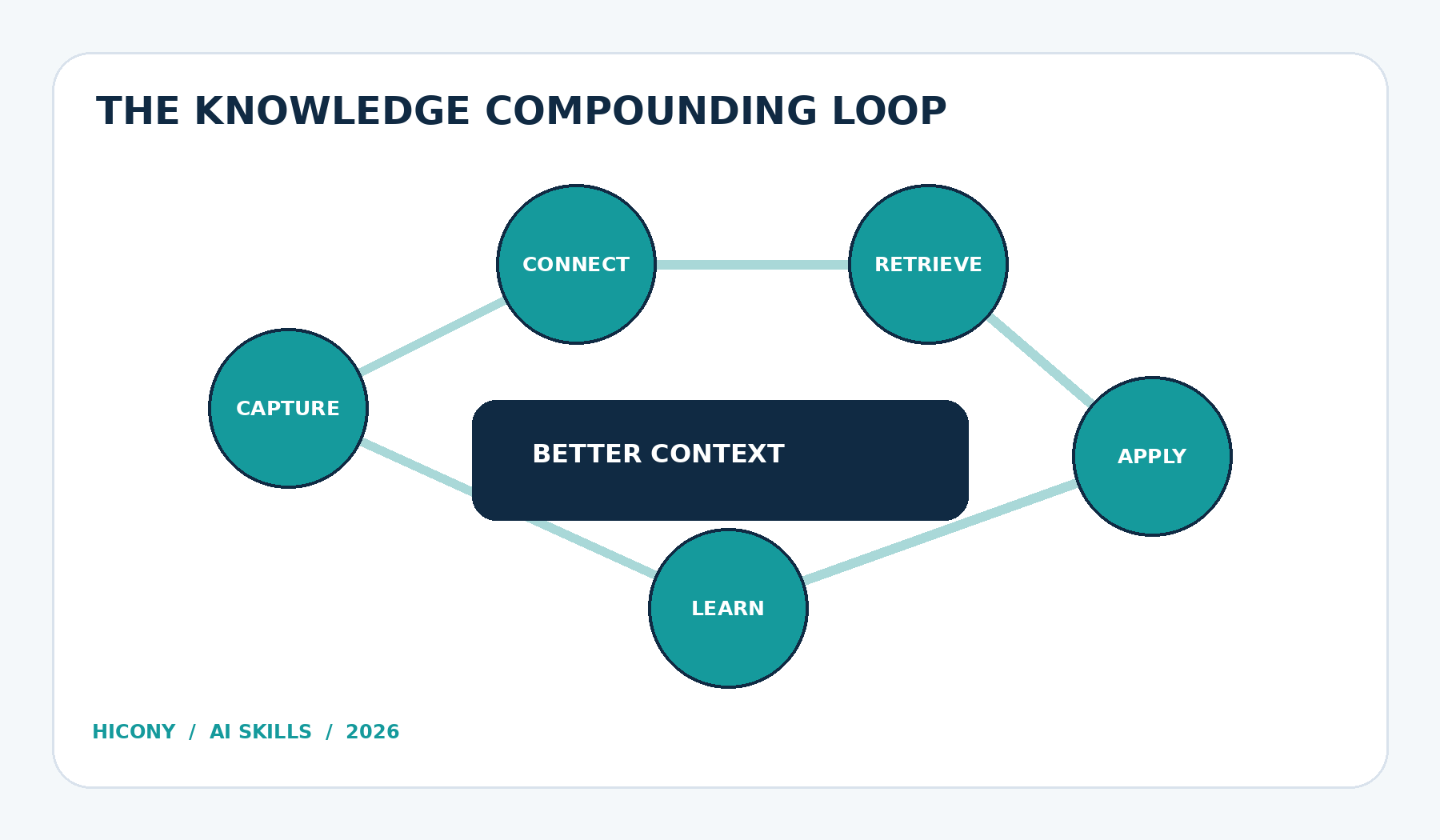
The Deeper Idea: Your Knowledge Can Compound
Traditional productivity often resets every morning.
You wake up, check the task list and begin working.
A knowledge system changes the curve.
Every project can leave behind something useful:
Experience → Documentation → Retrieval → Better decision → Better result → New experience
AI can accelerate this loop because it can help organize, compare and retrieve information much faster than manual methods.
But the human remains essential because only a human can decide what experience means, what should be trusted and what deserves to influence future decisions.
How This Connects With AI Productivity
Productivity is often described as doing more work in less time.
That is incomplete.
A better goal is:
Use less effort to produce better decisions and more valuable outcomes.
Your AI second brain contributes to this by reducing the amount of cognitive effort spent rediscovering your own knowledge.
Instead of repeatedly asking:
“What did I learn about this?”
you can move toward:
“Show me what I already know, what changed, what I still do not know, and what I should consider next.”
That is a much more powerful relationship with AI.
If you are building broader AI productivity skills, Hicony’s earlier guide on AI Skills can complement this system, while the AI workflow guide for delivering more value to clients provides a practical workflow-oriented extension.
Final AI Second Brain Checklist
- ☐ I have one trusted capture point.
- ☐ My important knowledge has enough context to be understood later.
- ☐ I distinguish facts, experience, hypotheses and outdated information.
- ☐ Important decisions include their reasoning.
- ☐ I preserve source material for important claims.
- ☐ AI can retrieve relevant information without treating everything as equally trustworthy.
- ☐ I review important knowledge periodically.
- ☐ Sensitive information has appropriate protection.
- ☐ I use the system to improve real work, not simply to collect notes.
- ☐ Human judgment remains responsible for important decisions.
Conclusion: Don’t Build a Bigger Brain. Build a Better Memory System.
The promise of an AI second brain is not that AI will become you.
It is that your accumulated knowledge no longer has to disappear into forgotten folders, old conversations and scattered notes.
A good system captures experience, preserves context, makes knowledge retrievable and turns lessons into future advantages.
AI adds another layer: it can help connect information, identify patterns, compress large bodies of material and bring relevant knowledge into the moment when you need it.
But the most important principle remains human:
Do not outsource your judgment. Externalize your memory, strengthen your context, and use AI to work with what you have learned.
Sources and Further Reading
- Springer / Discover Education – Empowering lifelong learners: the mediating role of personal knowledge management in harnessing generative AI affordances (2026)
- SSRN – A Local-First, Retrieval-Grounded Knowledge Management System for Personal LLM Assistants (2026)
- Meta Engineering – An Organizational Second Brain: Building an AI That Learns From Experts (2026)
- Microsoft Work Trend Index 2026 – Agents, human agency, and the opportunity for every organization