

Your heart is racing before a hard conversation, or your mind won’t stop looping at 2 a.m. — and someone tells you to “just breathe.” It’s not wrong advice, exactly, but it’s not specific enough to actually work when you need it. Box breathing is the specific version: a slow, four-count pattern of inhaling, holding, exhaling and holding again, repeated for a couple of minutes. It’s simple enough to do at a red light and structured enough that your mind has something to focus on besides whatever is stressing you out.
It’s also one of the few relaxation techniques with a genuinely interesting origin story — it’s the same breathing drill U.S. Navy SEALs are taught to stay calm and think clearly under real pressure, and it’s built on centuries-old yogic breath control (pranayama) that modern research keeps circling back to.
What Box Breathing Actually Is
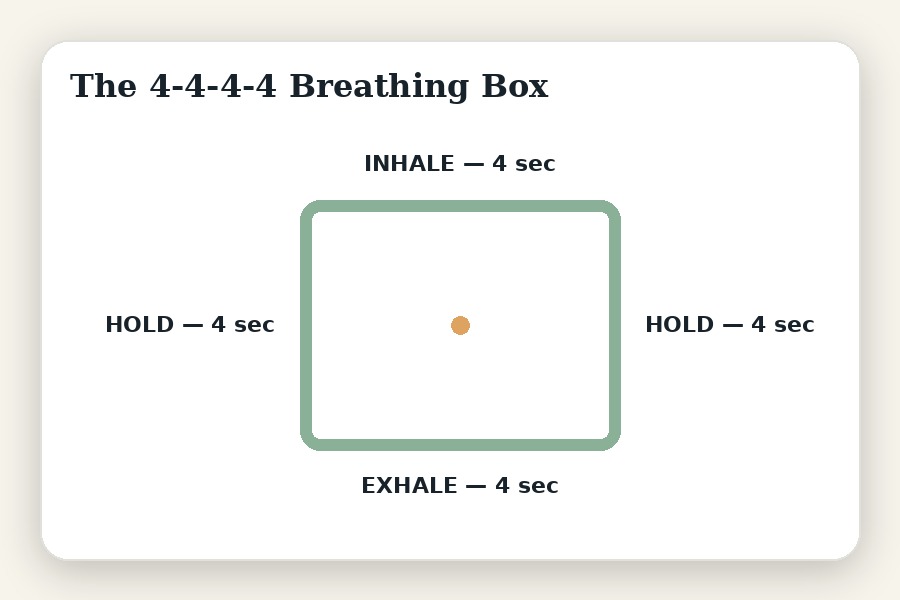
Box breathing gets its name from the shape of the pattern: four equal sides, four equal counts. You inhale for four seconds, hold the breath for four seconds, exhale for four seconds, and hold again for four seconds before starting over. According to Cleveland Clinic, this kind of breath regulation can lower levels of the stress hormone cortisol and may help lower blood pressure, which is part of why it’s used by everyone from combat units to people managing everyday anxiety.
Why a Four-Second Count Actually Calms You Down
The effect isn’t just mental distraction, though the counting does help occupy a racing mind. Slow, controlled breathing engages the vagus nerve, a key part of the parasympathetic nervous system — the branch responsible for calming the body down rather than revving it up. When you deliberately slow your breath, you’re sending your nervous system a direct signal that it’s safe to stand down from a stress response, rather than waiting for your mind to talk itself into feeling calmer first.
That’s a meaningful distinction. Most advice for stress management works top-down — think differently, and your body will follow. Box breathing works bottom-up: change what your body is doing, and your mind tends to follow. That’s often faster and more reliable in the middle of an actual stressful moment, when “just think positive” doesn’t have much to grab onto.
How to Do Box Breathing, Step by Step
- Sit or lie down comfortably. You don’t need a special posture — upright at a desk works fine, so does lying in bed.
- Exhale fully to empty your lungs before you begin.
- Inhale slowly through your nose for a count of four. Let your belly expand rather than just your chest.
- Hold the breath for a count of four. No straining — just a comfortable pause.
- Exhale slowly through your mouth for a count of four.
- Hold again, lungs empty, for a count of four.
- Repeat the cycle for two to four minutes, or for about eight to ten full rounds.
If a four-second count feels too long at first, three seconds works just as well while you build the habit — the ratio matters more than the exact number.
When Box Breathing Helps Most
This isn’t a technique you need to schedule into your day like a workout. It’s more useful as a tool you reach for in specific moments:
- Before a stressful meeting, presentation, or difficult conversation
- When you’re lying awake with a racing mind and can’t fall asleep
- Between tasks, as a genuine reset instead of another scroll break
- Right after a spike of anxiety, frustration, or overwhelm, before you react

Practicing it during calm moments — not just emergencies — actually makes it more effective when you need it under real pressure. Think of it the way you’d think of any other skill: rehearsing it while relaxed builds the muscle memory that makes it accessible when you’re not.
If you’re building this into a broader wind-down routine, it pairs naturally with reducing screen time before bed — see what a digital detox actually involves for a related approach to calming an overstimulated evening.
A Simple Way to Remember It
Picture a square, or trace one slowly in the air with a finger, moving up one side as you inhale, across the top as you hold, down the other side as you exhale, and across the bottom as you hold again. Some people count on their fingers instead; others just repeat “in, hold, out, hold” silently. The method matters less than doing it consistently — a habit doesn’t need to be sophisticated to be effective.
Box breathing won’t fix everything a hard day throws at you, and it isn’t a substitute for support when anxiety is a persistent, ongoing struggle rather than an occasional spike. But as a two-minute reset you can do anywhere, with no equipment and no app required, it’s one of the simplest tools available for bringing a racing nervous system back down to a manageable pace.