
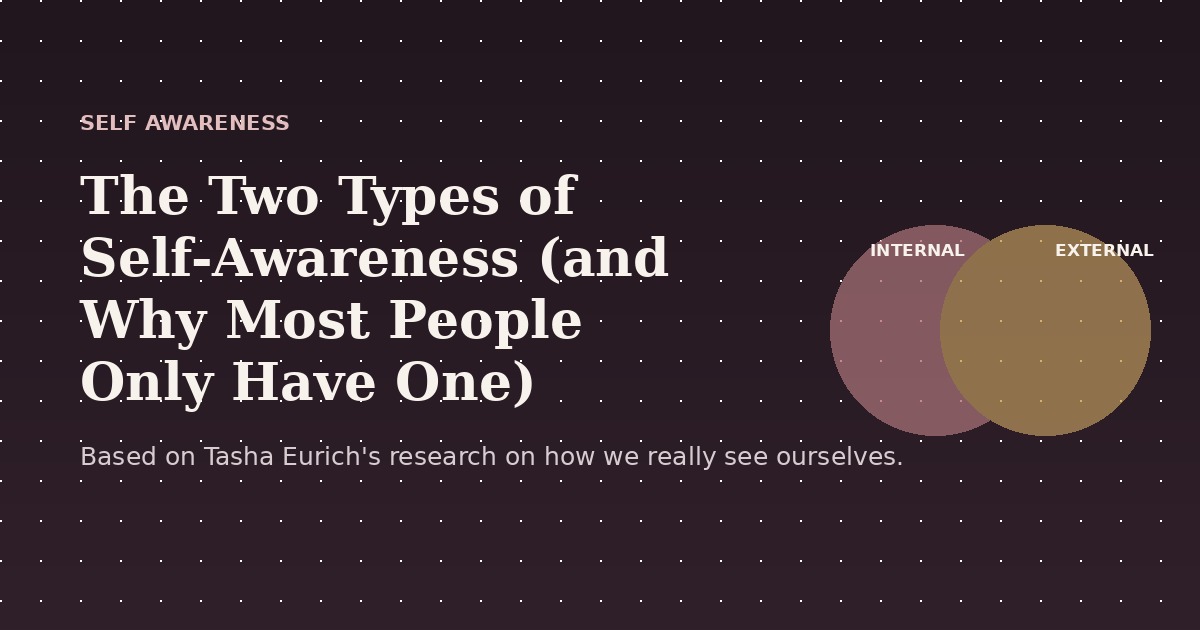
Ask almost anyone whether they’re self-aware, and they’ll say yes. Organizational psychologist Tasha Eurich actually tested this — across a research program spanning ten studies and nearly 5,000 participants, roughly 95% of people believed they were self-aware. Her team’s estimate of how many people actually met the criteria was far lower: somewhere around 10 to 15%.
That gap isn’t really about arrogance. It’s about a blind spot in how most of us think about self-awareness in the first place — we treat it as one skill, when Eurich’s research found it’s actually two, and they’re barely related to each other.
The Two Types of Self-Awareness
Internal self-awareness is how clearly you see your own values, passions, reactions, strengths and weaknesses — the inward-facing half most people mean when they talk about “knowing yourself.” External self-awareness is different: it’s how accurately you understand how other people actually experience you. According to Eurich’s research published in Harvard Business Review, these two categories are only weakly correlated — being strong in one tells you almost nothing about whether you’re strong in the other.

This is the part most self-improvement advice misses. Journaling, meditation, personality tests and quiet reflection all build internal self-awareness. They’re genuinely useful — but they do nothing to close the external gap, because no amount of looking inward tells you how you’re actually landing with the people around you.
Why You Can Be High on One and Low on the Other
It’s entirely possible to have a rich, accurate sense of your own values and motivations while consistently misreading how you come across to a partner, a manager, or a friend. It’s just as possible to be finely tuned to other people’s reactions — constantly adjusting based on their cues — while having very little clarity on what you actually want for yourself, independent of what pleases them.
Neither pattern is a character flaw. They’re just two different skills that happen to get lumped under one word, and most people have only ever deliberately practiced one of them.
Why Introspection Alone Doesn’t Close the Gap
A common instinct is to respond to this by introspecting harder — more journaling, more “why do I feel this way” questions. Eurich’s research found a counterintuitive problem with that approach: asking “why” tends to send people spiraling into rumination and invented explanations, rather than genuine insight, because most of our true motivations aren’t consciously accessible in the first place.
The fix she found effective is a small but real shift: ask “what” instead of “why.” Not “why do I feel so drained at work?” but “what situations make me feel this way, and what do they have in common?” The second version stays anchored to observable patterns instead of speculative self-narratives, and it tends to produce answers you can actually act on.
How to Actually Build External Self-Awareness
Internal self-awareness has no shortage of tools and content built around it already. External self-awareness is the harder, more neglected half — and it requires something introspection can’t provide: other people’s honest input.
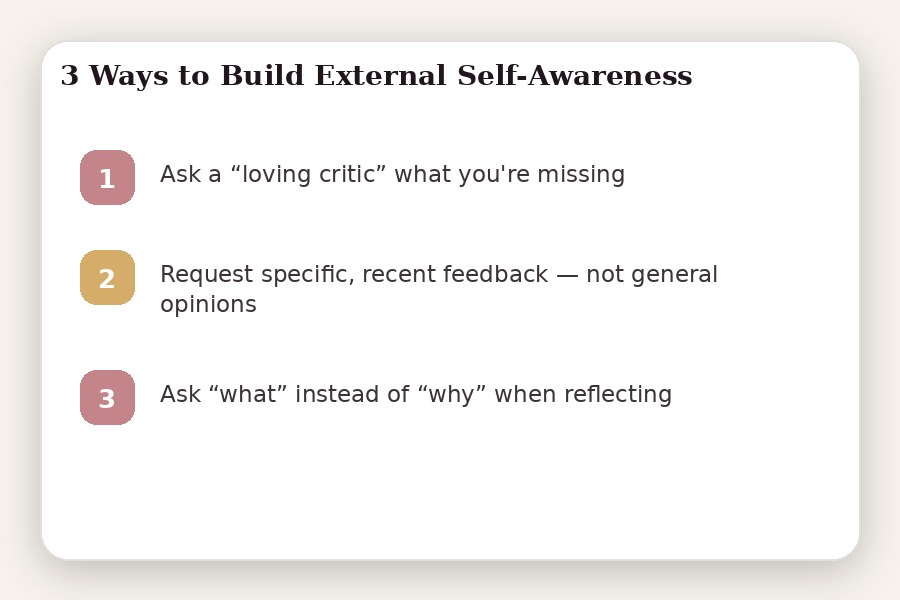
- Find a “loving critic.” Eurich’s term for someone who genuinely wants you to succeed and is willing to tell you the truth anyway — not someone who only offers comfort, and not someone using “honesty” as a excuse to be harsh.
- Ask for specific, recent examples, not general opinions. “How did I come across in that meeting?” gets a more useful answer than “Am I a good communicator?”
- Expect some discomfort, and don’t argue with the answer in the moment. The goal is to hear it clearly, not to defend yourself — you can sit with it and decide what to do afterward.
- Come back for a second round. One conversation gives you a data point. A habit of checking in occasionally gives you an actual mirror.
If you’re building a broader habit of self-reflection, it’s worth pairing this with a system for actually processing what you learn — see building a personal knowledge system for one way to keep track of patterns over time instead of losing the insight the next time life gets busy.
The Real Goal: Both, Together
Eurich’s research is clear that the people who benefit most aren’t the ones who max out one type of self-awareness — they’re the ones who deliberately build both. Internal clarity gives you a stable sense of what you actually want. External clarity keeps that self-image honest instead of comfortable. One without the other tends to produce either someone who’s clear-eyed about themselves but repeatedly blindsided by how others react to them, or someone who reads a room perfectly but has quietly lost track of what they actually think.
Self-awareness isn’t a trait you either have or don’t. It’s a pair of skills, and like most skills, the uncomfortable one — asking someone else what they actually see — is usually the one worth practicing first.