
By Don Dhairya Guptha Sumithraarachchi
Introduction
When we throw a ball, we instinctively imagine it travelling through something. The ball moves through air. Air molecules resist it. Eventually, the ball slows down.
Now consider Earth. Earth rotates. It orbits the Sun. The Sun travels around the Milky Way. The Solar System participates in larger cosmic motion.
But what is Earth moving through? Does Earth Really Move Through Space?
There is no ordinary cosmic atmosphere surrounding Earth. Space is extraordinarily dilute compared with Earth’s atmosphere. There are particles, radiation, fields and dust, but there is no established universal “cosmic air” that Earth must push aside.
This leads to a deceptively simple question: When we say that Earth moves through space, what exactly does “move through space” mean?
Don Dhairya Guptha Sumithraarachchi proposes a thought experiment that approaches the question from a different direction.
Instead of imagining Earth as a solid object travelling through an invisible substance called space, imagine Earth as occupying successive locations in spacetime.
At one moment: Earth — A.
At a later moment: Earth — B.
Later: Earth — C.
From the ordinary point of view, we say that Earth travelled from A to B to C.
At an extremely fine conceptual resolution, however, we could describe the same history as Earth no longer being at its previous spacetime location and now being at a new spacetime location.
This is not a claim that Earth literally teleports. It is a thought experiment about what motion actually means.
1. The Ball in the Air
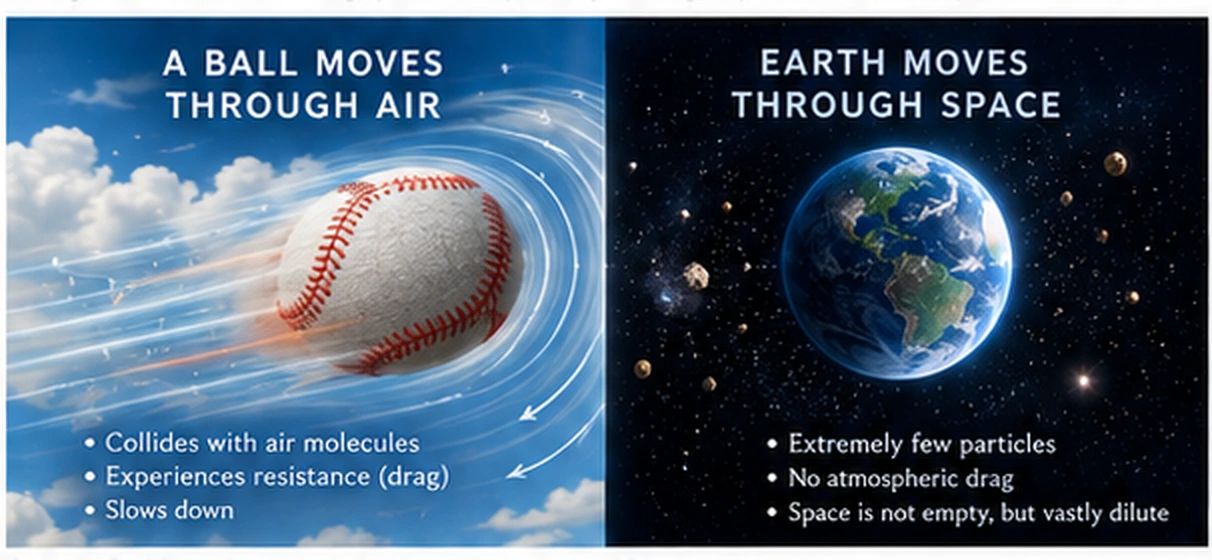
A thrown ball gives us a powerful everyday analogy. The ball encounters air molecules. Those interactions create drag. So we intuitively associate movement with resistance.
But the analogy breaks down in space.
The vacuum of space is not a perfect philosophical “nothingness.” Physical space contains extremely sparse matter and radiation, and objects can interact with particles, electromagnetic radiation and gravitational fields.
Nevertheless, there is no known universal medium equivalent to Earth’s atmosphere through which every object must travel.
Moving through air means interacting strongly with a material medium. Moving through space does not necessarily mean moving through a material substance.
2. What Does Relativity Say?
Einstein’s relativity changed the way physicists think about motion. There is no experimentally established universal stationary frame that functions as the absolute background of the universe. Motion is described relative to reference frames.
General relativity then treats space and time together as spacetime, whose geometry is connected with matter and energy.
Rather than imagining “object pushing through cosmic substance,” we can describe a physical system as having a history of events in spacetime. That history can be represented by a world-line.
3. The World-Line
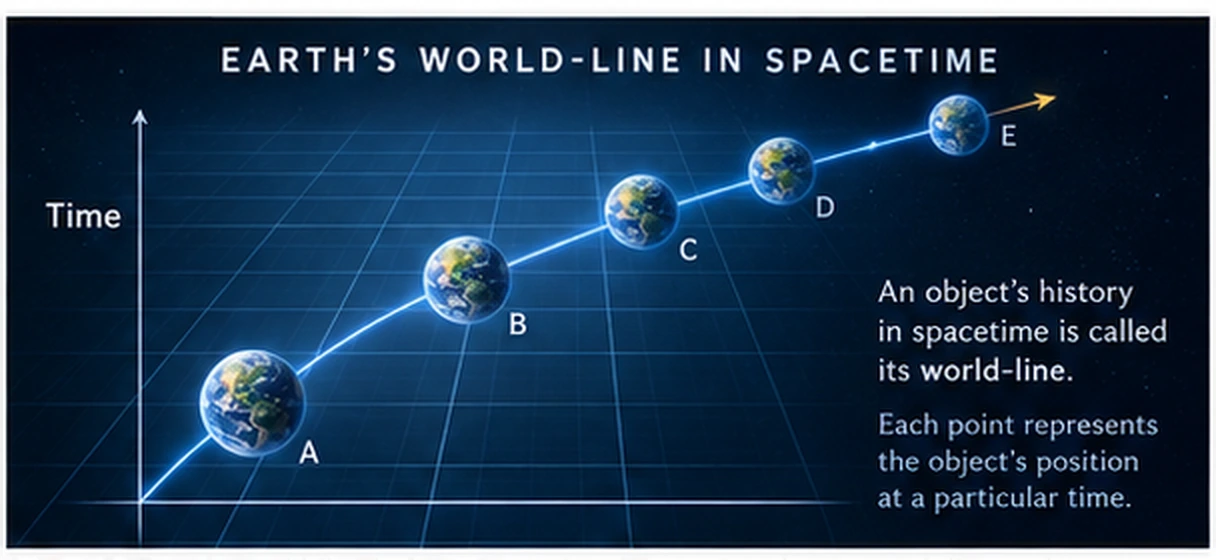
Imagine time pointing upward and space horizontally. A series of Earth positions connected by a line represents Earth’s history through spacetime.
Earth is therefore not adequately described simply by saying “Earth is here.” We must specify “where and when?” That distinction is central to relativistic thinking.
4. Don Dhairya Guptha Sumithraarachchi’s Thought Experiment

The central proposal can be stated carefully:
What if motion is not fundamentally a thing travelling through an invisible substance called space, but the succession of physical states and spacetime events associated with that thing?
The phrase “disappears here and appears there” can be useful as a metaphor, provided it is not confused with teleportation.
Earth does not literally vanish at one location and get recreated at another. Its matter, fields and internal processes continue according to physical laws.
The thought experiment simply asks us to remove the mental picture of an object pushing through a cosmic fluid.
5. Is Space Empty?
Not completely.
Space contains electromagnetic radiation, solar-wind particles, cosmic rays, interstellar gas and dust, magnetic and gravitational fields, gravitational waves, and quantum fields in modern quantum-field descriptions.
Light carries energy and momentum, so radiation can exert pressure. Particles travelling through space can interact with matter. Earth’s magnetic field interacts with the solar wind.
But none of this establishes an “ether” or universal cosmic fluid that causes ordinary aerodynamic drag on Earth’s motion.
6. What About Antimatter?
Antimatter should not be confused with an invisible substance filling space. Antimatter consists of antiparticles corresponding to ordinary particles. When matter and antimatter meet under suitable conditions, annihilation can occur, producing other particles and energy.
Modern physics has an important unresolved question: why the observable universe contains overwhelmingly more ordinary matter than antimatter.
But antimatter is not known to provide a cosmic resistance against Earth’s movement. The thought experiment concerns the meaning of motion—not a proposed antimatter medium.
7. The Old Ether Question
Before relativity, scientists proposed the luminiferous ether as a hypothetical medium through which light waves were thought to travel. The expected effects of Earth’s motion through such a medium were not observed, and special relativity eliminated the need for an ether as a preferred stationary medium.
Don Dhairya Guptha Sumithraarachchi’s thought experiment is different from ether theory. It does not require space to be a material substance. Instead, it asks whether the language of “travelling through space” itself may create an unnecessarily mechanical picture.
8. A Surprising Comparison With Abhidhamma
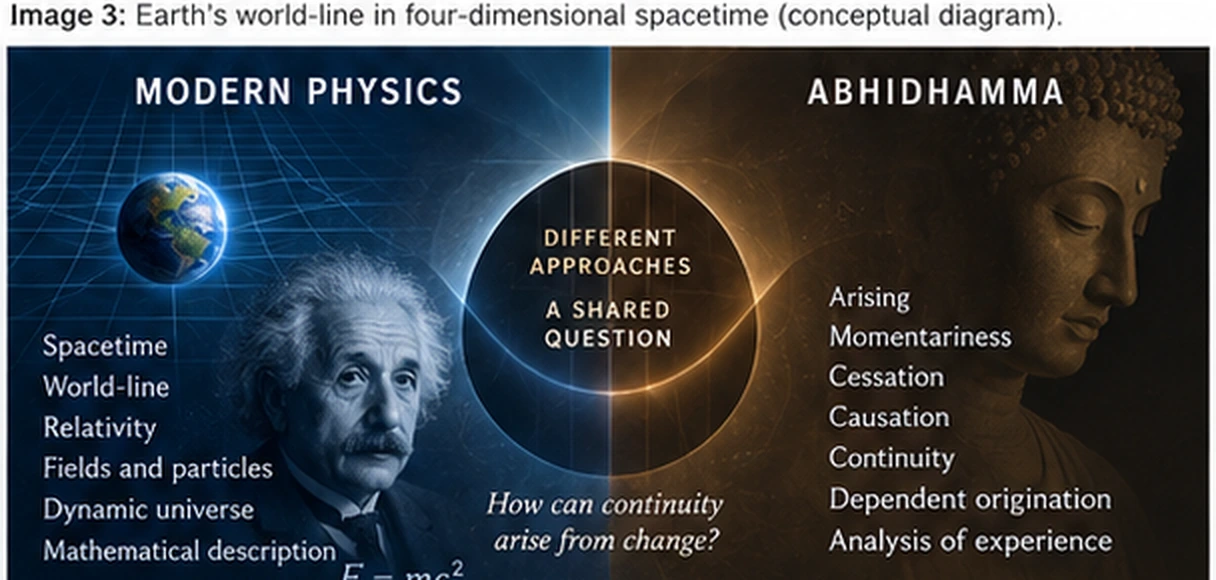
Buddhist Abhidharma/Abhidhamma traditions developed highly detailed analyses of phenomena as conditioned processes.
Scholarly treatments of Abhidharma describe a radical doctrine of momentariness, in which phenomena can be analyzed as momentary events that arise and cease in causal succession.
This is not Einstein’s relativity. It is not quantum physics. But it creates a striking conceptual parallel.
9. From “Thing” to “Process”
Ordinarily, we say “The Earth is moving.” We treat Earth as one stable thing.
But Earth is also an enormous collection of changing processes: atoms move, molecules interact, the atmosphere changes, oceans circulate, continents move, living organisms grow and die, energy enters and leaves, radiation interacts with matter, and Earth’s position relative to other bodies changes.
Yet our language gives all of this one name: Earth.
Abhidhamma analysis similarly challenges the tendency to treat apparently stable entities as permanent, independent substances. The philosophical emphasis is on conditioned phenomena arising and ceasing.
10. Momentariness and the Moving Earth
A useful conceptual sequence is:
Earth-at-A → Earth-at-B → Earth-at-C → Earth-at-D
Physics does not say that Earth is destroyed and recreated at each arrow. The diagram is a conceptual device.
It asks us to distinguish between the identity we give something and the continuously changing physical state of that thing.
The Abhidhamma tradition takes a much more radical approach to this question by analyzing experience into conditioned events that arise and cease.
11. Continuity: The Central Puzzle
Consider a movie. We perceive continuous movement, but a movie can be represented as a rapid succession of frames. The analogy is not a literal model of physical reality.
It gives us a way to think:
Frame 1 → Frame 2 → Frame 3 → Frame 4
The thought experiment invites:
Earth-at-A → Earth-at-B → Earth-at-C → Earth-at-D
Abhidhamma provides another conceptual sequence:
arising → continuation/change → cessation → conditioned succession
The three are not the same theory. But all three force us to ask: What produces the appearance of continuity?
12. An Important Difference Between Physics and Abhidhamma
It would be a mistake to say “Abhidhamma predicted Einstein.” There is no basis for that claim.
Physics and Abhidhamma developed different methods and answer different kinds of questions.
Physics uses observation, experiment, mathematics and quantitative prediction.
Abhidhamma is a Buddhist philosophical and phenomenological analysis concerned with phenomena, causation, experience, impermanence and liberation.
The similarity is therefore conceptual, not evidential. A philosophical parallel does not constitute scientific proof.
13. The Deeper Question: What Is Actually Moving?
Don Dhairya Guptha Sumithraarachchi’s thought experiment ultimately produces a more difficult question:
If Earth occupies a different location at every moment, what exactly is “moving”?
Possibilities include:
1. the physical matter of Earth;
2. Earth’s position relative to other physical systems;
3. Earth’s world-line in spacetime;
4. the changing physical state of the planet;
5. or several of these descriptions simultaneously.
Relativity gives us a mathematical framework for describing motion through spacetime. The Abhidhamma gives us a radically different philosophical framework for analyzing continuity and conditioned phenomena.
Neither needs the universe to contain an invisible cosmic fluid.
14. Could the Universe Be Like a Sequence?
Imagine reality as an immense sequence:
State₁ → State₂ → State₃ → State₄ → …
Each state contains physical relationships. Earth is located differently relative to other systems from one state to another.
In this picture, “motion” might be regarded as the pattern of difference between successive states.
This is not standard terminology for describing everyday planetary motion, and it should not be presented as an established replacement for relativity. It is a philosophical visualization.
Yet it raises a legitimate question: Is motion something additional to change, or is motion our description of patterned change?
15. The Buddhist Connection Becomes Even Deeper
Abhidhamma discussions of momentariness faced their own profound problem: if phenomena arise and cease moment by moment, how can continuity and causation occur?
If every “now” is different, how does one now relate to the next?
The Abhidhamma tradition developed elaborate accounts of conditionality and causal continuity.
Thus the comparison should not be “Abhidhamma says the Earth teleports.” It should instead be:
Both the thought experiment and Abhidhamma encourage us to question the assumption that continuity necessarily requires an unchanging underlying entity.
16. From Earth to Consciousness
The comparison becomes especially intriguing when applied to consciousness.
Abhidhamma analyses consciousness as a succession of events rather than as a permanently existing mental substance.
This provides another conceptual sequence:
Citta₁ → Citta₂ → Citta₃ → Citta₄
The person ordinarily says “I am continuously conscious,” but the Abhidhamma analysis investigates consciousness as a causally connected succession.
Likewise, the Earth can be conventionally described as one continuously moving object while its physical state is constantly changing.
This suggests a broader philosophical theme:
Continuity does not necessarily mean permanence.
17. What the Thought Experiment Does NOT Claim
To keep the idea scientifically honest, it does not claim:
– that Earth literally teleports;
– that matter disappears and is recreated every instant;
– that space is a substance;
– that antimatter creates resistance to Earth’s movement;
– that Abhidhamma proves relativity;
– that Einstein derived relativity from Buddhism;
– that quantum mechanics proves Buddhist philosophy.
Instead, the proposal is a conceptual experiment about how we visualize motion and continuity.
18. The Bigger Picture
Everyday intuition: A thing travels through space.
Relativity: A physical system has a history through spacetime, and motion is described relative to reference frames.
Don Dhairya Guptha Sumithraarachchi’s thought experiment: Instead of imagining an object pushing through an invisible cosmic substance, imagine its physical history as a succession of changing spacetime locations and states.
Abhidhamma: Conditioned phenomena arise, change and cease, and what appears as an enduring whole can be analyzed as a causally connected succession of phenomena.
These are not interchangeable theories. But their comparison reveals an extraordinary philosophical question.
19. The Question Behind the Question
Perhaps the most interesting question is not “How fast is Earth moving?”
It is:
“What does it mean for something to remain the same while everything about its state is changing?”
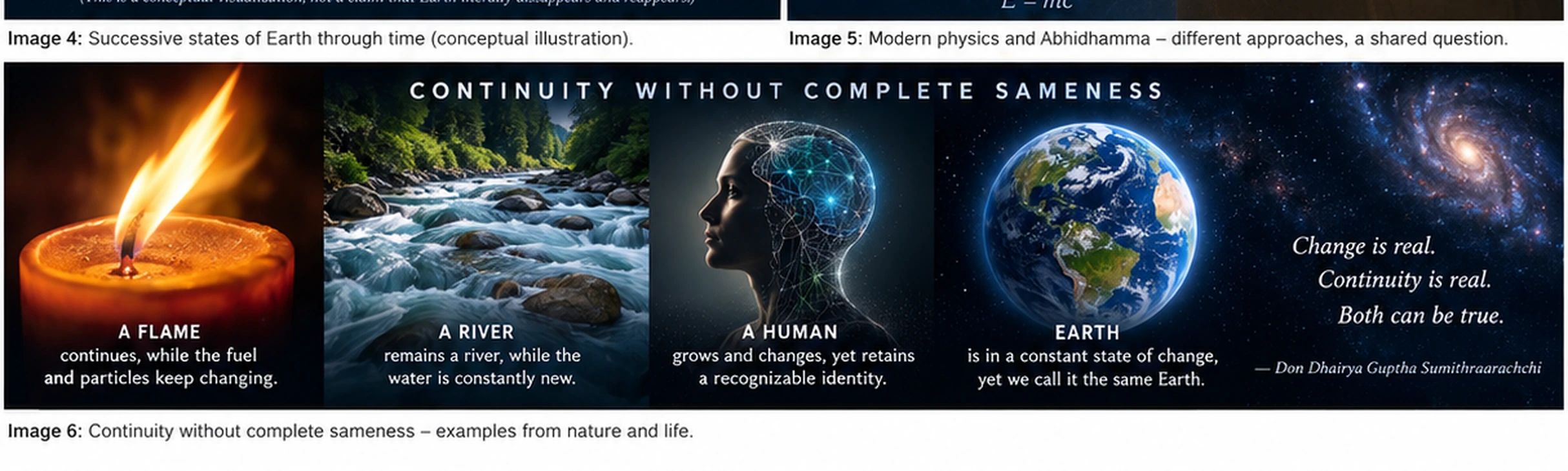
Earth today is not physically identical to Earth millions of years ago. Yet we call both Earth.
A river changes continuously, yet we call it the same river. A flame changes continuously, yet we call it the same flame.
This suggests a powerful philosophical distinction:
Identity is not complete physical sameness.
Continuity may instead be connected with causal relationship, structure, pattern and convention.
20. Conclusion
Earth does not need to behave like a thrown ball travelling through air.
There is no established cosmic atmosphere producing ordinary aerodynamic resistance against Earth’s motion.
Instead, modern physics describes motion using relationships between physical systems and, in relativity, their histories in spacetime.
Don Dhairya Guptha Sumithraarachchi’s thought experiment asks us to look at the same phenomenon from another angle:
At one moment Earth occupies one spacetime location. At another moment it occupies another. Rather than imagining Earth pushing through a cosmic substance, we can visualize motion as a continuous succession of physical states and spacetime events.
This is not teleportation. It is not a replacement for relativity. It is a way of questioning our everyday mental picture of motion.
The comparison with Abhidhamma makes the philosophical question even richer.
Abhidharma traditions developed sophisticated doctrines of momentariness, in which conditioned phenomena are analyzed as arising and ceasing in rapid succession. The resulting challenge is one of the deepest problems in Buddhist philosophy:
If everything changes, what explains continuity?
Physics asks a related but different question:
How should changing physical systems be described in spacetime?
The answers are not the same.
But placing the questions beside one another produces a remarkable intellectual landscape.
Perhaps the universe does not need to be imagined as a collection of permanent things travelling through a permanent container.
Perhaps what we call a “thing” is a continuing pattern.
Perhaps what we call “motion” is a patterned change of relationships.
And perhaps the distinction between being somewhere and becoming somewhere else is more subtle than ordinary language makes it appear.
The journey of Earth through the cosmos therefore gives us an unexpected philosophical lesson:
The universe may be less like a collection of objects travelling through an empty stage—and more like an immense, continuously changing history of events.
— Don Dhairya Guptha Sumithraarachchi
Further Reading: Science
- NASA — General Relativity and the Nature of Spacetime
- Einstein Online — World-Line
- NASA — Universe Glossary
- CERN — Antimatter
Further Reading: Abhidhamma and Buddhist Philosophy
Explore HICONY
This article is a philosophical thought experiment. It does not claim that Earth literally teleports, that space is a material fluid, or that Abhidhamma and modern physics are scientifically equivalent.