
By Don Dhairya Guptha Sumithraarachchi
What if the “self” is not a permanent thing at all — but a pattern continuously reconstructed from changing experience?
This HICONY thought experiment brings together three very different questions: what quantum physics means by an observer, what Buddhist philosophy means by anattā (not-self), and whether the continuity of a person requires a permanent inner entity. The comparison is deliberately careful: quantum physics does not prove Buddhism, and Buddhism is not a hidden quantum theory. The value is in the question they allow us to place side by side.
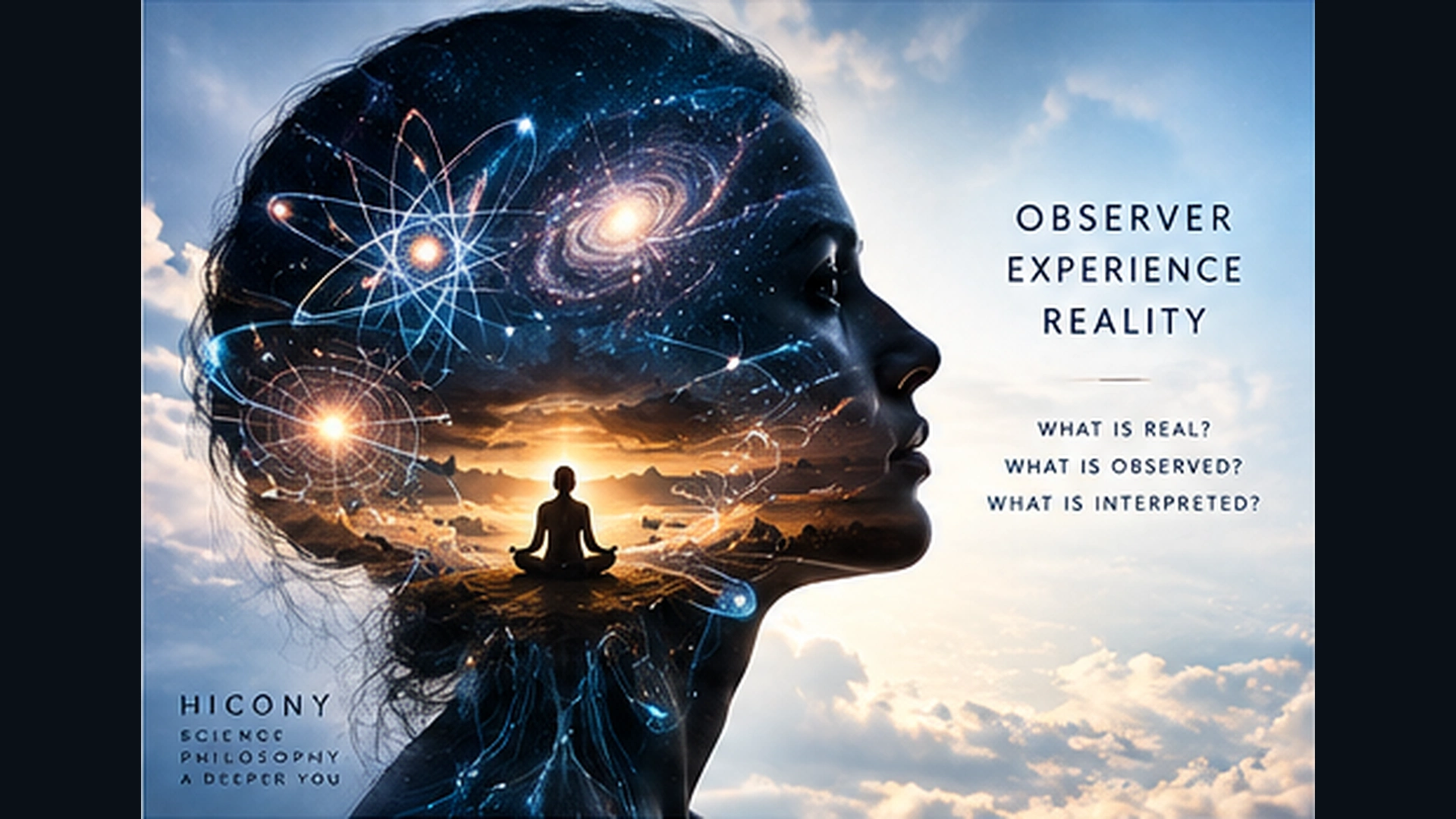
The popular quantum claim: “the observer creates reality”
Quantum mechanics really does contain a measurement problem. A quantum state can be represented mathematically as a superposition, while an actual experiment produces a definite recorded result. The difficult question is how the mathematical description, the measurement interaction and the definite outcome fit together. Philosophers of physics still discuss multiple interpretations of this problem.
But there is a crucial distinction between measurement and human consciousness. In modern quantum theory, an observer can be a physical measurement arrangement: a detector interacts with a system, information is registered, and the result can be recorded. The experiment does not establish that a human mind must stare at a particle before the particle becomes real.
Historical proposals associated with von Neumann and Wigner did explore a special role for consciousness. Those proposals are part of the interpretive history of quantum mechanics, not an experimentally established conclusion. Even within the Copenhagen family of interpretations, the historical positions of Bohr and Heisenberg were not identical.
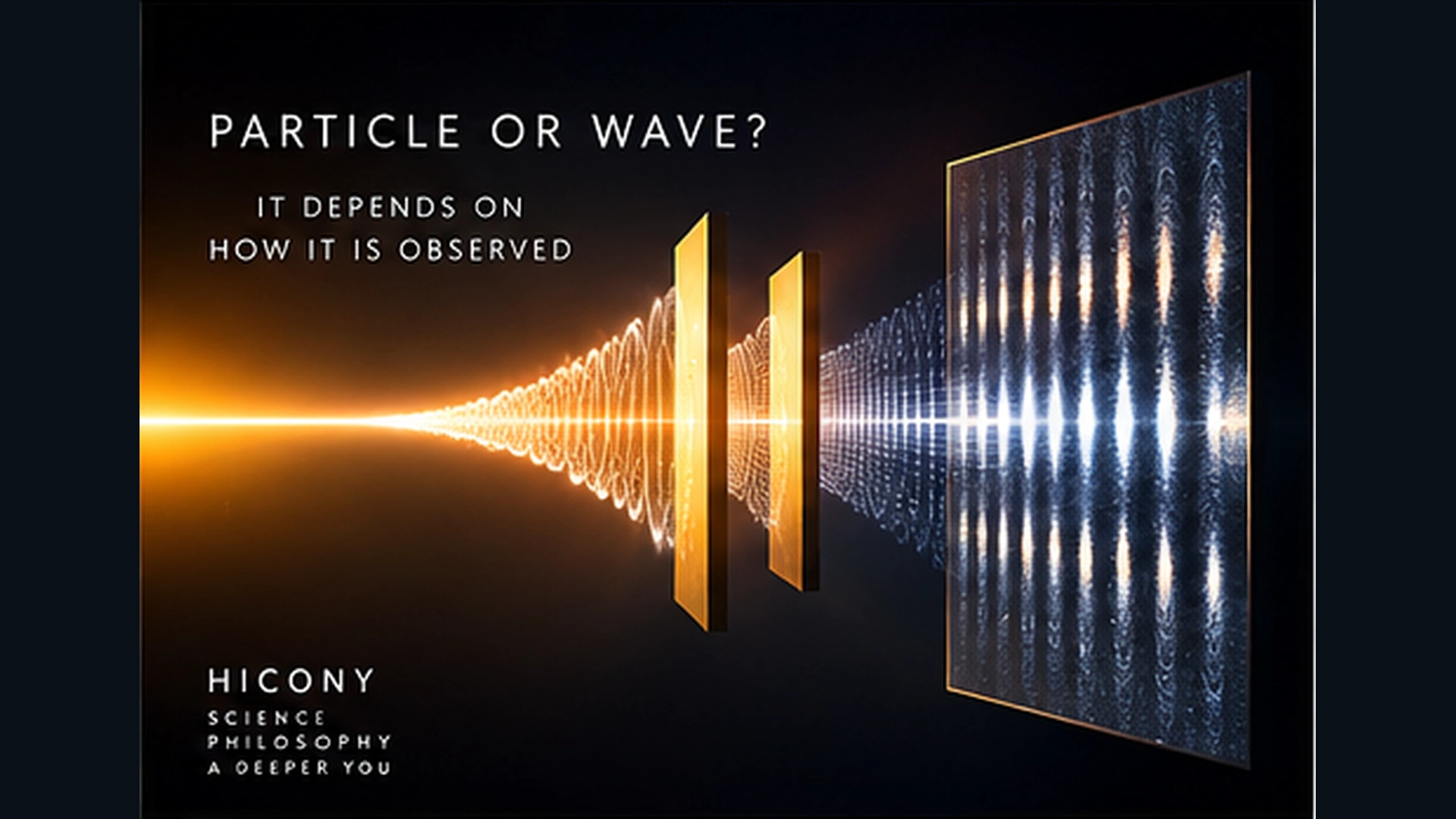
Then Buddhism asks: who is the observer?
Buddhist philosophy approaches the problem from almost the opposite direction. Instead of beginning with an external physical system and asking how it is measured, Buddhist analysis begins with experience itself and asks what we mean when we say “I”.
The doctrine of anattā is often translated as “no-self” or “not-self.” The more careful “not-self” wording is useful because the teaching is not simply the denial of conventional persons. It is a critique of the assumption that body, feeling, perception, formations or consciousness can be identified as a permanent, unitary and independent self.
The Buddhist analysis of the person through the five aggregates is especially important: rūpa (material form), vedanā (feeling), saññā (perception/recognition), saṅkhāra (formations and dispositions), and viññāṇa (consciousness). These are not five pieces sitting inside a person. They are an analytical way of describing the changing psycho-physical process that we conventionally call a person.
“I am angry” — or is anger occurring?
Take a simple statement: “I am angry.” Look carefully at what is actually present. There may be bodily sensations, unpleasant feeling, memories, perceptions, thoughts, impulses, attention and consciousness. These processes influence one another.
Then the mind performs a remarkable act of compression. It gathers this changing stream and gives it a single grammatical owner: “I.”
Perhaps the important question is not “Does the person exist?” but “What kind of thing is the person?”
A person can be real in an ordinary, practical and causal sense without being an unchanging metaphysical substance. Buddhist analysis becomes especially interesting here because it treats continuity as something that can be explained through causal relationships among changing phenomena rather than through an eternal inner owner.
My central thought: the self may be a pattern
This is the central philosophical proposal of this HICONY article, and it is my own thought experiment: the self may be more like a pattern than a thing.
A wave is a pattern in water. A flame is a pattern sustained by changing fuel and physical processes. A melody is a pattern across changing sounds. A whirlpool is recognizable even though the particular water molecules within it are continually changing.
In each case, continuity does not require complete material sameness. What persists is a structured relationship among changing events.
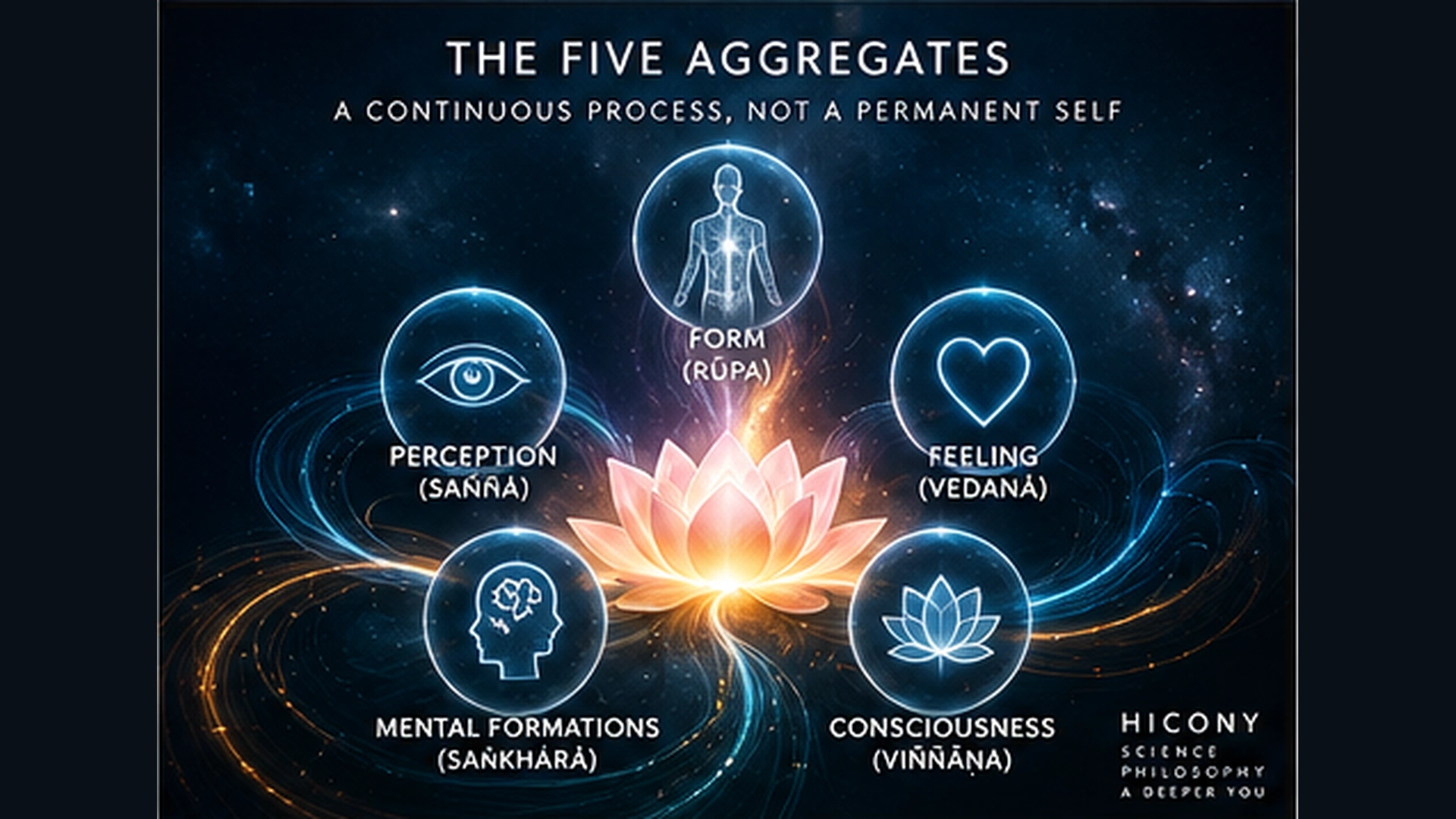
Could personal identity work in a comparable way? The body changes. Memories change. Emotions change. Beliefs change. Attention changes. The contents of consciousness change. Yet a powerful organizing pattern remains: “This is happening to me.”
This does not mean that the person is imaginary
The word “pattern” can be misunderstood. I am not proposing that people are fictional or that physical reality is merely an illusion. The stronger claim would require a completely different philosophical argument.
The proposal is narrower: perhaps personal identity is real as an organized process rather than real as a permanent substance. A pattern can have causal power and continuity without being a separate object hidden somewhere behind its changing components.
Where Abhidhamma becomes especially interesting
Abhidhamma traditions developed detailed analytical accounts of phenomena, causation, consciousness and materiality. In later Theravāda commentarial analysis, the term suddhaṭṭhaka (“pure octad”) is used for a basic cluster of inseparable material qualities. This should not be casually equated with a modern atom or photon.
That distinction matters. A Buddhist analytical unit and a particle in quantum field theory belong to different conceptual systems. Modern physics does not contain a “Buddhist octad,” and Abhidhamma does not provide an experimental quantum-field model.
Yet the methodological instinct is intriguing: take what appears to be a stable, unified thing and analyze the conditions and constituents through which that appearance is produced.
The observer may itself be part of the observed process
Now the thought experiment turns inward. Ordinary experience seems to contain a simple structure: observer → observes → world.
But Buddhist analysis invites a strange reversal: what if the observer is itself another phenomenon within the stream being observed?
There is visual information. There is sound. There is bodily sensation. There is memory. There is attention. There is interpretation. There is emotional reaction. There is conceptual labeling. There is consciousness. And somewhere within this process appears the thought: “I am the observer.”
The question is then not whether observation occurs. It clearly does. The question is whether we need to posit a separate, permanent observer behind the observing process.
Now return to quantum physics
Here the comparison becomes intellectually tempting — but also dangerous. Quantum mechanics teaches us that measurement is not always well described by the classical picture of a detached observer simply revealing pre-existing values. In some interpretations, experimental context is central to what can be meaningfully attributed to a quantum system. Other interpretations treat measurements differently.
That is enough to challenge a simplistic picture of observation. It is not enough to conclude that consciousness creates the universe.

The important boundary: analogy is not evidence
There is a great temptation to say: “Quantum physics has discovered what the Buddha already knew.” That sentence sounds profound, but it collapses two very different methods of inquiry.
Physics uses experiments, mathematical models and quantitative predictions. Buddhist philosophical analysis investigates experience, causation, impermanence, grasping and the construction of identity. Their questions can overlap at a philosophical level without their methods becoming interchangeable.
Therefore, this article makes a deliberately modest claim: quantum measurement and Buddhist not-self can be placed into a productive philosophical conversation. That is different from saying one scientifically proves the other.
Continuity without an unchanging thing
This may be the deepest common question running through the entire thought experiment.
How can something remain identifiable while changing?
A river remains a river while its water is replaced. A flame remains recognizable while its molecules and energy flows change. A living organism develops while its cells, memories and internal states change. Earth changes continuously while we continue to call it Earth.
Continuity therefore does not necessarily mean absolute sameness. It can mean an organized causal history.
From Earth’s world-line to the human “I”
This also connects with my earlier HICONY thought experiment about Earth moving through spacetime. Instead of picturing Earth as a permanent ball pushing through an invisible cosmic substance, relativity allows us to describe its history through spacetime and its relationships with other physical systems.
The philosophical analogy is then striking: Earth can have continuity without every physical detail remaining identical. Why should personal identity necessarily be different?
At one time there is one configuration of the body, brain, memories and environment. Later there is another. Between them is causal continuity. The word “I” may name that continuing pattern rather than an additional object travelling behind the scenes.
Does the self exist, then?
The most careful answer may depend on what we mean by “exist.”
The everyday person exists conventionally. People have bodies, memories, relationships, intentions and consequences. A person can make a promise, suffer, learn and change.
What anattā challenges is the stronger idea that somewhere within this changing process there is a permanent, independent and unitary self that can be identified as the ultimate owner of the aggregates.
Maybe “I” is not a thing moving through time. Maybe “I” is the pattern produced by the continuous interpretation of changing events.
A final caution about “interpretation”
Even the phrase “pattern of interpretation” needs care. It should not be taken to mean that external reality is nothing but whatever the mind imagines. There are physical processes, other people, bodies, environments and events that constrain experience.
The proposal is about the construction of selfhood: the way a changing stream becomes organized into a first-person narrative with memory, ownership, agency and continuity.
The question I want to leave with the reader
When you look at a tree, you normally distinguish the observer from the tree. When you look inward, you normally distinguish the observer from your thoughts. But can the observer itself be examined as part of the same changing process?
If every sensation changes, every thought changes, every memory changes and every bodily state changes, what exactly is the permanent “I” that owns them?
Perhaps the answer is not that nothing exists. Perhaps the more subtle answer is that what exists is a changing network of conditions and processes, while the permanent self is an interpretation we habitually place upon that network.
Conclusion
Quantum physics gives us a strange world in which measurement, interaction and physical description do not fit neatly into the classical picture. Buddhism gives us a different kind of strangeness: the person we instinctively experience as a permanent “I” cannot be found as an independent, unchanging entity among the changing aggregates.
These are not the same theory. They should not be made into one. But together they create a powerful philosophical question: what is an observer, what is an experience, and where exactly is the self?
My own proposal is simple: perhaps the self is neither a permanent thing nor sheer nothingness. Perhaps it is a real, causally connected pattern — continuously changing, continuously interpreted, and continuously mistaken for something more permanent than it is.
Author’s Note
The central conceptual proposal of this article — particularly the framing of the self as a continuously reconstructed “pattern of interpretation” and the comparison between observation, continuity and changing processes — is the author’s own philosophical thought experiment.
Author: Don Dhairya Guptha Sumithraarachchi
This article does not claim a new physical theory, does not claim that quantum mechanics proves Buddhism, and does not claim that the Buddha discovered quantum physics.
Further reading and sources
- Stanford Encyclopedia of Philosophy — Copenhagen Interpretation of Quantum Mechanics
- Stanford Encyclopedia of Philosophy — Philosophical Issues in Quantum Theory
- Stanford Encyclopedia of Philosophy — Mind in Indian Buddhist Philosophy
- Stanford Encyclopedia of Philosophy — Notes on Not-Self
- CERN — The Standard Model