

Freelancing with AI is becoming less about asking a chatbot to do everything and more about combining AI speed with human judgment, communication and real expertise. In 2026, that distinction matters. Clients can increasingly generate first drafts, summaries and ideas themselves, so a freelancer who simply produces raw AI output has a weak advantage. A freelancer who can understand a business problem, use AI intelligently, check the result and deliver something genuinely useful has a much stronger proposition.
This guide explains how to start freelancing with AI in 2026 without trying to become an expert in every AI tool. You will learn how to choose a service, select a niche, build a portfolio before you have clients, price your work, find prospects, write better proposals, use AI safely, create a repeatable delivery workflow and build toward a sustainable freelance business.
If you are completely new to digital work, you may also want to read Hicony’s guide to learning in-demand digital skills in 2026. If you already use several AI tools but your work feels scattered, the personal AI productivity system guide can help you build a more organized workflow.
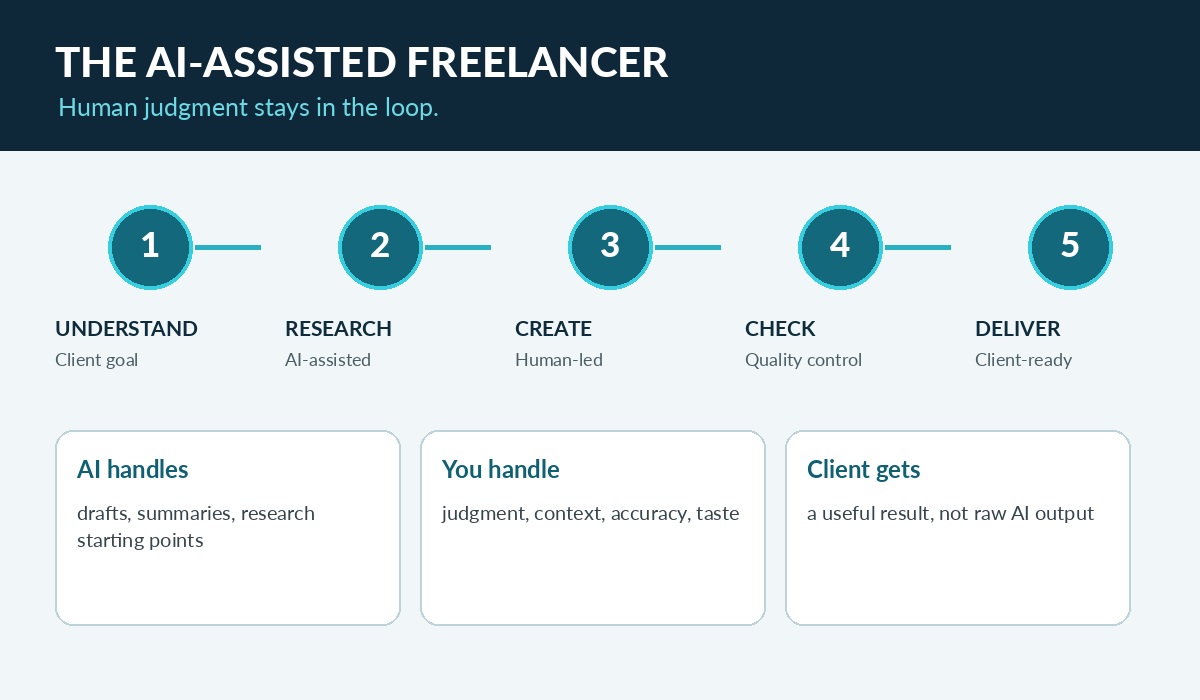
” alt=”AI-assisted freelancing workflow showing research, creation, quality control and client delivery” loading=”lazy” />
Is Freelancing With AI Worth Starting in 2026?
There is a reasonable opportunity, but there is also a lot of hype. You should not start freelancing with AI because someone promises effortless passive income. Start because AI can reduce the time required for parts of a real service while leaving important work—understanding the client, making decisions, checking facts, communicating clearly and taking responsibility—with you.
Recent labour-market research supports the broader shift toward technology skills. The World Economic Forum’s Future of Jobs Report 2025 identifies AI and big data, networks and cybersecurity, and technological literacy among the fastest-growing skill areas, while creative thinking, resilience and lifelong learning are also rising. Upwork’s 2026 In-Demand Skills research similarly describes AI becoming embedded in everyday work rather than existing as a separate niche.
The practical conclusion is simple: learn to use AI inside a valuable service. Do not make “I know how to use ChatGPT” your entire offer.
What Can You Actually Sell as an AI-Assisted Freelancer?
A service becomes easier to sell when the client can understand the result. “I provide AI services” is vague. “I turn long videos into ten short social posts and five caption-ready clips” is much clearer.
1. AI-Assisted Content Research and Writing
You can help businesses research topics, build content briefs, draft articles, refresh old pages, prepare social captions or turn existing material into new formats. The valuable part is not pressing a generate button. It is choosing the right angle, checking information, matching the client’s voice, improving structure and producing publishable work.
2. Content Repurposing
Many businesses already have useful material but do not have time to reuse it. A podcast can become a blog outline, newsletter, LinkedIn post, short-video script and FAQ. A webinar can become several educational pieces. AI can accelerate the transformation while you preserve the message and quality.
3. AI-Assisted Virtual Assistance
Virtual assistants can use AI for meeting-note cleanup, research, email drafting, document organization, spreadsheet summaries and recurring administrative work. The client is not paying for AI access. They are paying for dependable execution and fewer tasks on their plate.
4. Simple AI Workflow and Automation Setup
If you understand basic no-code tools, spreadsheets and APIs, you can help small businesses automate repetitive steps. Examples include turning form submissions into organized records, preparing draft replies, summarizing incoming information or creating internal content workflows.
5. AI-Assisted Research and Competitive Analysis
Research-heavy businesses may need competitor comparisons, market scans, customer-question summaries or structured research notes. AI can accelerate discovery and classification, but the freelancer must verify important claims and clearly distinguish evidence from assumptions.
6. AI-Assisted Design and Creative Production
AI can speed up concept generation, variations, background removal, visual ideation and production assistance. A designer who understands composition, branding and client requirements can use these tools as production accelerators rather than replacements for creative judgment.
7. AI-Assisted Data Cleanup and Reporting
Businesses often have messy information but need a clear answer. With appropriate spreadsheet and data skills, a freelancer can help clean data, categorize records, identify patterns and turn raw information into understandable reports. Accuracy and confidentiality are essential.
The Best Freelancing With AI Strategy: Combine AI With a Real Skill
The strongest beginner position is usually a T-shaped service profile: one useful core skill plus enough AI literacy to perform that skill faster and better.
- Writing + AI: research, editing, content systems and repurposing.
- Design + AI: concepts, variations, brand assets and production support.
- Administration + AI: research, organization, documentation and workflow support.
- Marketing + AI: content planning, audience research and campaign support.
- Data + AI: cleaning, analysis, reporting and decision support.
- Web skills + AI: content updates, simple websites, automation and troubleshooting.
This approach also connects naturally with Hicony’s article on digital skills in 2026: you do not need to master everything. Choose a useful combination and become reliable at it.
Step 1: Choose One Freelancing With AI Service Before You Choose Ten
When you start freelancing with AI, one of the most common beginner mistakes is building a profile that says you can write, design, edit videos, build websites, manage social media, perform SEO, automate businesses and do virtual assistance. It sounds flexible, but to a potential client it can sound unfocused.
Instead, use this formula:
I help [specific type of client] achieve [specific result] through [specific service].
For example:
- I help local service businesses turn their existing knowledge into useful website content.
- I help coaches repurpose long-form videos into short-form content.
- I help small online stores organize product information and customer-support content.
- I help busy consultants turn research and notes into polished client documents.
Your first offer does not have to be your forever business. It only needs to be specific enough that someone can understand what they are buying.
Step 2: Pick a Niche You Can Understand
A niche does not necessarily mean refusing work from everyone else. It gives your marketing a starting point. If you understand the language, problems and buying behaviour of a particular group, your proposals become more convincing.
Good beginner niches can be based on industries you already understand, communities you can access, or problems you have personally solved. You might choose accountants, lawyers, real-estate businesses, educators, coaches, local shops, ecommerce sellers, consultants or professional service firms.
Ask three questions:
- Does this group have a problem I can solve?
- Can I demonstrate the result with a sample?
- Can I find enough potential clients to make outreach worthwhile?
Step 3: Build a Portfolio Before You Have a Client
You do not need to wait for someone to hire you before you demonstrate ability. Create three realistic sample projects.
For a content service, you could create a before-and-after article edit, a researched content brief and a repurposing example. For an automation service, show a simple workflow diagram and explain the problem it solves. For data work, create a small anonymized dataset and show how you turned it into a useful report.
The key is to label samples honestly. Do not pretend a practice project was completed for a real client. Your portfolio should demonstrate what you can do, not manufacture a false history.
” alt=”30-day freelancing with AI plan showing service selection, portfolio, outreach and improvement” loading=”lazy” />
Step 4: Build a Simple AI-Assisted Delivery Workflow
A repeatable workflow makes freelancing easier to manage. One useful pattern is:
- Brief: understand the client’s objective, audience, constraints and definition of success.
- Research: gather source material and use AI to organize or summarize it where appropriate.
- Draft: create the first version using your normal skill plus AI assistance.
- Review: check facts, logic, tone, formatting, originality and client requirements.
- Refine: improve the work based on your judgment and the brief.
- Deliver: provide the final result in the requested format with a concise explanation.
- Learn: record recurring problems so the next project becomes easier.
The review stage is where many low-quality AI freelancers fail. AI output can sound confident while being incomplete, inaccurate or unsuitable for the client’s situation. Never treat fluent wording as proof of correctness.
For practical guidance on building repeatable AI workflows, you can also explore OpenAI Academy, which includes material on AI foundations, prompting and repeatable workflows.
Step 5: Learn Prompting as a Business Skill, Not a Party Trick
Good prompting is really good briefing. Give the system the task, context, constraints and desired output. Then evaluate what it produces.
Instead of asking:
“Write an article about accounting.”
Give it a usable brief:
“Create a 1,500-word educational article for small-business owners explaining three common bookkeeping mistakes. Use plain English, avoid legal or tax claims that require professional advice, include practical examples, and separate general information from recommendations.”
That is closer to how a professional uses AI. You are not trying to discover a magic sentence. You are designing a controlled process.
Step 6: Price the Result, Not the Number of AI Prompts
A client does not care how many prompts you typed. They care about the outcome and the reliability of the service.
As a beginner, you can experiment with fixed packages because they make the buying decision easier. For example:
- One optimized article with research and editing.
- A monthly content-repurposing package.
- A small research and reporting package.
- A simple workflow audit and implementation package.
As your portfolio improves, track how long each package actually takes. Your effective hourly rate should rise as your workflow becomes faster and your results become more valuable.
Step 7: Find Clients Without Spamming Everyone
Freelancing with AI still requires ordinary business development. AI does not remove the need to find people who have a problem and trust you to solve it.
A simple prospecting routine can be:
- Choose one client type.
- Build a list of relevant businesses or decision-makers.
- Look for a genuine problem or missed opportunity.
- Send a short, personalized message.
- Offer one useful observation rather than a generic sales pitch.
- Follow up politely.
- Track responses and improve your message.
If you use a marketplace, study the demand instead of blindly applying to everything. Upwork’s 2026 guide to high-demand careers and skills is one useful source for understanding how technical and human skills are being combined in freelance work.
How to Write a Better Freelancing With AI Proposal
A strong proposal is usually short. Start with the client’s problem, show that you understood it, explain your approach and point to relevant proof.
A simple structure is:
- Observation: mention something specific about the project.
- Approach: explain how you would handle it.
- Proof: provide one relevant sample or result.
- Next step: ask one sensible question or propose a small starting point.
Do not hide behind AI-generated generic proposals. If a client receives twenty nearly identical messages, yours will disappear with the others.
Use AI for Speed, But Keep Humans in the Loop in Freelancing With AI
The safest and most valuable freelance workflow is not “AI does everything.” It is “AI accelerates the parts where it is useful, while a human remains accountable for the result.”
Be particularly careful with confidential client information, personal data, credentials, unpublished business plans and legally sensitive material. Before putting client information into an AI system, understand the tool’s privacy settings, business terms and the client’s expectations.
Also verify factual claims. For important work, go back to primary sources rather than trusting a generated citation or summary. This is especially important for legal, medical, financial, scientific and regulatory content.
Seven Things You Should Not Sell as “AI Magic”
- Guaranteed income.
- Guaranteed rankings or viral results.
- Fully automated expert advice.
- Unverified research presented as fact.
- Mass-produced content with no quality control.
- Client work that secretly uses confidential material in inappropriate ways.
- A service whose only differentiator is access to a publicly available AI tool.
Your competitive advantage should become stronger as AI becomes easier to access. That happens when you build expertise, taste, reliability, domain knowledge and a track record.
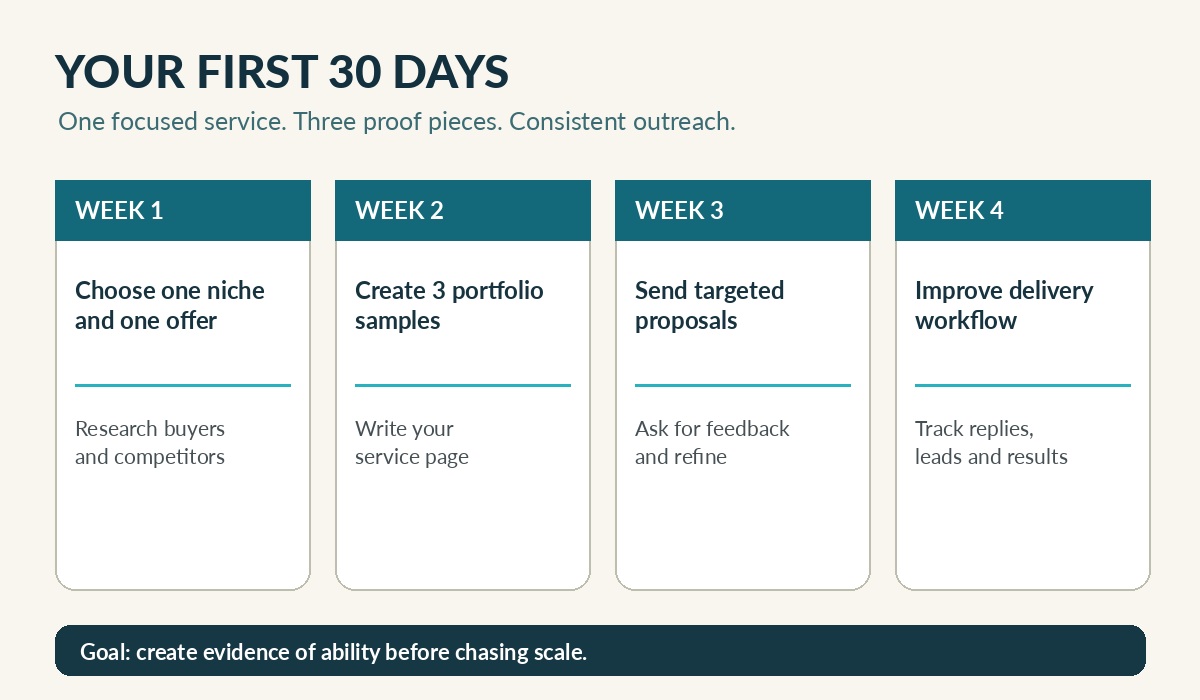
A Practical 30-Day Plan for Starting Freelancing With AI
You can start without building a complicated website or buying a large stack of subscriptions.
Days 1–7: Choose and Learn
Select one service and one client type. Study real examples of the work. Learn the basic tools required. Create a checklist for quality control.
Days 8–14: Build Proof
Create three portfolio samples. Make each sample demonstrate a different part of the service: research, execution and final presentation. Ask someone you trust to criticize the samples.
Days 15–21: Create Your Offer
Write a clear service description, define what is included and excluded, decide how clients will send information, and establish a basic delivery timeline. Prepare one short proposal template that you will personalize for every prospect.
Days 22–30: Start Outreach
Contact a small number of carefully selected prospects each day. Track the number of messages, replies, conversations, proposals and wins. The purpose of the first month is not to become rich. It is to learn which problem, offer and message generate real interest.
Common Beginner Mistakes in Freelancing With AI
Trying every tool
Tool collecting feels productive but often produces no portfolio. Learn the smallest toolset that can deliver your chosen service.
Choosing a service because it looks easy
If thousands of people can produce the same raw output with one click, the price of that output will tend to be pressured. Add judgment, specialization, editing, implementation or accountability.
Ignoring communication
Clients remember freelancers who communicate clearly, ask sensible questions, meet deadlines and respond when something goes wrong. These are not secondary skills.
Publishing a huge portfolio of mediocre work
Three excellent samples can be more persuasive than twenty weak ones. Build evidence that matches the service you want to sell.
Expecting AI to find clients
AI can help research prospects, personalize drafts and organize outreach. It cannot create trust with a person who has no reason to believe you can solve their problem.
How Freelancing With AI Can Become a Long-Term Business
Once you have repeat clients, look for patterns. This is where freelancing with AI can evolve from one-off tasks into a more repeatable service business. Perhaps several clients need the same content workflow. Perhaps the same reporting task appears repeatedly. Perhaps you keep solving the same operational problem.
Those patterns can become packages, templates, retainers, digital products or eventually a small agency. The progression is often more valuable than trying to invent a passive-income business on day one.
For a broader view of combining AI skills with online income, see Hicony’s guide to creating flexible remote income using AI. And if your personal workflow is becoming complicated, revisit the personal AI productivity system approach.
Frequently Asked Questions About Freelancing With AI
Can a complete beginner start freelancing with AI?
Yes, but beginners should start with a narrow service rather than advertising themselves as an AI expert. Learn one useful skill, build samples and improve through real projects.
Do I need expensive AI tools?
No. Start with the smallest practical toolset. Upgrade only when a paid feature saves enough time or improves results enough to justify its cost.
Will AI replace freelancers?
Some tasks will become easier to automate, and some low-complexity work may become less valuable. At the same time, AI creates demand for people who can integrate tools into real workflows, exercise judgment and take responsibility for outcomes. The exact balance will vary by field.
What is the best AI skill for freelancing?
There is no universal best AI skill. A better question is which combination of AI capability and real-world skill solves a problem that someone is willing to pay to solve.
How long does it take to get a first client?
There is no reliable timetable. It depends on your skill, offer, portfolio, market, pricing, communication and outreach. Treat the first month as a testing period rather than a guaranteed income deadline.
Final Thoughts: Build a Service, Not an AI Identity
The biggest opportunity in freelancing with AI is not becoming the person who knows the most AI tools. It is becoming the person who can use the right tools to solve a specific problem well.
Choose one service. Choose one audience. Build three strong samples. Learn a repeatable workflow. Use AI where it genuinely helps. Check everything important. Communicate clearly. Then talk to real potential clients and let their responses teach you what to improve.
The technology will continue to change. A useful service, however, can evolve with it.
Start small, build proof, deliver real value, and let your skills—not the hype—be your advantage.
Research note: This article uses current public research from the World Economic Forum and Upwork to provide context on changing skills and freelance work. Market conditions vary by country, profession and platform, so examples and research trends should not be treated as guarantees of income or employment.