

How to Get Your Website Noticed by AI Search in 2026
Search is changing.
A person who wants an answer no longer has to open a list of ten blue links, compare several pages and assemble the answer themselves. Increasingly, search experiences can summarize information, compare sources and point users toward pages that support the answer.
That creates a new challenge for website owners.
How do you make a page useful enough that an AI-powered search experience has a reason to use it?
The answer is not to stuff a page with keywords, publish hundreds of AI-written articles or chase a secret “AI SEO” trick. Google’s own guidance says the fundamentals remain people-first content, technical accessibility and unique, valuable information. Its guidance for generative AI search specifically emphasizes creating non-commodity content with a distinctive point of view and real value. Google Search Central guidance on generative AI features.
This guide explains a practical way to do that in 2026.
What “AI search visibility” actually means
AI search visibility is the ability of your website’s content to be discovered, understood and potentially used as a supporting source in AI-powered search experiences.
It is broader than traditional rankings.
A page can be useful even when a visitor does not arrive through a classic blue-link click. Your content might help an answer engine understand a topic, provide a definition, support a claim, compare options or answer a follow-up question.
That does not mean there is a guaranteed formula for getting cited. Google explicitly says that meeting its requirements and best practices does not guarantee crawling, indexing or inclusion in AI features. Google Search Central: AI Features and Your Website.
So the useful question is not:
“How can I trick AI into citing my website?”
A better question is:
“What can my page contribute that is genuinely useful, reliable and easier to understand than a generic summary?”
That change in mindset is the foundation of this entire strategy.
Why this matters more in 2026
Traditional search is not disappearing, but the discovery environment is becoming more complicated.
Research published in 2026 shows that AI search and answer engines are changing how people discover information. Ahrefs, for example, has documented the growth of AI Overviews and AI Mode alongside a broader shift toward “search everywhere” optimization. Ahrefs’ 2026 SEO research.
At the same time, a 2026 content-industry survey found that many marketers are deliberately thinking about LLMs as another audience for their content, while original research and proprietary information are receiving more attention. Clutch x Conductor 2026 State of Content Report.
This creates an important opportunity for smaller websites.
You do not necessarily need the biggest publishing operation.
You need pages that deserve to be selected.
The difference between searchable content and citable content
Traditional SEO often encourages a simple mental model:
keyword → page → ranking → click
AI-assisted discovery adds another layer:
question → interpretation → evidence → answer → supporting sources
That means a page should not merely contain the phrase someone searches.
It should help answer the whole information need.
For example, suppose someone searches:
“How can a beginner start freelancing with AI?”
A weak page might define freelancing, list five AI tools and end with a generic encouragement to “take action.”
A stronger page might explain:
- which services are realistic for beginners;
- what skills are actually required;
- what AI should and should not do;
- how to create a sample portfolio;
- how to find the first client;
- how to price a small project;
- how to check AI-generated work;
- what mistakes beginners commonly make;
- and what a 30-day learning plan looks like.
The second page creates more information value.
That is the principle to apply to every important Hicony article.
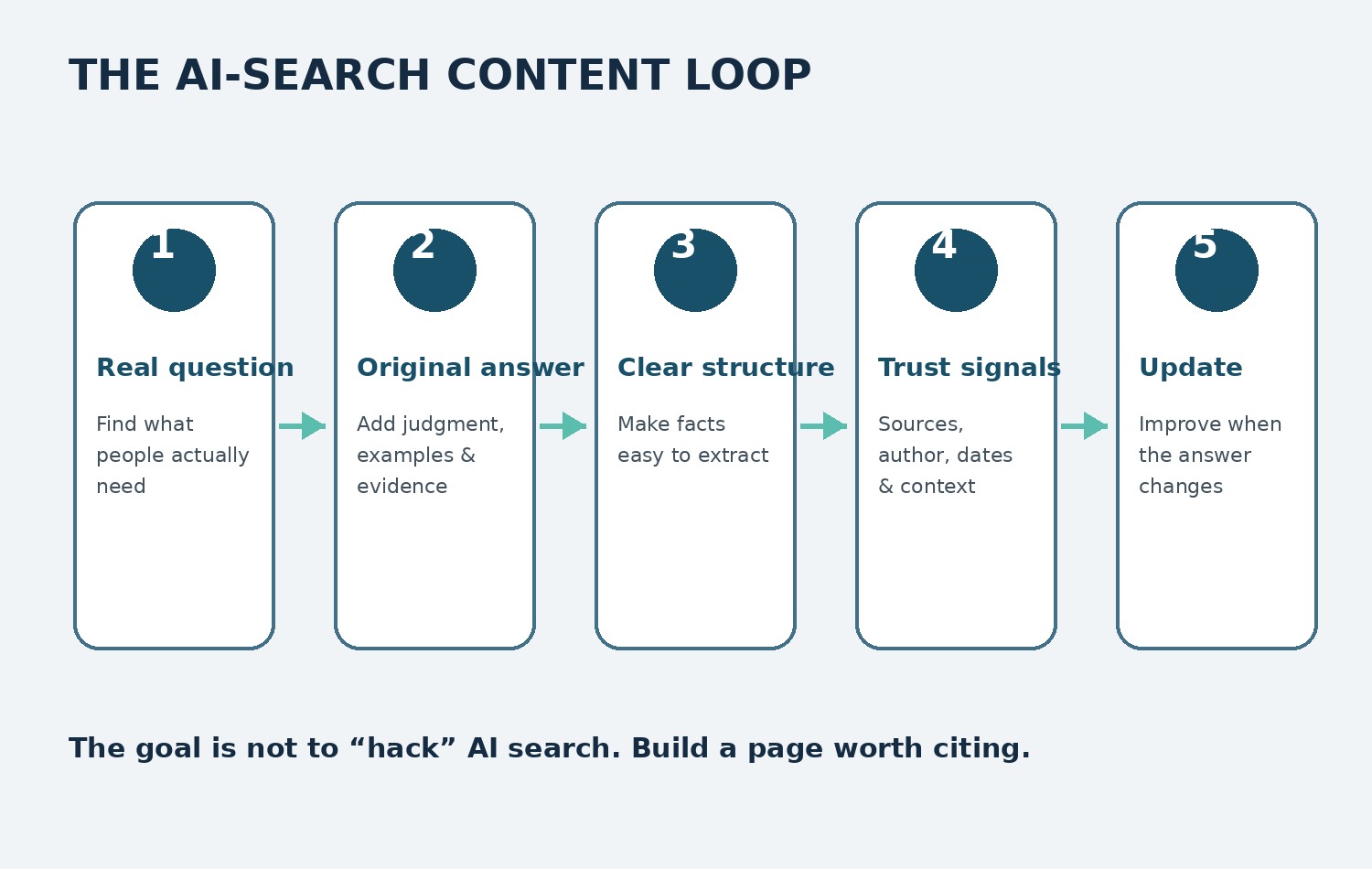
1. Start with a real question, not a keyword
Keywords are still useful. But they should be the beginning of the research process, not the end.
Instead of asking:
“What keyword can I rank for?”
ask:
“What problem is somebody trying to solve when they type this?”
Then map the questions around that problem.
For a topic such as personal productivity, for example, the main question could produce related questions such as:
- What should I do first?
- What should I automate?
- What should I avoid?
- What does a beginner need?
- How long does it take?
- What are the common mistakes?
- What happens when the first method fails?
- Which parts require human judgment?
This is closely related to the growing importance of query fan-out in modern search: one apparent query can represent a much larger set of related information needs. Current SEO research is increasingly examining this behavior as AI-powered search becomes more conversational. Ahrefs’ 2026 SEO research.
A simple research worksheet
Before writing, create five columns:
| Main question | Follow-up question | Evidence needed | Your useful contribution | Source |
|---|---|---|---|---|
| What is it? | What does it mean in practice? | Definition | Clear explanation | Primary source |
| Why does it matter? | Who benefits? | Data/research | Interpretation | Authority |
| How do I do it? | What are the steps? | Process | Practical framework | Experience |
| What can go wrong? | What should I avoid? | Examples | Warning signs | Authority |
| What next? | What should I do today? | Action plan | Checklist | Your framework |
This produces a much stronger article than simply writing 2,000 words around a keyword.
2. Give readers something generic AI can easily miss
This is one of the most important principles in 2026.
Google’s generative AI guidance encourages publishers to create content with a unique point of view and non-commodity value rather than simply recycling information that could easily be produced elsewhere. Google Search Central guidance on generative AI features.
Your contribution could be:
- an original framework;
- a decision tree;
- a checklist;
- a worked example;
- a comparison;
- a first-hand observation;
- a calculation;
- a case study;
- a template;
- a set of mistakes to avoid;
- or a practical sequence that connects several pieces of information.
You do not have to invent a scientific discovery.
You simply need to add value rather than rearrange existing sentences.
Example
Imagine ten websites all explain how to start a blog.
If every article says:
- 1. Choose a niche.
- 2. Buy a domain.
- 3. Install WordPress.
- 4. Publish articles.
- 5. Promote them.
A new article saying exactly the same thing adds little.
But a page that explains how to decide whether a niche is commercially viable before buying anything, with a scoring system and examples, creates something more useful.
That is the kind of content worth building.
3. Make important answers extremely easy to extract
AI systems need to understand pages.
Humans do too.
Clear structure therefore helps both.
Use descriptive headings rather than clever headings.
Instead of:
“The secret nobody tells you”
write:
“How to Choose a Profitable Freelancing Service”
The second heading tells the reader—and a machine—what the section is about.
Use:
- short introductory paragraphs;
- descriptive H2 and H3 headings;
- numbered processes;
- bullet lists;
- definitions;
- tables when comparison is genuinely useful;
- examples;
- concise answers before deeper explanations.
Do not turn every paragraph into a tiny fragment merely because you have heard that “AI likes chunks.” Google’s current guidance specifically warns against chasing artificial AI-search hacks; foundational SEO and genuinely useful content remain the priority. Google Search Central guidance on generative AI features.
4. Put the direct answer near the beginning
A strong article should not make the reader hunt for the answer.
After the introduction, give them a useful summary.
For this article, the practical answer is:
To improve AI search visibility, make your page technically accessible, directly answer a real question, add information that is not merely a generic rewrite, structure the information clearly, support important claims with trustworthy sources, demonstrate expertise and keep the page accurate as the subject changes.
Then explain each part.
This “answer first, depth second” structure works particularly well for informational content.
5. Build evidence into the article
Trust matters.
If you make a claim involving statistics, laws, prices, scientific findings, market trends or current events, support it.
Prefer:
- government sources;
- universities;
- recognized research organizations;
- official documentation;
- original studies;
- company reports when the company itself owns the data;
- reputable industry research.
Do not use ten sources merely to make an article look authoritative.
Use the right source for the claim.
For example, if Google explains how Google Search works, link to Google rather than a blog explaining what Google supposedly does.
If a labor-market claim comes from the World Economic Forum, cite the WEF report.
If a freelance-market statistic comes from Upwork, link to the relevant Upwork research.
That makes your article easier for a reader to verify.
6. Add your own interpretation after the source
A common content mistake is:
Source says X → repeat X → next source → repeat Y
That is research, but not necessarily useful analysis.
A better pattern is:
Source says X → explain what X means → explain why it matters → show how the reader can act on it.
For example, the World Economic Forum’s Future of Jobs research identifies AI and big data, networks and cybersecurity, and technological literacy among the fastest-growing skills, while creative thinking and resilience are also rising in importance. World Economic Forum Future of Jobs skills outlook.
The useful editorial step is then to ask:
What does that mean for an ordinary person choosing what to learn?
One reasonable interpretation is that learning a tool in isolation may be less valuable than combining technical capability with judgment, communication and the ability to solve a real problem.
That interpretation is more useful than simply reproducing the ranking.
7. Create “answerable” sections
A powerful article can be designed as a collection of questions a reader might naturally ask.
For example:
What is AI search?
Give the definition.
Does traditional SEO still matter?
Give the answer and explain why.
Does AI-generated content automatically hurt a website?
Explain the distinction between useful content and content produced primarily to manipulate rankings.
How can I make a page easier for AI systems to understand?
Give practical steps.
Do I need special AI files such as llms.txt?
Explain what Google currently recommends rather than repeating internet folklore.
How often should I update an article?
Explain that frequency should depend on whether the underlying information changes.
Can a small website compete?
Explain what a small publisher can control: depth, originality, clarity, evidence and expertise.
This approach naturally creates comprehensive content without padding.
8. Build “information gain” into every major section
Before publishing a section, ask:
“If someone already read the first three Google results, what does this section give them that they still don’t have?”
Possible answers:
- a better explanation;
- a practical example;
- a warning;
- a framework;
- a decision;
- a checklist;
- a comparison;
- a calculation;
- or a different perspective.
If the answer is “nothing,” rewrite the section.
This is one of the simplest ways to avoid commodity content.
9. Use internal links as a learning path
Internal links should not be decorative.
They should answer the reader’s next question.
For example, an article about AI search visibility can naturally point readers toward Hicony’s existing material on:
- learning in-demand digital skills;
- building an AI productivity system;
- creating remote income using AI;
- freelancing with AI.
The goal is to create a topic network, not isolated articles.
A reader who enters through one search result should be able to continue learning without leaving your site.
10. Use external links strategically
External links can strengthen an article when they help the reader verify something important.
For this topic, especially useful primary/authoritative references include:
- Google’s documentation about helpful, reliable, people-first content;
- Google’s documentation about AI features in Search;
- Google’s guidance for generative AI search;
- the World Economic Forum’s Future of Jobs research;
- current Upwork research about AI-related freelance demand.
The point is not to make an article look “researched.”
The point is to make important claims verifiable.
11. Create content that survives beyond one search trend
A dangerous strategy is building an entire article around a temporary phrase.
Instead, build around a durable problem.
For example:
Weak:
“Top 17 AI SEO hacks for September 2026”
Stronger:
“How to Make Your Website Useful and Discoverable in AI Search”
The second topic can be updated as search technology evolves.
This matters because AI search itself is changing quickly.
Upwork’s 2026 research, for example, shows that AI-related demand is increasingly moving into practical implementation and specialized workflows rather than simply being about experimentation. Upwork July 2026 Monthly Hiring Insights.
That suggests a broader lesson for content creators too:
Do not build around the novelty of AI. Build around the problem AI is helping people solve.
12. Build a page that a human expert would be comfortable signing
Google’s people-first guidance asks publishers to consider whether content demonstrates expertise, provides substantial value, contains accurate information and gives readers enough context to trust it. Google’s people-first content guidance.
Before publishing, ask:
- Who wrote this?
- Why should the reader trust the site?
- Are important claims sourced?
- Are the limitations clear?
- Are dates accurate?
- Are examples realistic?
- Does the article acknowledge uncertainty?
- Does it explain rather than merely assert?
- Would an informed reader consider it useful?
These questions are more valuable than obsessing over whether a keyword appears 14 or 16 times.
13. A practical 10-minute AI-search audit
After publishing, run this audit.
IMG_INARTICLE_2
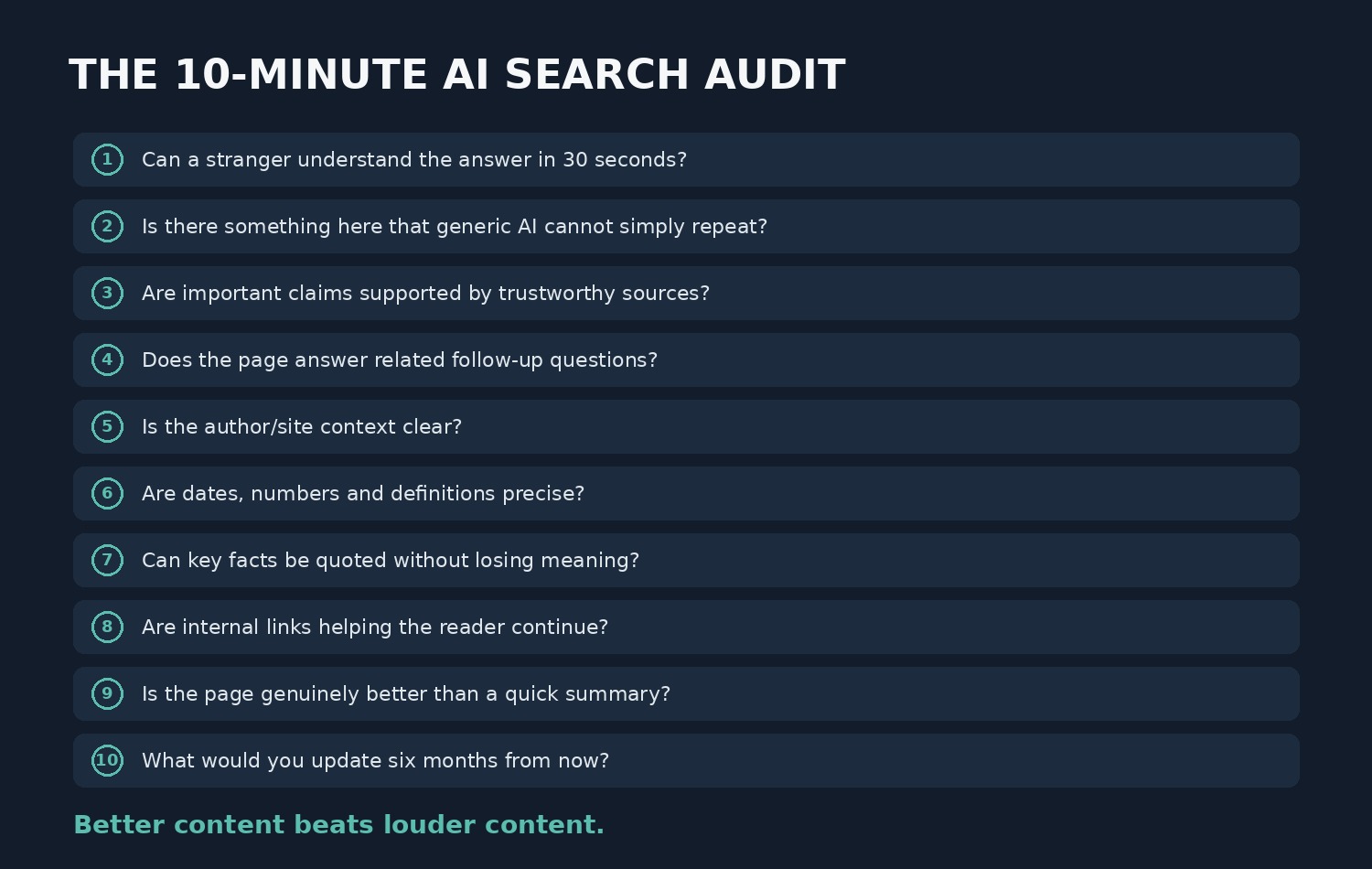
Question 1: Can I identify the page’s purpose immediately?
If not, improve the title and introduction.
Question 2: Does the page answer the main question directly?
If not, move the answer higher.
Question 3: Is there original value?
If the page could be recreated by asking an AI model to summarize five competing pages, it needs more.
Question 4: Are important claims supported?
Add primary or authoritative sources.
Question 5: Can the reader find the next useful answer?
Add relevant internal links.
Question 6: Is the structure obvious?
Improve headings, lists, tables and definitions.
Question 7: Is anything outdated?
Check dates, statistics, product names, policies and links.
Question 8: Is the page unnecessarily repetitive?
Remove padding.
Question 9: Does the article contain a useful conclusion?
Give the reader a next action.
Question 10: Would I recommend this page to another person?
If the honest answer is no, keep improving it.
14. A 30-day plan for improving AI search visibility
You do not need to rebuild an entire website in one weekend.
Days 1–3: Choose your strongest topic
Find one subject where your website can genuinely provide useful information.
Write down the main question and at least ten follow-up questions.
Days 4–7: Research the evidence
Find authoritative sources.
Separate:
- facts;
- statistics;
- expert opinions;
- your interpretation;
- and things you still need to verify.
Days 8–12: Build the article
Create a strong title, introduction, answer-first summary and logical H2/H3 structure.
Add examples and original frameworks.
Days 13–15: Add trust signals
Check author information, source links, dates, definitions and factual claims.
Days 16–18: Improve internal linking
Connect the article to your strongest related pages.
Also look at older articles that should link back to the new resource.
Days 19–21: Improve the visual experience
Use meaningful images, diagrams, illustrations, tables and callout sections where they genuinely help understanding.
Do not add images merely to make the page longer.
Days 22–25: Search like a reader
Ask several variations of the main question.
Read competing results.
Identify what they explain poorly.
Improve your page accordingly.
Days 26–30: Measure and update
Use Search Console and your analytics.
Look for:
- impressions;
- clicks;
- queries;
- pages gaining visibility;
- pages losing visibility;
- engagement;
- and conversions where relevant.
Then improve the page based on evidence.
15. What not to do
There are plenty of bad AI-search strategies circulating online.
Avoid building your strategy around:
- keyword stuffing;
- fake expertise;
- invented statistics;
- copied “expert” quotations;
- hundreds of thin AI-generated pages;
- meaningless FAQ sections;
- hiding keywords in invisible text;
- fake reviews;
- artificial mentions;
- unnecessary technical files simply because someone says an AI engine “requires” them;
- rewriting the top ten search results without adding anything.
Google’s own generative-AI guidance specifically emphasizes unique, valuable, non-commodity content and says publishers do not need special “AEO/GEO hacks” to succeed in Google Search. Google Search Central guidance on generative AI features.
16. The small-website advantage
A small site has one major advantage over a giant content factory:
it can be selective.
You do not have to publish every day.
You can spend more time making one article genuinely useful.
That matters because recent research into content performance suggests that simply increasing AI-assisted output does not automatically produce stronger results. A September 2026 report on the latest Orbit Media blogging survey found that stronger-performing content programs were more likely to use practices such as keyword research, original research, expert collaboration, human editing and analytics. Search Engine Land’s report on the 2026 Orbit Media blogging survey.
The lesson is simple:
Quality control becomes more important as content becomes easier to produce.
17. The Hicony content model
For a site like Hicony, a useful article can follow this model:
Problem
What does the reader want to solve?
↓
Clear answer
Give the answer early.
↓
Explanation
Teach the concept properly.
↓
Evidence
Support important claims.
↓
Framework
Give the reader a method they can use.
↓
Examples
Show what the method looks like.
↓
Tools/resources
Point to useful resources.
↓
Action plan
Tell the reader what to do next.
↓
Related Hicony content
Let the reader continue learning.
That structure creates something more valuable than a page designed merely to capture one keyword.
18. The most important mindset shift
AI search does not mean you have to write for machines.
In many cases, the opposite is true.
Write something so clear that a person can understand it.
Write something so well-supported that a researcher can verify it.
Write something so structured that an answer engine can understand the individual claims.
Write something so useful that a reader wants to bookmark it.
That is a much more durable strategy.
Frequently Asked Questions
Does traditional SEO still matter in AI search?
Yes. Google says the same foundational SEO practices remain relevant for eligibility in AI features. Pages still need to be technically accessible and eligible to appear in normal Google Search. Google Search Central: AI Features and Your Website.
Can I guarantee that Google AI Overviews will cite my website?
No. There is no guaranteed citation formula. Google explicitly says that meeting requirements and best practices does not guarantee that a page will be crawled, indexed or shown in an AI feature. Google Search Central: AI Features and Your Website.
Do I need to publish hundreds of articles?
No. Publishing volume by itself is not the goal. A smaller collection of genuinely useful, well-researched resources can be more valuable than a large collection of thin pages.
Is AI-generated content allowed?
AI assistance is not automatically the issue. The important question is whether the resulting content is useful, accurate and created for people rather than primarily to manipulate search rankings. Google’s people-first guidance emphasizes originality, completeness, accuracy and genuine value. Google’s people-first content guidance.
Should I use keywords in my article?
Yes, but naturally. Keywords help communicate the topic. They should not replace useful writing. Use the main phrase where it makes sense and cover the related questions readers genuinely have.
How often should I update an article?
Update it when the underlying information changes or when you discover a meaningful way to improve it. A date change without substantive improvement is not a real update.
Is AI search optimization a separate type of SEO?
It is better understood as an extension of good search and content practices rather than a completely separate discipline. Google’s current guidance emphasizes foundational SEO, unique content and people-first value rather than a separate collection of “AI ranking hacks.” Google Search Central guidance on generative AI features.
Final takeaway
The future of website discovery is becoming more complicated, but the fundamental opportunity is surprisingly simple.
Become useful.
Answer a real question.
Go deeper than the obvious answer.
Add your own useful framework, examples or analysis.
Support important claims with reliable sources.
Make the page easy to understand.
Connect it to the rest of your website.
Keep it accurate.
And update it when the subject changes.
You cannot force an AI search system to cite you.
But you can build the kind of page that an AI system, a search engine and—most importantly—a real human reader has a good reason to trust.
That is the strategy worth building on in 2026.
—
Sources and further reading
- Google Search Central — Creating Helpful, Reliable, People-First Content
- Google Search Central — AI Features and Your Website
- Google Search Central — Optimizing for Generative AI Features on Google Search
- World Economic Forum — Future of Jobs Report 2025
- Upwork — In-Demand Skills 2026
- Upwork Research Institute — Monthly Hiring Insights 2026