
Some decisions are difficult because the consequences are serious. Others become difficult because your mind is carrying too many possibilities at once.
You compare one option with another. Then you discover a third option. You read another opinion. You imagine what could go wrong. You think about what other people might say. You postpone the decision, return to it later, and somehow feel even less certain.
When that happens, the answer is not always “think harder.” Sometimes better decision-making begins by reducing the amount of thinking you are asking yourself to do at one time.
This guide introduces a practical seven-step Decision Reset: a repeatable way to move from mental noise to a decision you can explain, act on and review.
What We’ll Explore
- Why a reasonable decision can become overwhelming
- What decision fatigue is — and what the research does and does not prove
- How to separate facts, assumptions and fears
- How to reduce an excessive number of options
- How to choose criteria before comparing choices
- How to set a decision deadline without rushing important decisions
- How to act without demanding 100% certainty
- How self-awareness and emotional intelligence improve decision quality
- A reusable seven-step Decision Reset worksheet

Why Good Decisions Can Feel Impossible When You Are Overwhelmed
Imagine you are deciding whether to change jobs.
At first, the question seems simple: stay or leave.
Then the real questions appear:
- What if the new job is worse?
- What if I regret leaving?
- What will happen to my income?
- What will my family think?
- Should I wait six months?
- Should I study first?
- What if another opportunity appears?
Now the decision is no longer one question. It is a network of uncertain questions.
That is why a useful decision system starts by defining the actual decision instead of immediately trying to solve every possible future problem.
Decision Fatigue Is Real — But the Simple “Mental Battery” Story Is Incomplete
Decision fatigue is commonly described as a decline in decision quality or self-control after repeated decision-making. Research has examined it in healthcare, consumer decisions, workplace settings and other contexts.
A 2026 integrative review examined more than a thousand records and selected 23 studies for synthesis. It identified multiple individual, organizational and external contributors to decision fatigue and described effects including reduced decision efficiency and changes in decision behaviour. The review also presents decision fatigue as a complex phenomenon involving cognitive demand, motivation and context rather than a simple biological battery that becomes empty. Read the 2026 integrative review on decision fatigue.
Earlier conceptual work likewise identified decisional, self-regulatory and situational factors, while noting that the evidence base was conceptually diverse. Read the NIH/PubMed Central review of decision fatigue.
There is also an important scientific caution: some classic explanations based on a limited “self-control resource” have been challenged by later replication research. So it is better to say that repeated, complex or effortful decisions can make decision-making harder in some circumstances than to claim that your brain simply “runs out” of decision energy.
That distinction matters because it leads to a more useful practical response: instead of blaming yourself for having insufficient willpower, change the decision environment.
The Decision Reset: Seven Steps From Mental Noise to Action
The method below is designed for ordinary decisions. It is not a substitute for professional advice when the decision involves serious medical, legal, financial or safety consequences.
Step 1: Pause Before You Solve
The first step sounds almost too simple: stop adding information for a moment.
If you are already overwhelmed, opening another ten tabs may not create clarity. It may create another ten things to compare.
Give yourself a short pause.
You can:
- put the phone down;
- step away from the screen;
- take a few slow breaths;
- write the decision on paper; and
- decide what information is actually missing.
The purpose is not to empty your mind. It is to create enough space to see the decision as a decision rather than as an emergency.
Step 2: Define the Decision in One Sentence
Write:
“I am deciding whether to ________.”
Then complete a second sentence:
“The outcome I most need to protect is ________.”
For example:
“I am deciding whether to accept this new job. The outcome I most need to protect is long-term financial stability without creating an unsustainable commute.”
Notice what happened. “Should I change jobs?” became a more specific problem.
This is where self-awareness becomes useful. Your decision cannot be separated completely from what you value.
HICONY’s guide on becoming more self-aware explores questions about values, needs, emotional reactions and patterns. Those questions can be useful preparation for decisions because you cannot choose well if you do not know what you are actually trying to protect or achieve.
Step 3: Separate Facts, Assumptions and Fears
This is one of the most powerful parts of the Decision Reset.
Create three columns:
| Facts | Assumptions | Fears |
|---|---|---|
| The new salary is Rs. X. | The manager will probably be difficult. | I might regret leaving. |
| The commute takes 75 minutes. | The company may grow quickly. | I could fail in the new role. |
| The current job has a stable schedule. | My current employer may promote me soon. | I may disappoint someone. |
All three columns matter. But they do not have the same evidential status.
A fact can be checked. An assumption can be investigated. A fear can be acknowledged without automatically treating it as a prediction.
This is closely related to the reframing skill described in HICONY’s guide to reframing negative thoughts: distinguish what actually happened from the interpretation your mind immediately attached to it.
Step 4: Reduce the Options
More options do not always create better decisions.
Research on choice overload suggests that the effect of having many options is not universal. It depends on factors such as the complexity of the choice, difficulty of the task, uncertainty about preferences and the goal of the decision-maker. A major meta-analysis found that these moderators matter when determining whether a large assortment becomes a problem. Read the choice-overload meta-analysis.
So do not use “fewer options” as an absolute rule.
Instead, ask:
Which options are genuinely realistic?
Remove options that:
- are impossible under your current constraints;
- do not meet a requirement you consider non-negotiable;
- you included only because you are afraid of missing something; or
- are so similar that comparing them separately adds no useful information.
Aim for a small, serious shortlist rather than a giant catalogue of possibilities.
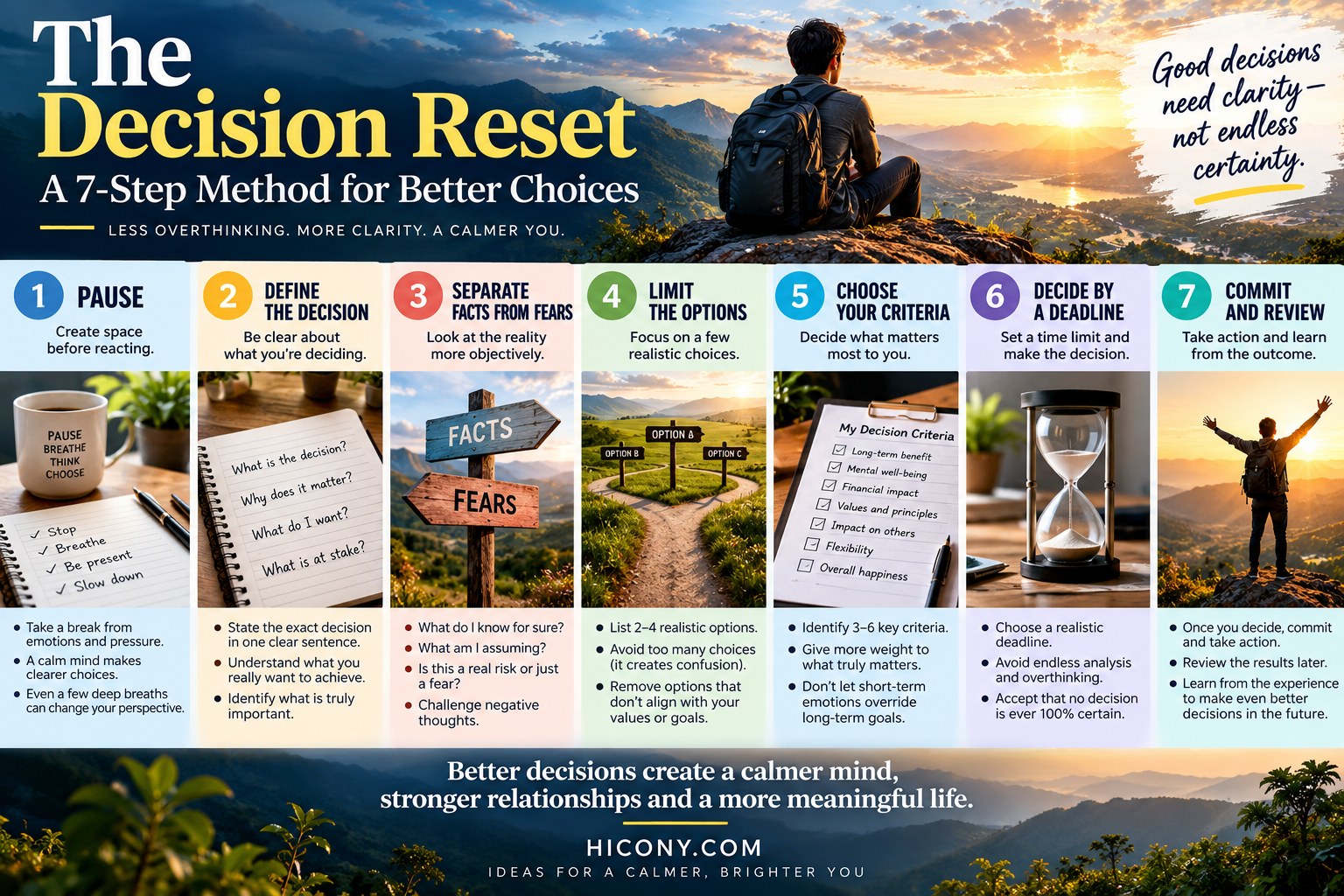
Step 5: Choose Your Criteria Before You Pick a Winner
People often compare options first and decide what matters later. That can make the criteria shift whenever a favourite option looks weak.
Instead, decide what matters before comparing the options.
For a career decision, your criteria might include:
- income;
- time;
- stability;
- learning opportunity;
- family impact;
- health and energy;
- future flexibility.
For a purchase, you might use:
- total cost;
- reliability;
- maintenance;
- actual need;
- replacement difficulty.
Do not create twenty criteria. Choose the few that genuinely matter.
Then ask which criteria are non-negotiable and which are merely preferences.
Step 6: Set a Decision Deadline
Some decisions need more time than others. A decision about a medical procedure, major investment, legal dispute or long-term contract should not be rushed simply because you want relief from uncertainty.
But ordinary decisions can become trapped in endless analysis.
A deadline creates a boundary:
“I will gather the missing information until Thursday evening. After that, I will decide using the criteria I have already chosen.”
The important phrase is missing information.
Do not keep researching merely because more information exists. There is almost always more information.
Ask:
“What information could realistically change my decision?”
If the answer is “nothing I am currently able to learn,” the research phase may already have reached its useful limit.
Step 7: Decide, Act and Review — Don’t Demand Certainty
A good decision is not necessarily a decision that produces a perfect result.
Sometimes the best decision available today produces an outcome you did not expect.
That is why the final step is not simply “choose.” It is:
Choose → act → observe → learn.
Before deciding, ask:
- What am I choosing?
- Why am I choosing it?
- What are the main risks?
- What would make me reconsider?
Then act.
Later, review the outcome without rewriting history. A decision can be reasonable even if the result is disappointing, because the result contains information that was unavailable at the time.
What If You Are Afraid of Making the Wrong Decision?
This is where overthinking can become particularly persuasive.
Your mind may tell you:
“If I think long enough, I will eventually find the choice that guarantees the right outcome.”
But many real-life decisions do not contain a guaranteed answer.
You may be choosing between two imperfect options. You may have incomplete information. Other people may make independent choices. Circumstances may change after you decide.
The goal is therefore not to eliminate uncertainty.
The goal is to make uncertainty visible and manageable.
A Better Question Than “What If I Regret It?”
Try:
“If I make this decision and it doesn’t work as hoped, what could I learn or change?”
This does not make every bad outcome harmless. Some decisions genuinely have irreversible consequences.
But for many ordinary decisions, thinking about recoverability changes the problem.
Compare:
“Which option guarantees I won’t regret anything?”
with:
“Which option is reasonable given what I know, and how reversible is it if circumstances change?”
The second question is usually easier to work with.
Use a Reversibility Test
Ask whether the decision is:
- Easy to reverse: You can change course with little cost.
- Partly reversible: You can change course, but it will cost time, money or effort.
- Hard to reverse: Changing course would be expensive or difficult.
The more reversible a decision is, the less useful it may be to demand exhaustive certainty before acting.
The harder it is to reverse, the more appropriate it is to slow down, verify important facts and seek qualified advice where necessary.
When Your Emotions Are Loud
Emotions are not automatically enemies of good decisions.
They can contain information. Fear may point to a genuine risk. Frustration may indicate that a situation is no longer sustainable. Excitement may reveal something you value.
The problem comes when an emotion is treated as the entire decision.
Instead of:
“I’m anxious, therefore this is the wrong choice.”
try:
“I’m anxious. What exactly is the anxiety responding to, and what evidence supports that concern?”
This is one reason emotional intelligence matters. HICONY’s guide to emotional intelligence explains the practical distinction between noticing an emotion and automatically reacting from it.
The Five-Minute Decision Reset Worksheet
Save this template for the next time your thoughts start looping.
- The decision: What exactly am I deciding?
- The goal: What outcome matters most?
- The facts: What do I actually know?
- The assumptions: What am I treating as true without confirmation?
- The fears: What am I afraid might happen?
- The options: What are the two to four realistic choices?
- The criteria: What three to six things matter most?
- The missing information: What could genuinely change my decision?
- The deadline: When will I stop researching and decide?
- The next action: What will I do immediately after deciding?

Three Situations Where This Method Works Differently
1. A Small Everyday Decision
If you are choosing between two similar products, do not spend an hour researching tiny differences that do not matter to your actual use.
Set two or three criteria, make the choice and move on.
2. A Meaningful Life Decision
For a job, relationship, relocation or education decision, give yourself more time. Talk to relevant people, verify important facts and think about your values and constraints.
3. A High-Stakes Decision
For serious legal, medical, financial or safety matters, do not use a self-help framework as a substitute for qualified professional advice. The Decision Reset can help you organize your questions and assumptions, but the appropriate professional should help you evaluate the actual risk.
What the Research Says About Too Many Choices
It is tempting to turn “choice overload” into a simple slogan: more choices are bad.
The research is more nuanced.
A 2015 meta-analysis of choice-overload research found that the effect of larger choice sets depends on several moderators, including task difficulty, complexity, uncertainty about preferences and the decision goal. In other words, the number of options is only part of the story. Choice overload: a conceptual review and meta-analysis.
That gives us a useful HICONY principle:
Why a Decision System Can Be Better Than More Motivation
When you are overwhelmed, it is easy to blame yourself:
“Why can’t I just decide?”
But a better question is:
“What part of this decision is creating unnecessary complexity?”
Maybe the options are poorly defined.
Maybe your criteria keep changing.
Maybe you are mixing facts with fears.
Maybe you are asking five different people for opinions without knowing what question you actually need answered.
Maybe the decision is reversible, but you are treating it as permanent.
Once the structure changes, the emotional experience of the decision can change too.
A Decision Is Not the Same Thing as a Prediction
This distinction is easy to miss.
A decision is something you choose to do.
A prediction is something you believe will happen.
You can make a sensible decision without knowing the future.
For example:
“Based on the information available, I will choose option B because it better fits my priorities and has a manageable downside.”
That is a decision.
“Option B will definitely work.”
That is a prediction.
Keeping those statements separate can make uncertainty much easier to tolerate.
When to Stop Deciding and Start Doing
There is a moment when analysis stops improving the decision and starts protecting you from the discomfort of acting.
One useful test is:
“What new information am I expecting to discover?”
If you cannot name it, you may no longer be researching. You may be postponing.
That does not mean you should rush.
It means you should identify what is actually keeping you from acting.
Sometimes the missing ingredient is information.
Sometimes it is permission to choose imperfectly.
Sometimes it is a conversation.
Sometimes it is rest.
And sometimes the decision genuinely needs more time.
Final Thoughts
Making better decisions does not mean becoming someone who is never uncertain.
It means learning how to make uncertainty manageable.
Pause.
Define the real decision.
Separate facts from assumptions and fears.
Reduce unnecessary options.
Choose your criteria.
Set a sensible deadline.
Then decide, act and learn.
The objective is not to find the mythical choice that guarantees a perfect future.
It is to make a decision you can reasonably defend with the information you had, the values you hold and the risks you understood at the time.
Sometimes clarity arrives before the decision.
Sometimes clarity arrives because you finally made the decision and began moving.
Quick Takeaway
When a decision feels overwhelming, stop adding options and start adding structure. Define the decision, separate facts from assumptions and fears, narrow the realistic choices, choose your criteria, set a deadline and act without demanding perfect certainty. A good decision is not a guarantee about the future—it is a reasoned choice followed by action and learning.
Important Note
This article is an educational self-management guide, not individualized medical, legal, financial or mental-health advice. For high-stakes decisions, obtain advice from an appropriately qualified professional who can assess your specific circumstances.