
Sometimes the hardest sentence to say is surprisingly simple: “Could you help me with this?”
If you are used to solving problems alone, asking for help can feel uncomfortable. You may worry that you are demanding too much, taking advantage of someone, appearing weak, or becoming a burden.
But there is another way to look at it. Asking for help is a communication skill. It requires self-awareness to recognize what you need, enough honesty to say it, and enough respect for the other person to let them decide whether they can help.
This guide explains how to ask for help without feeling like a burden—without pretending that you should never need anyone and without turning every request into an apology.

What We’ll Explore
- Why asking for help can feel emotionally difficult
- How to tell the difference between a real need and an automatic fear of bothering people
- How to identify exactly what kind of help you need
- How to make a clear request without over-explaining
- What to say when you feel guilty about asking
- How to accept help without feeling indebted forever
- How to handle a “no” without turning it into a judgment about yourself
- How asking for help connects with emotional intelligence and self-compassion
- A five-step “ask without guilt” framework you can use today
Why Does Asking for Help Feel Like Such a Big Deal?
For some people, independence becomes part of their identity. They learn to manage problems themselves, avoid inconveniencing others and keep difficult emotions private.
That can be useful. Independence is valuable. But there is a difference between being capable of doing something alone and believing that you must always do everything alone.
The second belief can create unnecessary pressure.
You might think:
- “They already have enough to deal with.”
- “I should be able to handle this myself.”
- “If I ask, they may think I am incapable.”
- “I don’t want to owe them anything.”
- “What if they say no?”
Notice that these are predictions, not necessarily facts.
The useful question is not “Am I allowed to need help?” It is:
“Is there a reasonable request I can make while giving the other person a genuine choice?”
That changes the situation. You are not forcing someone to help. You are communicating a need and allowing them to decide.
Asking for Help Is Not the Same as Giving Up Independence
Healthy independence does not mean never relying on another person.
Consider ordinary life. We ask someone for directions. We ask a colleague to review something. We ask a friend to listen. We ask a family member to watch a child for an hour. We ask a professional for specialist advice.
None of those requests automatically mean we are incapable.
In fact, knowing when another person’s knowledge, time, experience or emotional presence would be useful can be part of good judgment.
HICONY’s guide on what emotional intelligence means explores the broader skill of noticing emotions and choosing responses deliberately. Asking for help fits naturally into that picture: you first recognize what is happening inside you, then decide what response is actually useful.
Step 1: Notice When You Are Struggling
Before asking another person for help, start with yourself.
What is actually happening?
Perhaps you are:
- stuck on a practical problem
- overwhelmed by too many tasks
- uncertain about an important decision
- emotionally exhausted
- trying to learn something unfamiliar
- dealing with a problem that needs specialist knowledge
- carrying something alone because you are embarrassed to mention it
Sometimes the first sign is not a dramatic crisis. It is repetition.
You keep postponing the same task. You keep thinking about the same problem. You keep opening the same document without knowing what to do next. You keep telling yourself, “I’ll deal with it later.”
That can be a useful signal.
Instead of waiting until the problem becomes much bigger, pause and ask:
“Would another person’s time, knowledge, perspective or presence make this easier?”
Step 2: Name What You Actually Need
“I need help” is honest, but it may be too vague.
Before making the request, identify the type of help you want.
| What you need | Example request |
|---|---|
| Information | “Could you show me how this works?” |
| Practical assistance | “Could you help me carry these boxes?” |
| Perspective | “Could I get your opinion on this decision?” |
| Feedback | “Would you read this and tell me what is unclear?” |
| Emotional support | “Could you listen for a few minutes? I don’t need advice right now.” |
| Accountability | “Could you check in with me tomorrow to see whether I finished this?” |
Specificity helps both people. You know what you are asking for, and the other person can decide whether that request fits their time and ability.
Step 3: Make the Request Specific
One of the easiest ways to make asking for help less uncomfortable is to remove unnecessary uncertainty.
Instead of:
“I’m having a terrible time with everything. I don’t know what to do. Can you somehow help me?”
Try:
“I have been stuck on this document for an hour. Could you look at the first page with me for ten minutes and tell me where you think I’m going wrong?”
The second request is easier to understand.
It tells the other person:
- what the problem is
- what you want from them
- roughly how much involvement you are requesting
- that they can decide whether they have the time
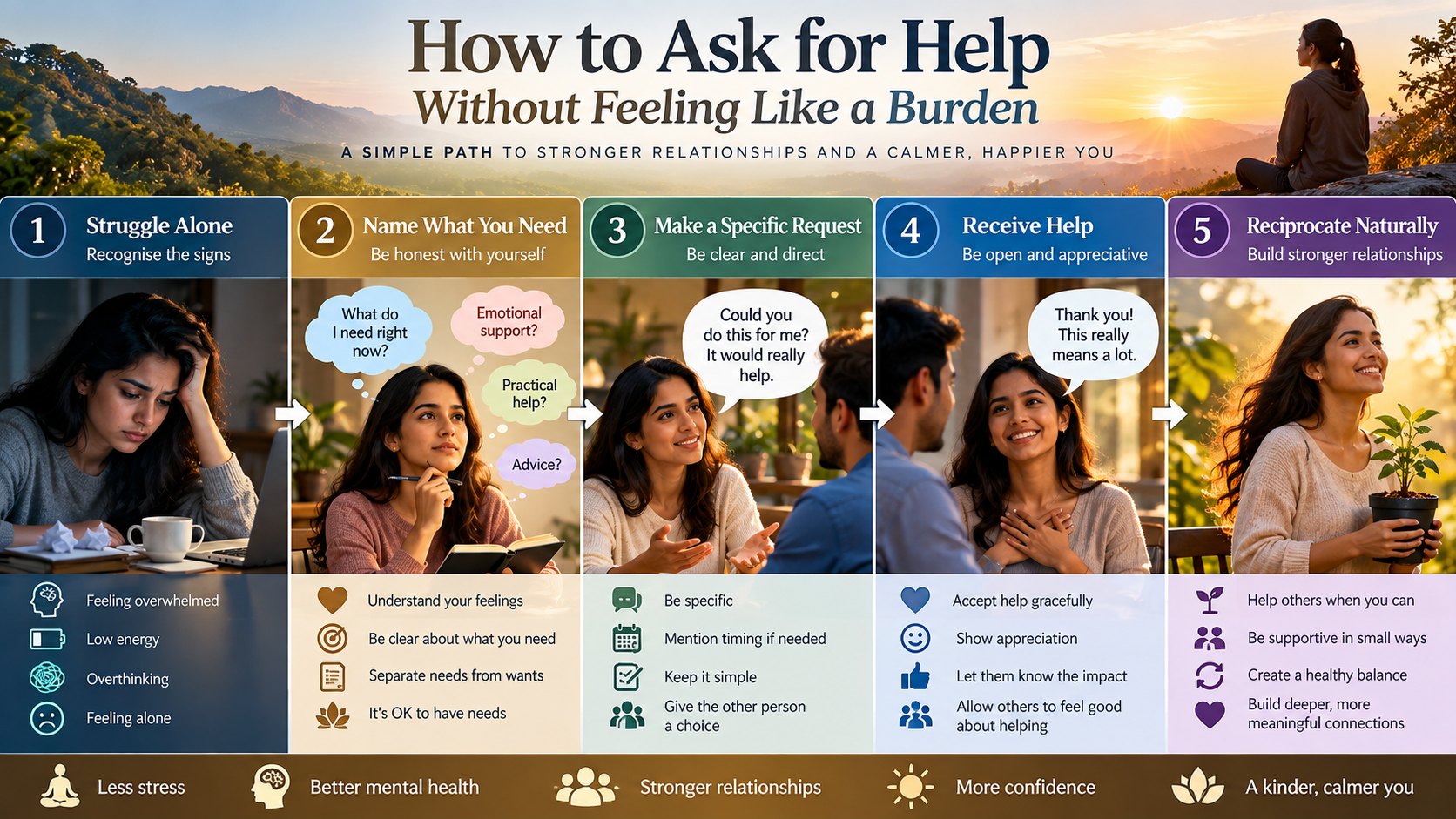
A Simple Formula for Asking
Try this four-part sentence:
“I’m dealing with [situation]. I need [specific kind of help]. Would you be willing to [specific action]?”
For example:
- “I’m trying to understand this spreadsheet. I need another pair of eyes. Would you be willing to look at it with me for fifteen minutes?”
- “I’ve had a difficult day. I don’t need a solution. Would you be willing to listen for a few minutes?”
- “I have too much to finish before Friday. Could you help me decide which two tasks should come first?”
This approach is direct without being demanding.
Step 4: Stop Over-Apologizing
There is a difference between courtesy and repeatedly telling someone that your existence is an inconvenience.
Compare:
“Sorry to bother you. I’m really sorry. I know you’re busy. You don’t have to do it. I probably shouldn’t even be asking. Sorry.”
with:
“I know you may be busy, so no pressure. If you have time, could you help me with this?”
The second version respects the other person’s time without attacking your own worth.
You do not have to make yourself smaller before making a reasonable request.
Step 5: Give the Other Person a Real Choice
This is one of the healthiest parts of asking for help.
A request should contain room for a genuine “no.”
Try:
- “If you have time, could you help me?”
- “Would you be available later today?”
- “If now isn’t a good time, that’s completely fine.”
- “Do you have the capacity to help with this?”
When people know they are free to decline, the request becomes a conversation rather than a demand.
And something important follows: their answer is information, not a verdict on your worth.
What If They Say No?
This is often the hardest part.
If someone says no, your mind may immediately create a story:
“They don’t care about me.”
“I shouldn’t have asked.”
“I’m annoying.”
But a “no” can have many ordinary explanations.
- They may genuinely be busy.
- They may not know how to help.
- They may have their own responsibilities.
- They may be unable to help with that particular request.
- They may need more information before agreeing.
Try separating the event from the interpretation.
Event: “They couldn’t help me today.”
Interpretation: “Nobody wants to help me.”
Those are not the same statement.
This is closely related to the skill HICONY explores in how to stop negative self-talk: noticing when a thought has moved from describing an event to attacking your identity.
Step 6: Accept Help Without Creating a Lifetime Debt
Some people are comfortable asking for help but become uncomfortable receiving it.
They immediately think:
“Now I owe them.”
Gratitude is healthy. Keeping a mental spreadsheet of every favour is different.
Relationships naturally contain periods when one person gives more and the other receives more. Circumstances change. A person who needs support today may be the person offering support tomorrow.
You can say:
“Thank you. That genuinely helped me.”
You don’t necessarily need to repay the exact favour immediately.
Let appreciation be appreciation.
Step 7: Don’t Turn Reciprocity Into Accounting
Healthy relationships are not perfectly balanced transactions.
If a friend helps you move house, you might later help them with something else. But the exchange does not need to happen within twenty-four hours or have identical monetary value.
Reciprocity is better understood as a pattern over time.
Ask:
- Do I care about this person?
- Do I generally show up when I reasonably can?
- Do I appreciate what they do?
- Do I respect their boundaries?
If the answer is yes, one request does not make you a burden.
What If You Feel Guilty Even After They Agree?
Guilt can continue after the other person has already said yes.
You may think:
“They said it’s fine, but they probably don’t really mean it.”
Be careful here. You are trying to read another person’s mind.
If they have clearly agreed and there is no evidence that they are uncomfortable, you can practise accepting their answer.
Try:
“They made their decision. I don’t need to invent a hidden answer.”
This is a small but powerful form of emotional discipline.
Asking for Help and Self-Compassion
Self-compassion is not about telling yourself that every decision you make is perfect. It is about responding to difficulty without adding unnecessary hostility toward yourself.
That matters when asking for help because the inner critic can turn an ordinary request into an identity judgment:
“I need help, therefore I am incapable.”
A more balanced interpretation is:
“I have encountered something I cannot—or do not want to—handle entirely alone. I can decide what support would be useful.”
HICONY’s practical guide to self-compassion explores this broader idea of responding to difficulty without turning one mistake or difficult moment into a judgment of your whole identity.
Recent research also gives this topic useful context. A 2026 cross-sectional study of 684 Chinese music students examined how social support related to help-seeking intentions, with self-compassion and resilience examined as potential mediators.
Asking for Help Is Also an Emotional-Intelligence Skill
Good help-seeking requires several abilities at once.
- Self-awareness: noticing that you need support.
- Emotional regulation: managing the embarrassment or fear that may appear.
- Clear communication: explaining what you need.
- Perspective-taking: considering the other person’s time and situation.
- Respect for boundaries: accepting that they may decline.
- Gratitude: recognizing the support without becoming excessively indebted.
That is why asking for help can actually be a sophisticated interpersonal skill rather than a sign that something has gone wrong.
A Five-Step “Ask Without Guilt” Framework
When you are stuck, remember:
- Notice. Admit that you are struggling.
- Name. Identify exactly what kind of help would be useful.
- Ask. Make a specific, reasonable request.
- Allow. Give the other person genuine freedom to say yes or no.
- Accept. Receive the answer without turning it into a judgment about your worth.
Then, if they help, thank them sincerely.
If they cannot help, ask someone else, change the plan, or look for another source of support.

Real-Life Examples
At Work
Instead of spending three hours silently struggling with a task, try:
“I’m stuck on the last part of this report. Could you spend ten minutes showing me how you approached this section?”
With a Friend
If you need emotional support:
“I’ve had a rough day. I don’t need advice right now. Would you mind listening for ten minutes?”
With Family
If you need practical assistance:
“I have several things to finish this evening. Could you handle dinner tonight? That would give me enough time to finish the urgent work.”
When You Need Professional Help
Some situations are better handled by someone with appropriate training. Asking a qualified professional for help can be a practical decision rather than something to feel ashamed about.
If you are experiencing severe distress, thoughts of harming yourself or someone else, or a situation that feels unsafe, seek appropriate urgent professional or emergency support rather than relying only on friends or online information.
How to Make Asking for Help Easier Over Time
You don’t have to begin with your biggest problem.
Practise on small requests.
Ask someone:
- to explain something you don’t understand
- to give you feedback
- to carry something
- to recommend a resource
- to listen for a few minutes
Then notice what happens.
Did the relationship collapse?
Did the person become angry?
Or did something much more ordinary happen?
You asked.
They considered it.
They answered.
Life continued.
Repeated experiences like this can challenge the belief that every request is a burden.
One Important Boundary: Don’t Ask the Wrong Person for the Wrong Kind of Help
Asking for help does not mean asking everyone for everything.
Choose the person according to the situation.
- Ask a knowledgeable colleague for technical guidance.
- Ask a trusted friend for emotional support.
- Ask a family member for practical assistance when appropriate.
- Ask a qualified professional when the problem requires professional expertise.
This protects both sides of the relationship.
Good help-seeking is not indiscriminate dependence. It is matching the need to the right source of support.
The Deeper Lesson
Many people believe strength means carrying everything without assistance.
But human life has never worked that way.
We learn from other people. We borrow knowledge. We cooperate. We comfort one another. We ask questions. We teach. We receive advice. We help someone today because they helped us yesterday—or simply because they needed us.
The goal is not to become dependent on everyone around you.
The goal is to become flexible enough to recognize:
“I can handle many things myself, and I can also ask for help when help makes sense.”
Final Thoughts
Learning how to ask for help without feeling like a burden begins with changing the question.
Instead of asking:
“Am I weak for needing help?”
try asking:
“What do I need, who is appropriate to ask, and how can I make a respectful request?”
That is a much more useful question.
You do not have to apologize for having needs. You do not have to demand that other people meet them. And you do not have to interpret every “no” as a rejection of who you are.
Notice the need.
Name it.
Ask clearly.
Give the other person a choice.
Accept the answer.
Sometimes the strongest thing you can say is simply:
“Could you help me?”
Quick Takeaway
Asking for help is not automatically a sign of weakness or dependence. A healthy request identifies a real need, asks a suitable person for specific assistance, respects their freedom to decline, and accepts support without turning it into a permanent debt.
Sources & Further Reading
- PubMed: Social support, self-compassion and help-seeking intention — 2026 study
- Frontiers in Psychiatry: Self-compassion and psychological help-seeking delay — 2026 research
- PubMed: Systematic review and meta-analysis of perceived social support and human thriving
Note: This article is educational and is not a substitute for professional medical, psychological or emergency advice.