

Artificial intelligence is most useful when it removes small, repetitive tasks from your day. If you do Things to Boost Your AI Productivity, you do not need to automate everything or learn complicated software. A few practical AI tools can help you write faster, organize ideas, summarize information and stay focused.
This guide looks at five practical ways to use AI in a productivity workflow. The goal is simple: save time without adding another complicated system to manage.
1. Use an AI Assistant to Organize Your Thoughts
One of the easiest ways to use AI is as a thinking partner. Instead of staring at a blank page, give the AI your rough notes, ideas or problem and ask it to organize them.
- Turn rough notes into a clear outline.
- Create a step-by-step action plan.
- Summarize a long document into key points.
- Turn a confusing idea into a simple explanation.
Best practice: Give the AI context. Explain what you are trying to achieve, who the result is for and what format you want.
2. Use AI to Write First Drafts Faster
AI can be useful when you need to get started quickly. It can help produce a first draft for emails, blog outlines, social media captions, checklists and other routine content.
The important word is draft. The final version should still reflect your knowledge, experience and voice.
- Draft a professional email from bullet points.
- Create several headline ideas.
- Turn notes into a structured article outline.
- Rewrite text to make it clearer and easier to read.
3. Turn Long Information Into Actionable Summaries
Long articles, reports and meeting notes can consume a surprising amount of time. AI can help you extract the information that matters most.
Instead of asking only for a summary, ask for a useful output. For example:
- What are the five most important points?
- What action should I take next?
- What information is uncertain or needs verification?
- Create a checklist from this document.
This makes AI more useful because you are turning information into decisions and actions.
4. Use AI to Reduce Repetitive Work
The best productivity gains often come from small tasks you repeat again and again. Look for work that follows a similar pattern.
Examples include:
- Creating email replies from a standard structure.
- Generating meeting agendas and follow-up lists.
- Creating content outlines from the same template.
- Converting research notes into a consistent format.
Before automating anything, write down the steps you currently follow. Then decide which parts require your judgment and which parts are repetitive. AI should help with the repetitive part while you keep control of the important decisions.
5. Build a Simple Personal AI Workflow
You do not need five different apps open all day. A simple workflow is often more effective.
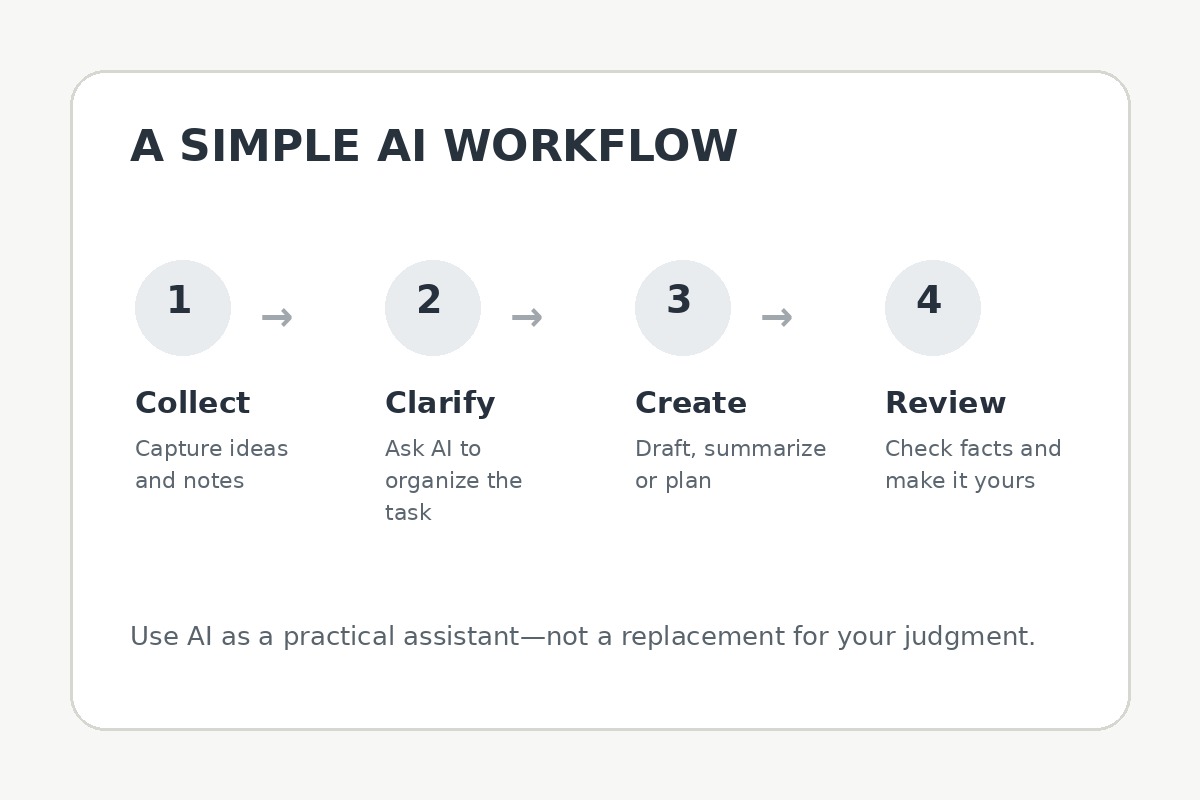
Try this four-step approach:
- Collect: Capture notes, ideas, links and tasks in one place.
- Clarify: Use AI to organize the information and identify the next action.
- Create: Use AI to help draft, summarize or plan.
- Review: Check the output, verify important facts and make the final decision yourself.
This approach keeps AI connected to your real work instead of becoming another distraction.
How to Choose the Right AI Tool
Do not choose an AI tool only because it is popular. Start with the problem you want to solve.
- If writing takes too long, look for a strong writing assistant.
- If research overwhelms you, use a tool that can help summarize and organize information.
- If repetitive tasks consume your day, look for automation features.
- If your ideas are scattered, use an AI assistant to turn them into a structured plan.
Start with one tool and one problem. Use it consistently for a few weeks before adding more tools.
Final Thoughts
The most productive way to use AI is not to hand over your entire workflow. It is to identify the small areas where AI can save time, reduce repetitive work and help you think more clearly.
Start simple: choose one repetitive task this week and test whether AI can make it faster or easier. Keep what works, remove what does not, and build your system gradually.
The best AI productivity system is the one that helps you spend more time on meaningful work.