
Karma, Anattā, Attachment and the End of the Print
By Don Dhairya Guptha Sumithraarachchi · HICONY.com
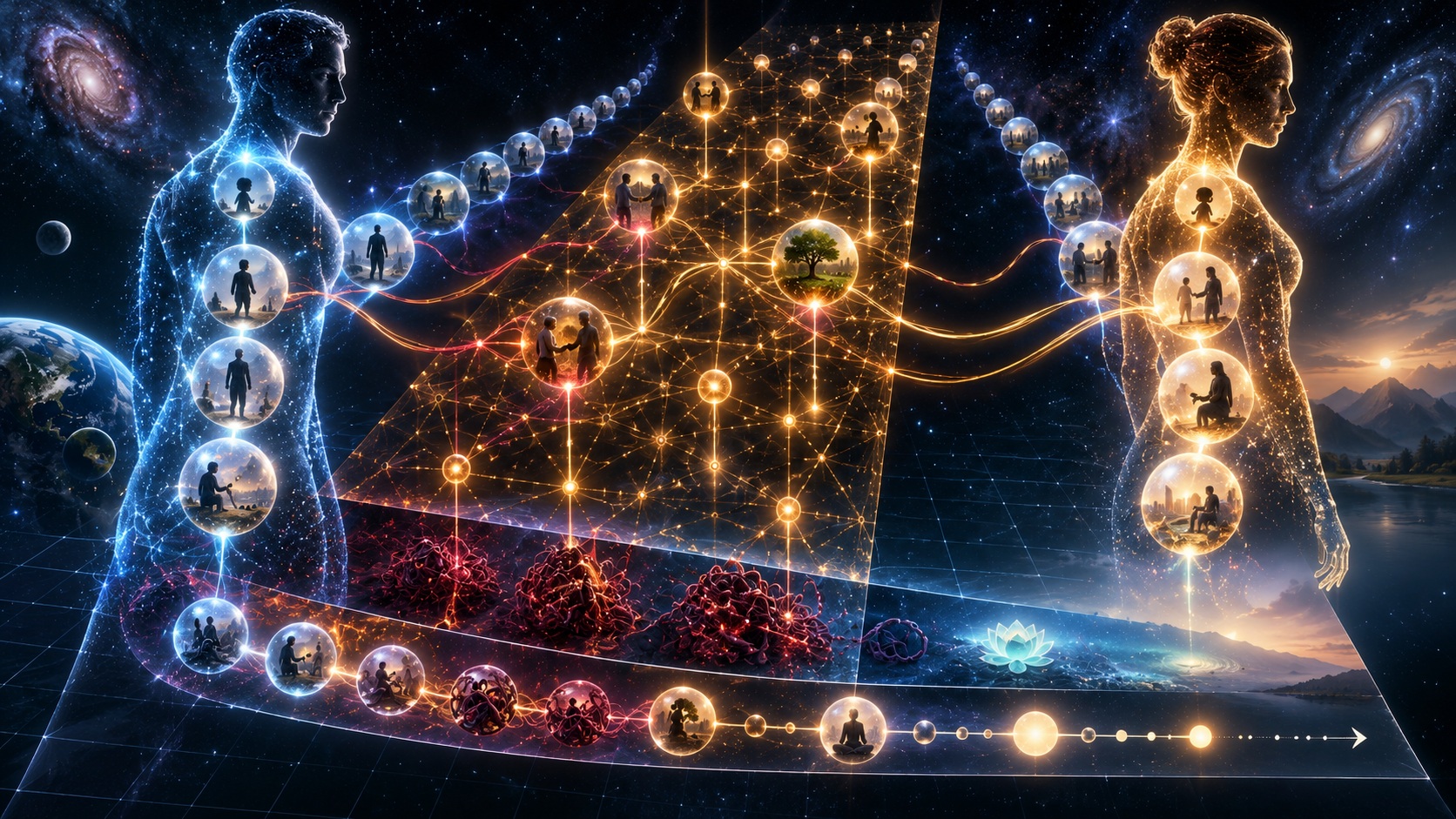
This article is a philosophical thought experiment by the author. “Spacetime print” and “karma as a connecting dimension” are explanatory language created for this model. They are not standard Buddhist technical terms, and karma is not being proposed here as a newly discovered physical dimension.
Why try to explain an ancient idea with pictures?
Some of the deepest Buddhist ideas are easy to misunderstand when they are encountered only through difficult philosophical vocabulary. Terms such as anattā, paṭicca-samuppāda, kamma and Nibbāna have long histories, many layers of commentary and different contexts. A beginner can therefore know the words without yet having a picture of how the ideas relate to one another.
This article takes the opposite approach. We start with an image: imagine that what we call a person is not a permanent object moving unchanged through time, but a sequence of changing states. I call each state a spacetime print. The term is simply a teaching device. It gives us a way to ask a difficult question in ordinary language:
If there is no permanent self, what connects one moment with the next?
My proposed answer is a process of conditions and consequences rather than a permanent substance. When different beings interact, their processes can affect one another. I use the word karma in this model for the causal connection created by intentional action and its consequences. Again, this is a conceptual model, not a claim that physics has measured a karma field.
1. The first picture: a life as a sequence of prints

Imagine taking an impossibly precise snapshot of everything that makes up a person’s present condition. The body has one state. Feelings have one state. Perceptions have one state. Memories, intentions, habits, attention and awareness have one state. The surrounding environment has one state.
Call that Print 1.
A moment later, the conditions have changed. Call the new configuration Print 2. Another moment produces Print 3. Then Print 4, Print 5 and so on.
The important point is that Print 2 is not an exact copy of Print 1. Yet it is not unrelated to Print 1 either. What happened before helps condition what happens next.
So the model is:
Print 1 → Print 2 → Print 3 → Print 4 → Print 5 → …
This gives us a way to talk about continuity without assuming that a permanent “thing” called the self must travel from one moment to the next.
2. Is the person travelling through spacetime?
Modern physics gives us a precise language for events, spacetime and world-lines. This article is not trying to replace that mathematics with a spiritual metaphor. Instead, the spacetime-print picture asks a philosophical question about identity.
Suppose a world-line represents the sequence of events associated with a person. We can mentally mark successive points along it:
P₁ → P₂ → P₃ → P₄ → P₅
At each point there is a different physical and mental condition. Yet we conventionally call the whole sequence “the same person.” The model asks whether that identity is best understood as a continuing pattern rather than as an unchanging substance.
This connects with the central intuition behind anattā, while remaining careful not to claim that relativity or physics proves Buddhist doctrine.
3. Now introduce another being

Now imagine another person. They also have a sequence:
A₁ → A₂ → A₃ → A₄ → …
and:
B₁ → B₂ → B₃ → B₄ → …
At some point, A and B meet.
A₂ ↔ B₂
Maybe A says something to B. Maybe B helps A. Maybe one harms the other. Maybe they form a relationship. Maybe an intention creates a promise, a habit, a fear, an attachment or an act of kindness.
The interaction is not merely a frozen event. It can become part of the conditions shaping later states.
That is where your central idea enters: karma is the connection between the prints of different beings.
4. What do I mean by “karma is the connection”?
Here we need to be especially precise. Karma should not be imagined as an invisible cable carrying a substance from one person to another. Nor should the word “dimension” be interpreted as a claim about a fifth physical coordinate.
In this model, karma is a causal relationship. An intentional action can create conditions whose effects appear later. Those effects can become conditions for still later actions and experiences.
Early Buddhist teaching gives an important foundation for this way of thinking. In AN 6.63, the Buddha is quoted as saying that intention is kamma, and the discourse discusses the consequences and cessation of kamma. This is much closer to the model than treating karma as a physical energy or substance.
So the visual language is:
Person A’s print → intentional interaction → consequences → later conditions
and similarly for Person B.
The “connection” is therefore causal and conditioned, not a physical communication wire.
5. Karma as another dimension — a visual metaphor

Here is the most unusual part of my model.
Imagine ordinary spacetime as a three-dimensional landscape evolving through time. Now imagine drawing another layer above it—not because physics says it exists, but because the diagram helps us represent something different.
That layer represents causal connection between processes.
In the picture, two beings can occupy their own sequences of events, while intentional actions create links that influence what happens later.
So, for the purposes of this thought experiment:
- Spacetime layer: where and when a state occurs.
- Process layer: the changing body-mind-environment configuration.
- Karma layer: a visual representation of causal continuity produced through intentional conditions.
This third layer is not a physical dimension in the scientific sense. It is a conceptual bridge that makes the Buddhist idea of karmic continuity easier to picture.
6. Why does the printing continue?
The next question is more important than the picture itself. Why does the sequence continue?
My simplified version is:
Ignorance → “I” and “mine” → attachment → intention → action → consequence → further conditioned arising → another print
Ignorance here means not seeing things clearly. Identification turns experience into “me” and “mine.” Attachment gives the process something it desperately wants to preserve, obtain, resist or control. Intention leads to action. Action produces consequences. Those consequences become part of later conditions.
This is not meant as a replacement for the detailed chain of dependent origination. It is a simplified map for a reader who is encountering the idea for the first time.
7. The five aggregates: what exactly is being printed?

If we say “a person is a print,” a reader can reasonably ask: what is inside the print?
A useful Buddhist framework is the five aggregates:
- Form (rūpa): the material/physical aspect.
- Feeling (vedanā): pleasant, unpleasant or neutral feeling-tone.
- Perception (saññā): recognition and identification of what is experienced.
- Mental formations (saṅkhāra): intentions, volitional formations and other constructed mental processes.
- Consciousness (viññāṇa): awareness associated with an object and sense-base.
The point is not that these five are a modern scientific list of components of a human being. They belong to a different analytical framework. But they provide a remarkably useful way of asking whether a permanent self can actually be found among changing processes.
That leads to the central question:
If every part of the experience is changing, where is the permanent “I”?
8. The self as a pattern
My own philosophical proposal is that the “self” can be understood as a pattern rather than a thing.
A whirlpool is a useful ordinary analogy. A whirlpool has a recognizable form, but no single drop of water is “the whirlpool.” The pattern continues while the material participating in the pattern changes.
The analogy is not exact, and a human being is vastly more complicated. But it illustrates the kind of continuity being proposed here: continuity does not necessarily require an unchanging substance.
In the spacetime-print model, each print is real as a momentary configuration. The pattern across prints gives us the ordinary sense of a continuing person.
9. A simple calculation — not a physics equation

We can make the model almost mathematical:
Pn+1 = f(Pn, C, I, A)
Where:
- Pn = the current print/state
- C = conditions, including environment and previous consequences
- I = intention
- A = action
- Pn+1 = the next conditioned state
The equation is intentionally simple. It says only that the next state is a function of the present state and relevant conditions. It does not calculate karma, predict rebirth or describe a physical field.
We can then extend the picture:
P₁ → P₂ → P₃ → P₄ → …
and when two beings interact:
PAn ↔ PBm
The interaction can become part of the conditions affecting later prints.
10. What changes after Nibbāna?
This is the point where the model becomes especially useful for explaining your distinction.
Before liberation, attachment continues to generate intentional activity and conditions that sustain further becoming.
After Nibbāna, the central change is not that the physical body suddenly disappears. The Buddhist teaching describes liberation from the causes of continued suffering and rebirth. The remaining life continues until death.
Therefore, in our visual language:
Attachment ends → new karmic production for future becoming ends → existing life continues → death → no further conditioned print.
This distinction matters. Saying “Nibbāna means the person stops interacting with everybody immediately” would be misleading. A liberated person can still walk, speak, eat, teach and affect others while alive.
11. The two Nibbāna-elements
The Itivuttaka explicitly describes two Nibbāna-elements. One is described as having residue remaining: the liberated person is still alive with the faculties functioning. The other is described as having no residue remaining after the life-process ends.
For a beginner, the timeline can be simplified as:
Nibbāna during life → life continues → death → no further conditioned arising.
This is why your “printing” metaphor needs two stages. The printing process does not mean the physical body disappears at the instant of liberation. Rather, the conditions that would produce another existence are understood to have ended.
The distinction should still be studied through the original texts and traditional explanations. The “print” language is only a teaching analogy.
12. What happens to interaction with other beings?
This is another important clarification.
Even after liberation, while the person is alive, their actions can have ordinary effects on other people. If an arahant teaches someone, the student hears the teaching. If the arahant helps someone, that person may benefit. Physical and social interaction does not stop.
What this model is trying to represent is something narrower: the liberated person is no longer generating the conditions for another karmically conditioned existence.
So the diagram is not:
Nibbāna → no interaction.
It is:
Nibbāna → no new karmic continuation → remaining life → death → no further print.
13. What does “no further print” mean?
“No further print” is deliberately a metaphor. It does not mean that something called a soul is destroyed. It means that, within the model, there is no further conditioned arising into another existence after the end of the arahant’s life.
This is also why I would avoid saying that Nibbāna is simply “nothingness.” Early Buddhist texts use distinctive language for Nibbāna and do not present it as another ordinary place or object in spacetime. The purpose of this article is to explain the cessation of the process without turning Nibbāna into a physical location.
14. The whole model in one diagram
Put everything together:
Changing conditions → Print → Interaction → Intention → Action → Consequence → Attachment/conditioning → Further Print → …
Then:
Understanding → non-clinging → cessation of the conditions for further becoming → remaining life → death → no further print.
15. The visual summary
Here is a short visual animation of the model. It is deliberately simple: the graphics should give the viewer an intuitive map before the detailed article is read.
Visual summary: spacetime prints, interacting processes, the conceptual karma layer and the Nibbāna timeline.
16. Science and Buddhism must remain distinct
There is a temptation to say that modern physics has discovered what Buddhism taught thousands of years ago. This article does not make that claim.
Physics has its own methods, equations, measurements and standards of evidence. Buddhist philosophy has its own methods of analysis, meditation, ethical practice and investigation of experience. The spacetime-print model sits between them as a philosophical visualization.
The value of the model is therefore not that it proves a scientific proposition. Its value is that it can help a reader visualize a difficult question: how can continuity exist without requiring a permanent self?
17. Three levels of the model
To prevent confusion, keep these three levels separate:
- Established science: spacetime, physical processes, measurement and other scientific concepts supported by their respective evidence.
- Buddhist teaching: anattā, the five aggregates, dependent origination, kamma and Nibbāna as taught in Buddhist sources and interpreted within Buddhist traditions.
- My explanatory model: “spacetime prints,” the visual karma connection/dimension, and the idea of stopping new printing when attachment has ended.
The third level is where the originality of this article lies. It is an attempt to make difficult ideas easier to see.
18. Why this model may help a beginner
A beginner often asks: “If there is no permanent self, who experiences the result of karma?” The question can seem impossible if we imagine only two choices: either a permanent soul moves from life to life, or absolutely nothing is connected.
The print model offers a third picture: causal continuity without an unchanging entity.
Print 1 conditions Print 2. Print 2 conditions Print 3. An action in one state can influence later states. An interaction can influence another person’s process. Yet none of the prints needs to be an eternal object.
This is not intended as a final answer to every philosophical problem. It is a visual starting point.
19. The deepest question
Perhaps the most important question is not “What is the self?” but:
What keeps the pattern going?
If the answer is attachment, craving and ignorance, then liberation can be understood not as destroying a permanent person, but as ending the conditions that keep the cycle of conditioned becoming going.
That is why the image of “stopping the printer” can be useful—but only if we remember that the printer is a metaphor. Nibbāna is not a machine being switched off. It is a profound transformation described in Buddhist teaching as the ending of the causes of suffering and further becoming.
20. Final picture
Imagine countless streams of changing prints across a vast universe. Each stream is a changing process. Streams meet. Actions have consequences. Intentions matter. Attachments strengthen the continuation.
Now imagine one stream reaching complete understanding.
The stream does not have to disappear immediately. Its already-arisen life continues. But the causes for another karmically conditioned existence are no longer being produced.
Then death comes.
And, in this model, there is no next print.
“We are not permanent things travelling through spacetime. We can instead understand ourselves as changing patterns, conditioned by what came before and by what we do now. When attachment ends, the need for another karmically conditioned print ends.”
Conclusion
This “spacetime print” model is my attempt to translate difficult philosophical ideas into a visual language. It does not claim to replace Buddhist texts, and it does not claim that modern physics has proven Buddhism.
Its central proposal is simple:
We continually arise as changing patterns. Our actions and interactions become conditions. Karma describes causal continuity rather than a permanent substance. Attachment keeps conditioned continuation going. Understanding and non-clinging end the conditions for further becoming.
Whether a reader accepts the model, modifies it or rejects it, the important question remains worth examining:
If there is no permanent “I,” what exactly is continuing?
That question can lead from a simple picture into some of Buddhism’s deepest teachings.
Further reading
- AN 3.33 — Nidāna Sutta: Causes
- Itivuttaka 44 — The Nibbāna-element
- SN 12.20 — Paccaya Sutta: Requisite Conditions
- Ud 8.4 — Nibbāna: Unbinding
Author: Don Dhairya Guptha Sumithraarachchi
Website: HICONY.com