
An emergency fund is the one financial tool that quietly protects every other goal you have. A broken phone, a medical bill, a sudden gap between jobs: none of these is rare, and none of them waits until you are ready. The difference between a stressful week and a financial setback is usually whether there is cash set aside to absorb the hit.
The good news is that you do not need a large income or a perfect budget to build one. You need a clear target, a safe place to keep the money, and a system that works even when motivation is low. This guide walks through all three, step by step.
Quick note: this article is general education, not personalised financial advice. Your situation, local rules and available accounts will shape the details.
What Is an Emergency Fund (and What It Is Not)?
An emergency fund is a cash reserve set aside for unplanned, necessary expenses: urgent repairs, medical costs, or a drop in income. It is not an investment, a holiday fund or a pot for things that are merely on sale. Its job is stability, not growth.
That distinction matters because the fund only works if it stays boring and untouched. If it is mixed into everyday spending, it quietly disappears. The Consumer Financial Protection Bureau describes it as money kept specifically for unexpected costs, and recommends deciding in advance what counts as an emergency. You can read its full guidance in the CFPB essential guide to building an emergency fund.
What counts as a real emergency
- Sudden loss of income or reduced working hours
- Urgent medical, dental or vision costs
- Essential repairs: a failed boiler, a leaking roof, a car you need for work
- Emergency travel for a family crisis
- An unexpected, unavoidable bill that would otherwise go on a credit card
What does not count
- Sales, gadget upgrades or holidays
- Predictable annual costs such as insurance renewals or school fees (these belong in a separate sinking fund)
- Investing opportunities
Why an Emergency Fund Comes Before Almost Everything Else
Without a cushion, every surprise becomes debt, and debt costs more than the original problem. Savings change the maths in three ways:
- They stop small problems becoming big ones. A repair you can pay for in cash stays a repair. The same repair on a high-interest card becomes a months-long drag.
- They protect your long-term plans. Without a buffer, people raid retirement savings or sell investments at a bad time to cover short-term shocks.
- They improve your decisions. When you are not one bill away from panic, you can negotiate, wait for a better job offer, or say no to a bad deal. If you tend to freeze under pressure, our guide to making better decisions when you are overwhelmed pairs well with this one.
How Much Should Be in Your Emergency Fund?
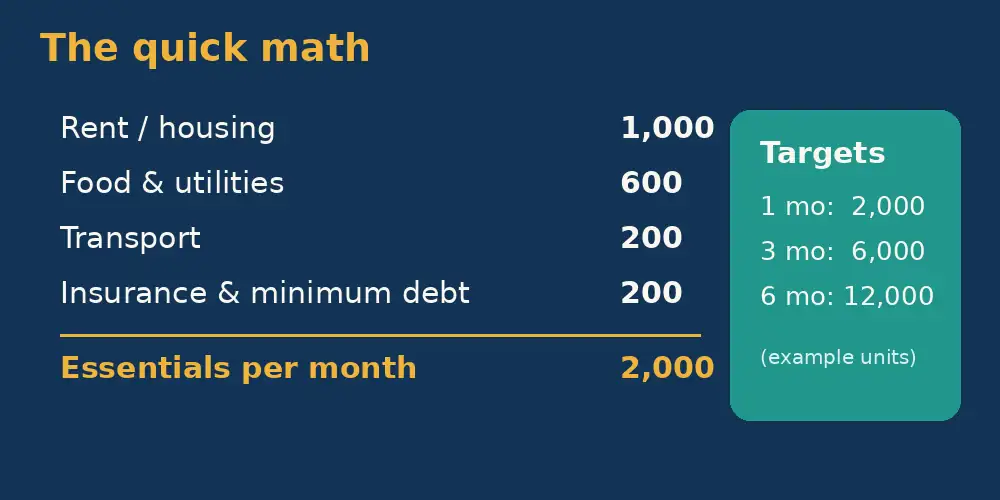
The most common guideline is to save three to six months of essential expenses. Essential means the costs you cannot skip: housing, utilities, groceries, transport to work, insurance and minimum debt payments. It does not mean your current lifestyle spending.
Step 1: Add up your monthly essentials
Open your last two or three months of bank and card statements and total only the non-negotiables. A simple example, in any currency:
| Essential expense | Monthly amount (example) |
|---|---|
| Rent or housing | 1,000 |
| Food and utilities | 600 |
| Transport | 200 |
| Insurance and minimum debt payments | 200 |
| Total essentials | 2,000 |
With essentials of 2,000 a month, one month is 2,000, three months is 6,000 and six months is 12,000. Seeing the real number turns a vague worry into a defined target.
Step 2: Pick the multiplier that fits your life
| Your situation | Suggested target |
|---|---|
| Stable salary, no dependants, shared expenses | 3 months |
| Single income household or dependants | 4 to 6 months |
| Freelancer, commission-based or seasonal income | 6 to 12 months |
| Specialised job that takes long to replace | 6 months or more |
If you work for yourself, the higher end is not excessive. Income that arrives unevenly needs a larger buffer to smooth out the quiet months.
How to Build an Emergency Fund From Scratch
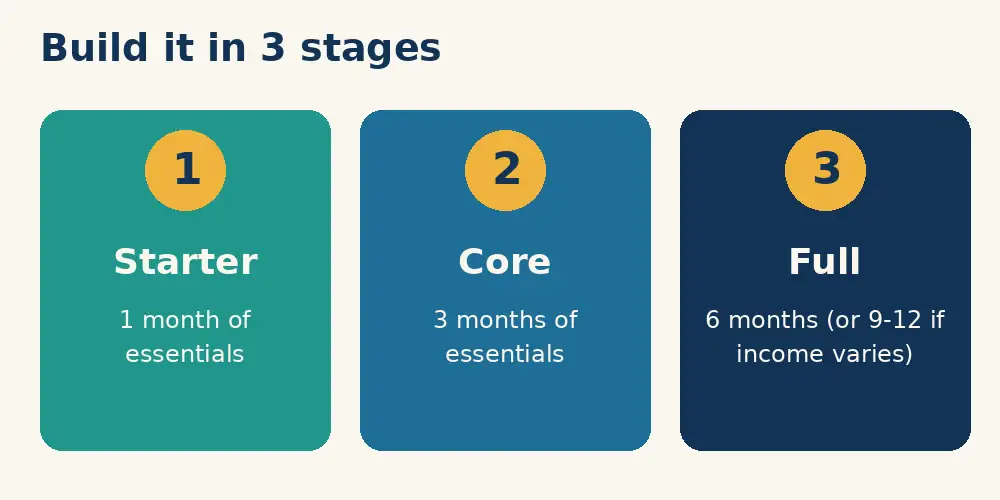
Six months of expenses can feel impossible at the start, so do not begin there. Build in stages and let each milestone be a win.
Stage 1: The starter fund (one month of essentials, or a small fixed amount)
If you have nothing saved, start with a modest, concrete goal. Many guides suggest a small starter amount first, because it covers the most common surprise costs and builds the habit. Even a few weeks of savings is a real buffer compared with none.
Stage 2: The core fund (three months)
Once the starter is in place, keep going until you reach three months of essentials. This is the level that gets most people through a typical job change or medical event.
Stage 3: The full fund (six months or more)
Move toward the full target if your income is irregular, you support others, or your field is volatile. When you reach the goal, stop adding and redirect that monthly amount to other goals.
7 Practical Ways to Fund It Faster
- Automate it on payday. Set a standing transfer that moves money out before you can spend it. Even a small amount counts. Consistency beats size.
- Run a subscription audit. Forgotten recurring payments are often the fastest source of savings. Our step-by-step subscription audit guide shows how to find and cancel them.
- Send windfalls straight to the fund. Tax refunds, bonuses, gifts and one-off payments can cover big chunks of your target in a single move.
- Use the 24-hour rule on non-essentials. Delay discretionary purchases for a day. Many of them lose their appeal, and the money goes to your fund instead.
- Sell what you no longer use. Unused electronics, furniture and equipment can turn into quick, one-time deposits.
- Add a side income for a defined period. A short-term project or extra shifts, with every rupee, dollar or pound of it going to the fund, can shorten the timeline dramatically.
- Round up and sweep. If your bank offers round-ups or automatic sweeps of leftover balances, use them. Tiny amounts add up quietly.
If you want a structured way to track spending while you save, our budgeting toolkit review covers one option for organising your numbers.
A realistic timeline
Suppose your target is 6,000 (three months of the example essentials). Saving 250 a month gets you there in 24 months. Add a 1,000 windfall and a trimmed subscription bill of 30 a month, and the timeline shortens by several months. You do not need to guess: divide your target by your monthly contribution to see the date, then adjust until it feels achievable.
Where Should You Keep Your Emergency Fund?
The ideal home for an emergency fund balances three things: safety, access and separation.
- Safety: choose an account protected by your country’s deposit protection scheme, where available. This is not the place for volatile assets.
- Access: you should be able to reach the money within a day or two, without penalties or waiting for a sale to settle.
- Separation: keep it apart from your everyday account so you are not tempted to dip in. A separate savings account, ideally at a different bank or with no linked debit card, adds helpful friction.
An interest-bearing savings account is usually enough. The goal is to protect the money from impulse and risk, not to chase returns. Compare options in your own country, since rates, fees and protections vary.
What to avoid
- Stocks, crypto or any asset that can fall just when you need the cash
- Locked deposits with heavy early-withdrawal penalties
- Money lent to friends or relatives that you may not get back quickly
Emergency Fund vs Paying Off Debt: Which Comes First?
This is one of the most searched questions in personal finance, and the honest answer is that both matter. A balanced approach works well for most people:
- Build a small starter fund first, so a surprise does not push you deeper into debt.
- Keep making minimum payments on all debts.
- Put extra money toward the highest-interest debt.
- Once debt is under control, grow the fund to your full target.
The starter fund is what keeps a car repair from undoing your debt progress. Without it, you risk a cycle of paying down and re-borrowing.
How to Protect and Rebuild Your Emergency Fund
Write your rules down
Decide in advance what qualifies as an emergency, using the lists above. A written rule is far harder to negotiate with than a feeling in the moment.
Use it without guilt, then refill it
The fund exists to be used. If a genuine emergency happens, spend what you need. Then make refilling it the top priority again until you are back to your target. If you notice self-blame creeping in, remember that using the fund as intended is success, not failure.
Review it once or twice a year
Your essential expenses change when your rent rises, your family grows or your job changes. Recalculate your target at least once a year so the fund keeps pace with your real life.
Common Emergency Fund Mistakes
- Waiting until you can save a lot. A small, regular amount beats a perfect plan you never start.
- Keeping it in your main account. Money you can see is money you spend.
- Counting credit as savings. A credit limit is borrowing, not a buffer.
- Setting the target from lifestyle spending. Base it on essentials, or the goal will feel out of reach.
- Treating it as an investment. Its return is peace of mind and avoided debt.
Frequently Asked Questions About Emergency Funds
How much should I have in an emergency fund?
A common guideline is three to six months of essential expenses. Freelancers and single-income households often aim for the upper end or beyond.
How do I start an emergency fund with no savings?
Begin with a small, concrete target, automate a modest transfer on payday, and direct any windfalls to it. The habit matters more than the starting amount.
Should I save in cash or invest my emergency fund?
Keep it in a safe, easily accessible savings account. Investments can drop in value exactly when you need the money.
Is it better to pay off debt or build an emergency fund first?
Most people do best with a small starter fund first, then paying down high-interest debt, then growing the fund to its full size.
How long does it take to build an emergency fund?
It depends on your target and monthly contribution. Divide the target by what you can save each month to estimate the timeline, then speed it up with windfalls and spending cuts.
What if I have to use my emergency fund?
That is what it is for. Cover the emergency, then rebuild the balance as your next financial priority.
Your Next Step
You do not need to finish this today. You only need to do one thing: calculate your monthly essentials and set up your first automatic transfer. Everything else builds from there, one small deposit at a time. A steady emergency fund will not make life predictable, but it will make you far harder to knock off course.
For more practical money habits, browse our Personal Finance and Budgeting and Saving guides.