
If you are searching for how to fall asleep faster, you are in good company. Lying awake while the clock moves toward morning is one of the most common and most frustrating experiences adults report. The good news is that falling asleep is partly a skill, and the habits that support it are well studied. Most of them cost nothing and can be started tonight.
This guide explains why sleep sometimes will not come, then walks through the habits with the strongest evidence behind them: a fixed wake time, smart caffeine timing, an evening wind-down, a cool dark bedroom and the “20-minute rule” used in cognitive behavioural therapy for insomnia. It ends with a simple 14-day reset plan, a sleep diary you can copy, and clear signs that it is time to talk to a doctor.
This article is general education, not medical advice. If sleep problems are severe, long-lasting or come with symptoms such as loud snoring, gasping at night or low mood, please speak to a qualified healthcare professional.
The Short Answer: How to Fall Asleep Faster Tonight
If you only have a minute, these are the habits most likely to help:
- Get up at the same time every day, including weekends.
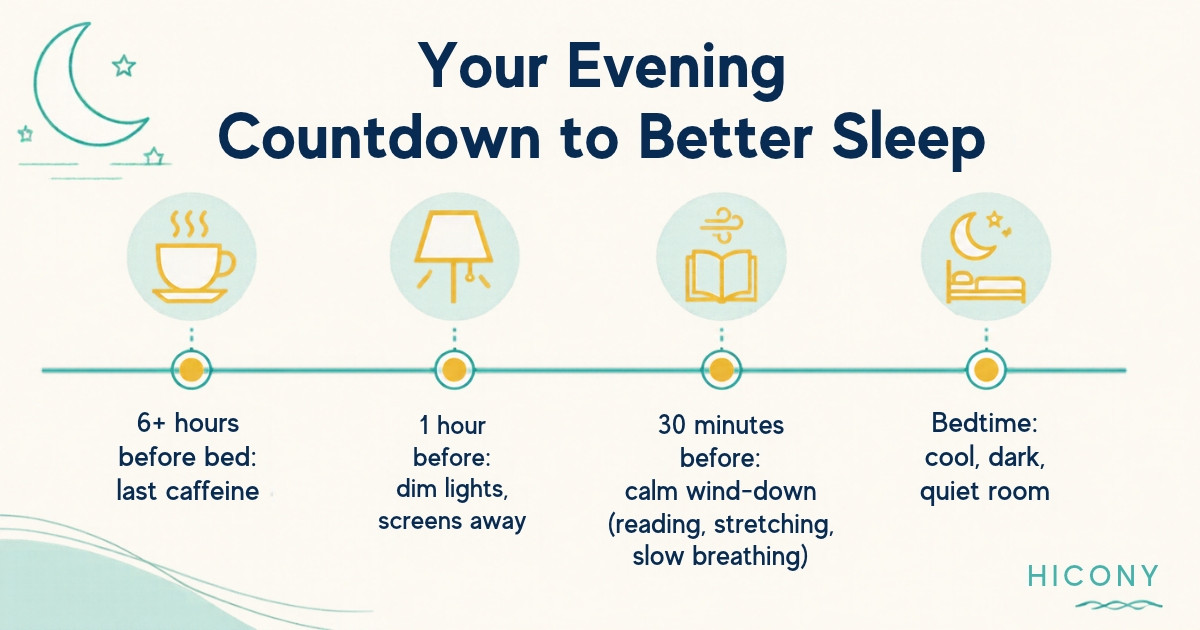
- Stop caffeine at least six hours before bed.
- Dim the lights and put screens away for the last hour of the day.
- Keep the bedroom cool, dark and quiet, and use the bed only for sleep.
- If you have been awake for roughly 20 minutes, get out of bed, do something calm in low light, and return only when you feel sleepy.
- Park your worries on paper earlier in the evening instead of in bed.
The rest of this guide explains each step, why it works and how to put it all together.
Why You Cannot Fall Asleep Even When You Are Tired
Feeling tired and being able to fall asleep are not the same thing. Three systems have to line up:
- Sleep pressure. The longer you have been awake, the stronger the drive to sleep becomes. Long naps, or lying in bed for many hours, can weaken it.
- Your body clock. A daily rhythm tells your body when to feel alert and when to wind down. Irregular schedules and bright light late in the evening can push it out of step.
- Mental and physical arousal. Stress, racing thoughts and stimulating activity keep the nervous system switched on, even when you are exhausted.
Many people also add a fourth problem on top: worrying about not sleeping. The more you try to force sleep, the more alert you become. Most of the habits below work by strengthening the first two systems and calming the third.
How Much Sleep Do You Actually Need?
For most adults, the recommendation is at least seven hours a night. The American Academy of Sleep Medicine and the Sleep Research Society advise that adults aged 18 to 60 sleep seven or more hours regularly for good health, and the US Centers for Disease Control and Prevention (CDC) uses the same threshold. The CDC reported that more than a third of US adults were getting less than that in a large national survey, and linked short sleep with higher risks of conditions such as obesity, diabetes, high blood pressure, heart disease and stroke. You can read the original summary in the CDC press release on healthy sleep duration.
These are population guidelines, not a personal prescription. What matters is that you wake up reasonably refreshed and function well during the day, not that you hit an exact number every night.
How to Fall Asleep Faster: 12 Habits That Work
1. Fix your wake-up time first
Most people focus on bedtime, but a consistent wake time is the stronger anchor. Getting up at the same time every day, even after a poor night, steadies your body clock and builds sleep pressure for the following night. Sleep specialists who teach CBT-I consistently treat a regular out-of-bed time as a core rule, and the CDC likewise advises going to bed and rising at the same times each day.
2. Get daylight and move your body
Light early in the day helps your body clock know when morning is, and regular physical activity is part of standard sleep education for people with insomnia. Aim for some outdoor light after waking and some movement during the day. Intense exercise very close to bedtime can leave some people feeling too wired, so notice how your own body responds.
3. Set a caffeine cut-off
Caffeine has a long reach. In a controlled study published in the Journal of Clinical Sleep Medicine, researchers gave 12 healthy adults 400 mg of caffeine (roughly two to three cups of coffee) at bedtime, three hours before and six hours before. Even the dose taken six hours before bed cut total sleep time by more than an hour, and participants often did not notice the effect. The American Academy of Sleep Medicine summarises the findings on its patient site, Sleep Education. The practical takeaway is to keep your last coffee, strong tea, energy drink or cola well before the evening, and to remember that chocolate and some medicines contain caffeine too.
4. Be careful with alcohol
A drink may make you feel drowsy, but alcohol tends to fragment sleep later in the night. Standard sleep education for insomnia advises limiting alcohol, especially close to bedtime. If you are struggling with sleep, cutting back is a simple experiment to run for a couple of weeks.
5. Build a 30 to 60 minute wind-down
Your brain cannot switch from full alert to sleep instantly. A predictable wind-down tells it that the day is ending. Dim the lights, finish demanding tasks, and choose calm activities: gentle stretching, a warm shower, reading something light, quiet music or a hobby that does not involve a bright screen.
6. Keep screens and devices out of the bedroom
The CDC specifically recommends turning off or removing televisions, computers and mobile devices from the bedroom. Beyond light, the issue is stimulation: messages, news and videos keep your mind engaged. Charge your phone across the room and use a basic alarm clock if you can. If you want a gentler approach to reducing screen time overall, see our guide to what a digital detox is and whether it really helps.
7. Make the bedroom cool, dark and quiet
The CDC advises a sleep environment that is quiet, dark and not too hot or too cold. Practical fixes include blackout curtains or an eye mask, earplugs or a steady background fan, breathable bedding and a slightly cool room. You do not need expensive gadgets to get most of the benefit.
8. Use your bed only for sleep
This is the heart of stimulus control, one of the most important parts of CBT-I. If you work, scroll or watch television in bed, your brain starts linking the bed with wakefulness. Reserve the bed for sleep (and intimacy), and take other activities elsewhere.
9. Use the 20-minute rule
If you have been lying awake for what feels like about 20 minutes, get out of bed. Go to another room, keep the light low and do something calm, such as reading a paper book or gentle stretching. Return to bed only when you feel sleepy. Repeat as often as needed, and keep your morning wake time the same. Clinical guidance for CBT-I recommends judging the time by feel rather than watching the clock, because clock-watching raises frustration. The Cleveland Clinic lists the same stimulus-control steps in its overview of cognitive behavioural therapy for insomnia.
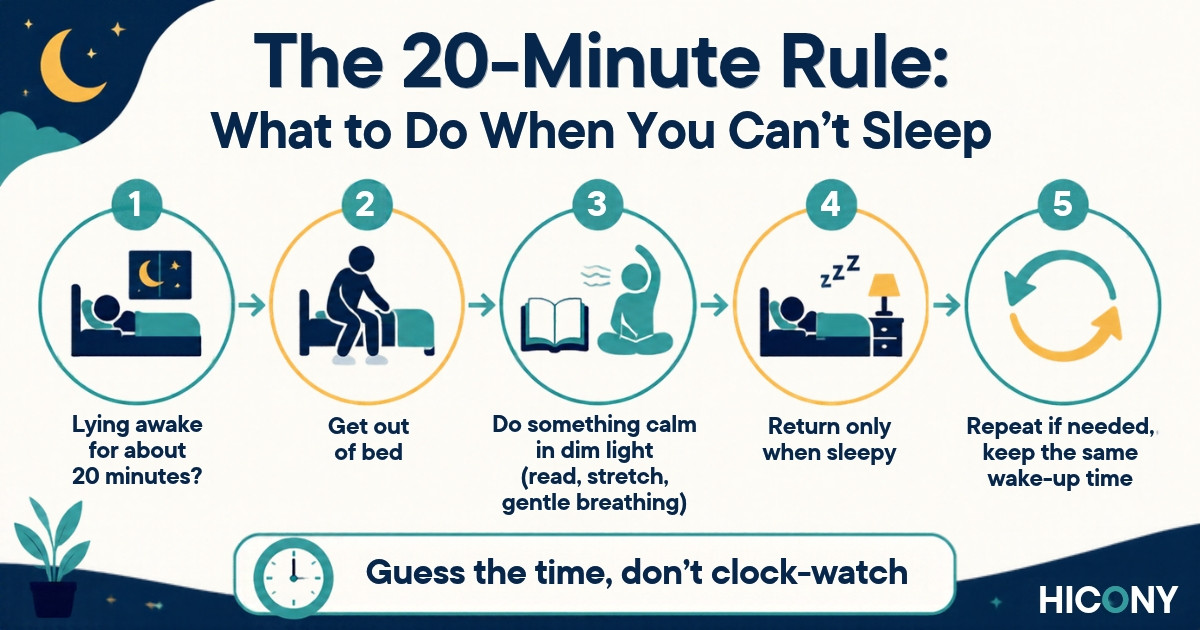
10. Stop checking the clock
Turn the clock face away or cover it. Calculating how many hours you have left is a reliable way to raise anxiety and make sleep harder.
11. Give your worries a time slot
Racing thoughts are one of the biggest barriers to falling asleep. A common CBT-I technique is “constructive worry time”: earlier in the evening, spend ten to fifteen minutes writing down what is on your mind and one next step for each item. When worries appear in bed, remind yourself they are already on the list. If you often replay decisions at night, our guide on how to stop second-guessing yourself may help.
12. Try a relaxation technique
Relaxation training is a recognised part of CBT-I. Two simple options are:
- Slow breathing: breathe in gently through your nose, then breathe out a little more slowly than you breathed in, for a few minutes.
- Progressive muscle relaxation: tense each muscle group for a few seconds, then release, moving from your feet to your face.
If stress is a regular driver of poor sleep, calming daytime habits can also help. Our article on gardening for stress relief is one gentle example.
Sleep Myths That Make It Harder to Fall Asleep
| Common belief | What helps more |
|---|---|
| “I must get exactly eight hours.” | Aim for at least seven, and judge by how you function in the day. |
| “If I stay in bed, at least I am resting.” | Lying awake for long periods trains your brain to be awake in bed. Use the 20-minute rule. |
| “A nightcap helps me sleep.” | Alcohol can fragment sleep later in the night. |
| “I will catch up with a long nap.” | Long or late naps reduce sleep pressure. Keep naps short and early, or skip them while you reset. |
| “One bad night ruins tomorrow.” | Most people cope better than they fear. Worrying about it makes sleep harder. |
Your 14-Day Plan to Fall Asleep Faster
Changing everything at once is hard. This plan adds a few habits at a time so you can notice what works for you.
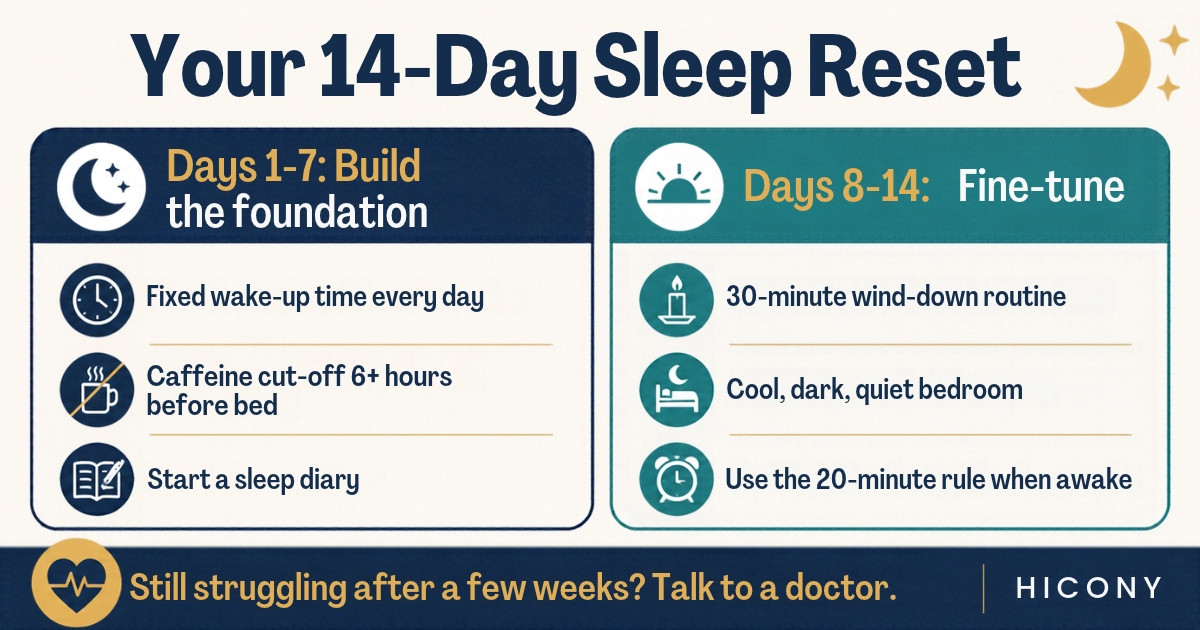
Days 1 to 7: build the foundation
| Day | Focus |
|---|---|
| 1 | Choose a fixed wake-up time you can keep every day. Start your sleep diary (template below). |
| 2 | Set a caffeine cut-off at least six hours before your usual bedtime. |
| 3 | Get outdoor light soon after waking and take a short walk. |
| 4 | Move your phone charger out of the bedroom. |
| 5 | Skip alcohol close to bedtime and keep any nap short and early. |
| 6 | Do a ten-minute “worry list” in the early evening. |
| 7 | Review your diary. Note which nights went better and what was different. |
Days 8 to 14: fine-tune
| Day | Focus |
|---|---|
| 8 | Start a 30-minute wind-down: dim lights, no demanding tasks. |
| 9 | Make the bedroom cooler, darker and quieter. |
| 10 | Go to bed only when you feel sleepy. Keep the same wake time. |
| 11 | Practise slow breathing or muscle relaxation for five minutes. |
| 12 | Use the 20-minute rule if you are awake in bed. Plan what you will do in the other room. |
| 13 | Remove the clock from view. |
| 14 | Review your diary. Keep what helped and drop what did not. |
Give the plan a fair trial. Sleep habits often take a couple of weeks to settle, and some nights will still be rough. That is normal.
A Simple Sleep Diary You Can Copy
A sleep diary turns guesses into data and is a standard first step in CBT-I. Each morning, write down:
| Item | Example |
|---|---|
| Time you got into bed | 10:45 pm |
| Roughly how long it took to fall asleep | 40 minutes |
| Night waking and how long awake | Twice, about 20 minutes total |
| Wake-up time and time out of bed | 6:30 am / 6:40 am |
| Caffeine, alcohol and naps | Last coffee 1 pm, no alcohol, no nap |
| How you feel during the day (1 to 5) | 3 |
What About Sleep Aids, Pills and Supplements?
It is natural to look for a quick fix, but the evidence points elsewhere for long-term problems. The American College of Physicians recommends cognitive behavioural therapy for insomnia as the initial treatment for all adults with chronic insomnia, and suggests that medication be considered only after discussion with a clinician, mainly for short-term use if CBT-I alone has not worked. Details are in the ACP clinical practice guideline. Over-the-counter sleep products and supplements vary in quality and may interact with medicines or conditions, so check with a pharmacist or doctor before using them, especially if you are pregnant, take other medication or have a health condition.
When Self-Help Is Not Enough: CBT-I
CBT-I is a structured programme that combines education, stimulus control, sleep scheduling, relaxation and work on unhelpful sleep-related thoughts. The American College of Physicians notes that it can be delivered in person, by phone, through web-based programmes or apps, and through self-help books. One component, sleep restriction, temporarily limits time in bed to build sleep pressure. It can cause daytime sleepiness at first and is not suitable for everyone, so it is best done with guidance from a trained clinician rather than as a DIY experiment.
When to See a Doctor
Make an appointment if you notice any of the following:
- Trouble sleeping at least three nights a week for three months or longer, which is the usual benchmark for chronic insomnia
- Loud snoring, choking or gasping at night, or pauses in breathing noticed by a partner (possible signs of sleep apnoea)
- Strong urges to move your legs in the evening, or uncomfortable leg sensations that keep you awake
- Severe daytime sleepiness, especially while driving
- Low mood, persistent anxiety or worries about your mental health alongside poor sleep
- Sleep problems that began after a new medication, injury or illness
Sleep problems often have treatable causes, and getting help early can save weeks of frustration.
Frequently Asked Questions About Falling Asleep
How long should it take to fall asleep?
Many sleep clinicians treat roughly 30 minutes or less as a reasonable target for falling asleep. Taking a little longer on occasional nights is normal. If it regularly takes much longer, track it in a diary and consider speaking to a doctor.
What is the fastest way to fall asleep?
There is no instant switch, but the combination of a regular wake time, a caffeine cut-off, dim lights, a calm wind-down and a cool, dark bedroom gives the best chance of falling asleep quickly. A relaxation exercise such as slow breathing can help in the moment.
Should I stay in bed if I cannot sleep?
If you have been awake for about 20 minutes and feel frustrated, CBT-I guidance suggests getting up, doing something calm in low light, and returning when sleepy.
Does it help to go to bed earlier?
Not always. Going to bed before you feel sleepy can mean more time awake in bed. Fixing your wake time and going to bed when sleepy is usually more effective.
Is it bad to nap?
Short, early naps are fine for many people, but long or late naps can make it harder to fall asleep that night. If you are working on a sleep problem, it is often recommended to avoid napping for a while.
Why do I wake up in the middle of the night?
Brief awakenings are a normal part of sleep. Stress, alcohol, caffeine, noise, temperature, medical conditions and sleep apnoea can make them longer or more frequent. If night waking is frequent or comes with snoring or daytime exhaustion, see a doctor.
Can I fix my sleep in a few days?
Some people notice improvement within a week or two of consistent changes, but many need longer. Aim for steady habits rather than overnight results.
Do I need a sleep tracker?
No. A simple paper diary is enough. Trackers can be interesting, but for some people the numbers create extra worry and make sleep harder.
Sources and Further Reading
- Centers for Disease Control and Prevention: 1 in 3 adults don’t get enough sleep
- American Academy of Sleep Medicine: Late afternoon and early evening caffeine can disrupt sleep, summarising Drake et al., Journal of Clinical Sleep Medicine, 2013
- American College of Physicians: Management of chronic insomnia disorder in adults, Annals of Internal Medicine, 2016
- Cleveland Clinic: Cognitive behavioral therapy for insomnia (CBT-I)
Your Next Step
Do not try to fix everything tonight. Choose one habit, probably your wake-up time or your caffeine cut-off, and keep it for the next seven days while you fill in your diary. Small, consistent changes beat dramatic ones. If you want to look at how energy and focus rise and fall across the day, read our piece on working with the 90-minute rule, and browse more guides in the Wellness category.