
If you have ever bought a nice notebook, written two pages, and then never touched it again, you are not alone. Most people who want to learn how to start journaling get stuck for the same few reasons: they do not know what to write, they feel they have to do it “properly”, or they quit after missing a few days.
Here is the good news. Journaling does not need nice handwriting, a perfect routine or a deep life story. It needs about ten minutes, a pen or a keyboard, and a simple way to begin. This guide gives you exactly that: what journaling is, what research does (and does not) say about it, five methods to choose from, a 10-minute template, 30 prompts and a gentle seven-day plan.
A quick note: journaling is a helpful habit for many people, but it is not a substitute for professional care. If you are dealing with serious distress, please talk to a doctor, therapist or someone you trust.
What Is Journaling, Exactly?
Journaling is the habit of writing down your thoughts, feelings, experiences or plans on a regular basis. That is all. It can be a few lines on your phone, a page in a paper notebook or a long, messy brain dump at the end of a hard day.
It is different from a diary only in spirit. A diary often records what happened. A journal can also explore what you think about what happened, what you want next and what you notice about yourself. That is why journaling is such a useful tool for building self-awareness: when you put a thought on the page, you can look at it instead of living inside it.
Does Journaling Actually Work? What the Research Says
Journaling is popular online, so it is worth being honest about the evidence. The most studied form is called expressive writing. In the classic version, people write about a stressful or emotional experience for about 15 to 20 minutes, on three to five occasions, often on consecutive days. A well-known review by Karen Baikie and Kay Wilhelm in Advances in Psychiatric Treatment found that people who did this often showed better physical and psychological outcomes than people who wrote about neutral topics, although the emotional benefits were less consistent than the physical ones. You can read the paper here: Emotional and physical health benefits of expressive writing.
The picture is not simple, though. The Greater Good Science Center at UC Berkeley, which publishes a short guide to the exercise, notes that some studies found no changes in health after a few days of expressive writing, and that results can vary with personality, culture and circumstances. You can see their summary on the Greater Good in Action page on expressive writing.
So the honest takeaway is this: journaling is a low-cost, low-risk habit that helps many people think more clearly and feel a little lighter, but it is not a magic fix, and it works better for some people than others. Treat it as an experiment, not a promise.
The Benefits People Commonly Notice
- A calmer mind. Getting thoughts out of your head and onto paper can make them feel smaller and more manageable. If your mind feels crowded, our guide to clearing mental clutter pairs well with a journal.
- Better self-knowledge. Over a few weeks, patterns appear: what drains you, what energises you, what keeps coming up.
- Clearer decisions. Writing out a problem often shows you which option you already lean toward.
- A healthier inner voice. Seeing your harsh thoughts in black and white makes them easier to question. See our practical system for changing negative self-talk.
- A record of progress. It is easy to forget how far you have come. A journal remembers for you.
Before You Begin: Choose Paper or Digital
There is no right answer. Pick the one you will actually use.
| Option | Why it works | Watch out for |
|---|---|---|
| Paper notebook | Slower, fewer distractions, feels personal | Harder to search, others could read it |
| Notes app or document | Always with you, searchable, easy to type fast | Notifications and other apps nearby |
| Journaling app | Reminders, prompts, streaks | Check the privacy policy; streaks can create pressure |
If privacy worries you, choose a lock, a password or a place only you use. You can also write freely and delete or tear out pages afterwards. The writing helped even if nobody ever reads it.
5 Journaling Methods for Beginners
You do not have to pick one forever. Try each for a few days and keep the one that feels easiest.
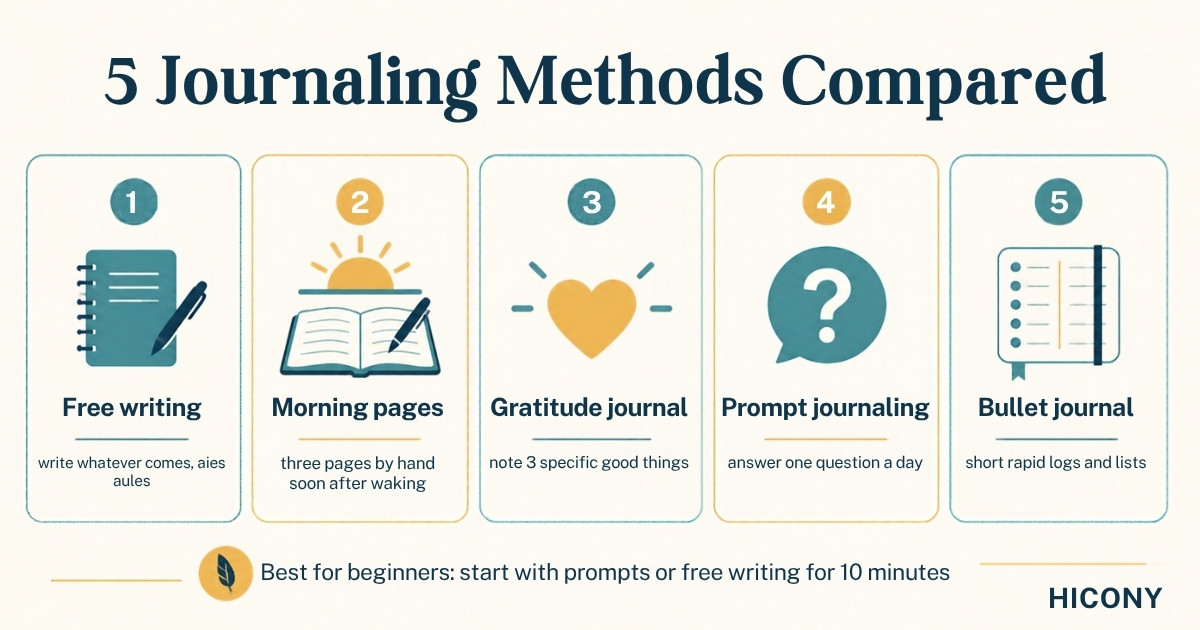
1. Free writing
Set a timer for ten minutes and write whatever comes to mind. Do not stop to edit, fix spelling or make sense. If you get stuck, write “I do not know what to write” until something else appears. It sounds silly, and it works more often than you would expect.
Best for: clearing your head, busy minds, people who like no rules.
2. Morning pages
Made popular by Julia Cameron in her book The Artist’s Way, morning pages mean writing three pages by hand, first thing in the morning, about anything at all. It takes longer than most beginners can manage, so you can start with one page.
Best for: creative people and anyone who wants a daily reset before the day begins.
3. Gratitude journaling
Each day, write down three specific good things. “My neighbour waved and asked about my week” is better than “family”. Specific details make you actually notice them. If you want ideas, see our simple gratitude journal prompts.
Best for: people who want a short, positive habit that takes five minutes.
4. Prompt journaling
Instead of a blank page, you answer one question: “What has been taking up the most space in my head this week?” Prompts remove the hardest part of journaling, which is deciding where to start. You will find 30 below.
Best for: beginners and anyone who says “I never know what to write.”
5. Bullet journaling
Created by designer Ryder Carroll, the Bullet Journal method uses short bullet points, symbols and lists to track tasks, events and notes. It sits somewhere between a planner and a diary, and you can add a small “reflection” line at the end of each day.
Best for: list lovers who find long writing intimidating.
A Simple 10-Minute Journaling Routine
If you only remember one thing from this guide, make it this template. It gives your session a gentle shape without becoming a rulebook.
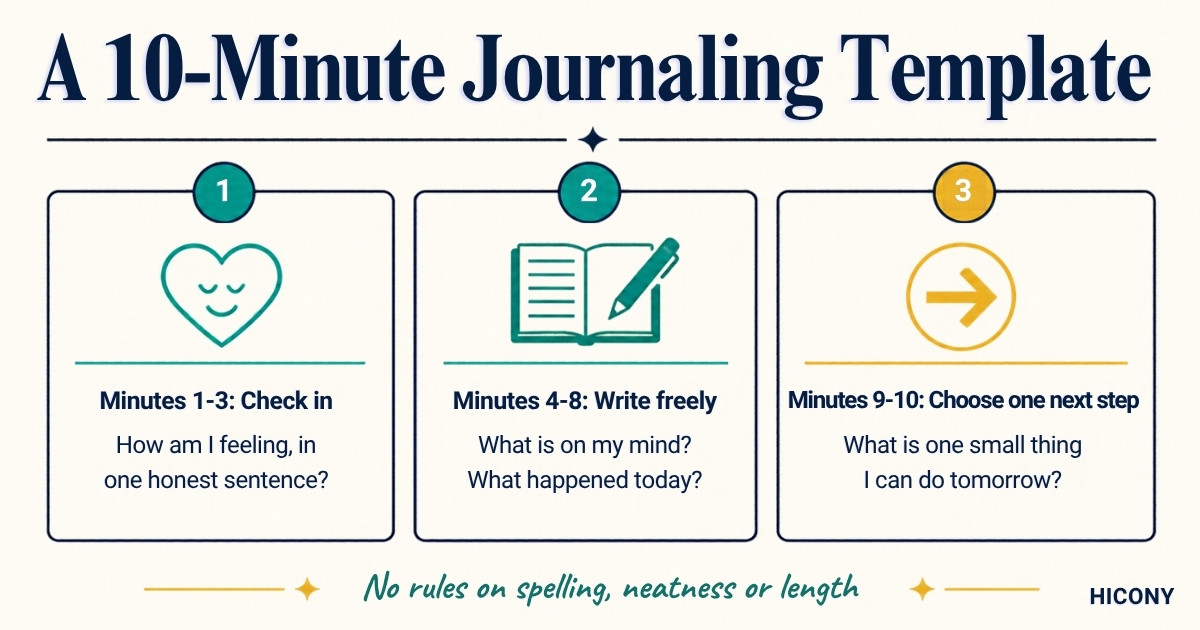
- Minutes 1 to 3: Check in. Write one honest sentence about how you feel right now. “Tired and a bit anxious about tomorrow” is perfect.
- Minutes 4 to 8: Write freely. What is on your mind? What happened today? Let it wander.
- Minutes 9 to 10: Choose one next step. Finish with a single small action you can take tomorrow. This turns reflection into something useful.
There are no rules about spelling, neatness or length. A messy page you wrote beats a perfect page you never started.
30 Journaling Prompts for Beginners
Pick one prompt, set a timer and begin. You do not have to answer in full sentences.
To clear your head
- What is taking up the most space in my mind right now?
- What am I trying to control that I cannot?
- If I could put one worry down for a day, which would it be?
- What is one thing I keep putting off, and what is the real reason?
- What do I need to say that I have not said?
To understand yourself better
- When did I feel most like myself this week?
- What drained my energy today? What gave me energy?
- Which of my reactions today surprised me?
- What do I believe about myself that may not be fully true?
- What am I proud of that nobody knows about?
To handle hard feelings
- What am I feeling, and where do I feel it in my body?
- If a friend described my situation, what would I tell them?
- What is one thing about this situation I can influence?
- What would help me feel 5 percent better today?
- What do I need to forgive, in myself or someone else?
To build gratitude and joy
- What are three small things that went well today?
- Who made my life easier recently, and how could I thank them?
- What ordinary moment did I enjoy this week?
- What is something I am looking forward to?
- What is a simple pleasure I should make more time for?
To set direction
- What would a really good week look like for me?
- Which values do I want to live by, and where did I act on them today?
- What is one habit I want to start, and what is the smallest version of it?
- What would I do if I were not afraid of looking foolish?
- What do I want to remember about this season of my life?
For decisions and relationships
- What are my options, and what does my gut say?
- If I knew I could not fail, what would I choose?
- What boundary do I need to set or protect?
- Who do I feel most at ease with, and why?
- What did I learn this week that I want to carry into the next one?
If decisions keep looping in your head, our guide to how to stop second-guessing yourself shows how to review a choice without overthinking it.
Your First 7 Days of Journaling
Starting small is the secret. Here is a one-week plan that takes about ten minutes a day.
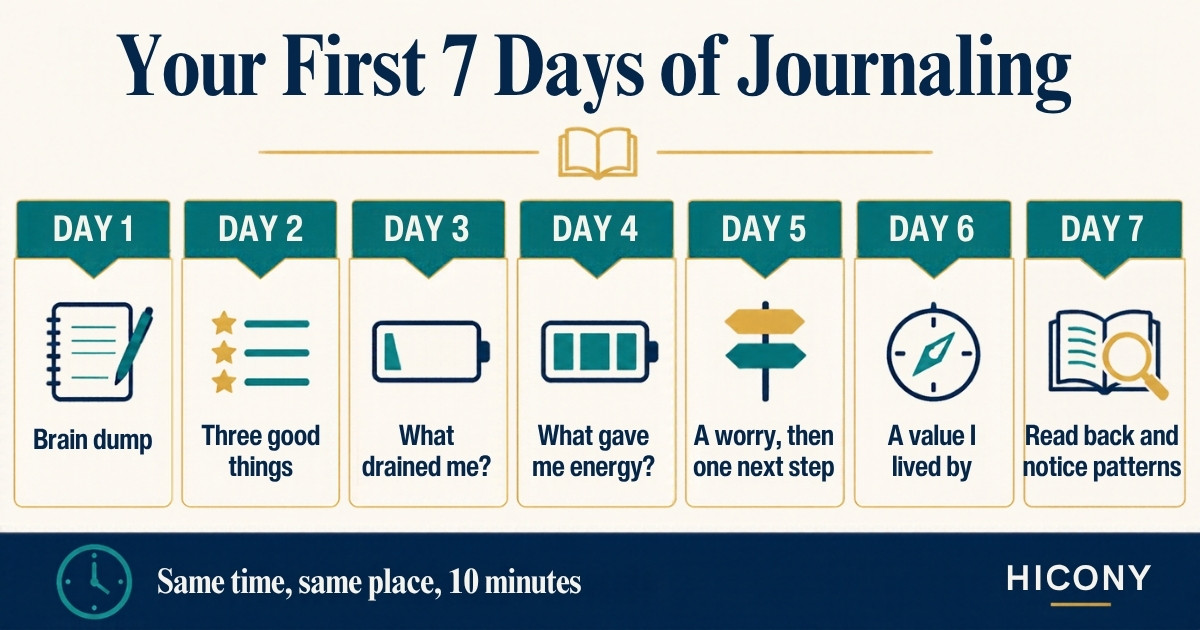
| Day | What to write |
|---|---|
| 1 | Brain dump. Write whatever is in your head. |
| 2 | Three good things from today, with one detail each. |
| 3 | What drained me today? |
| 4 | What gave me energy today? |
| 5 | One worry, then one small next step. |
| 6 | A value I lived by, or wish I had. |
| 7 | Read back over the week. What patterns do you notice? |
Day 7 is the one most people skip, and it is where the magic often happens. Reading your own words from a few days ago shows you things you cannot see in the moment.
How to Make Journaling a Habit That Sticks
- Attach it to something you already do. After your morning coffee or just before you brush your teeth. A fixed cue beats a vague intention. If mornings are your thing, the Slow Morning Method already includes a few written lines.
- Start embarrassingly small. Two minutes is enough on busy days. The aim is to keep showing up.
- Keep the notebook visible. Put it on your pillow, desk or kitchen table. If you use a phone, pin the notes app to your home screen.
- Do not break the habit with guilt. Missed three days? Pick up on day four. A journal has no deadlines.
- Do not reread everything straight away. Wait a week or two. Early rereading often invites self-criticism.
- Be kind on the page. If your writing turns harsh, write the way you would speak to a friend.
Common Problems and Simple Fixes
| Problem | Try this |
|---|---|
| “I do not know what to write.” | Use a prompt, or write “Today I feel…” and finish the sentence five different ways. |
| “My writing is boring.” | A journal is for you, not an audience. Boring pages still do their job. |
| “I only write when I am upset.” | That is common. Add a few lines of gratitude or good moments so the journal is not only a place for bad days. |
| “I am afraid someone will read it.” | Choose a private app, a lock or a hiding spot, or write and shred. |
| “I keep forgetting.” | Set a phone reminder and link it to an existing routine. |
| “It makes me ruminate.” | Limit the session to ten minutes and always end with one next step or one good thing. |
A Gentle Warning About Difficult Topics
Writing about painful experiences can stir up strong feelings, especially at the beginning. Researchers who study expressive writing note that people sometimes feel worse for a short time before they feel better. That is normal, but it should not feel overwhelming. If you feel distressed, stop, take a few slow breaths, look around the room and name five things you can see. You can come back to the topic another day, or work on it with a therapist. If journaling regularly leaves you feeling worse, or you are struggling with thoughts of harming yourself, please contact a mental health professional or a local emergency or crisis service.
Journaling can also help you wind down in the evening. If racing thoughts keep you awake, try a short “worry list” earlier in the evening, as described in our guide on how to fall asleep faster.
Frequently Asked Questions About Journaling
How often should I journal?
Daily is nice, but not required. Three to five times a week still gives you a strong habit. Consistency matters more than length.
How long should a journal entry be?
Ten minutes is a good starting point. Some days it will be two lines, other days three pages. Both are fine.
What time of day is best for journaling?
The best time is the one you will keep. Mornings suit people who want to set intentions. Evenings suit people who want to unload the day. Some people do both with two short entries.
Is it better to journal by hand or on a computer?
Both work. Handwriting is slower and can feel more reflective, while typing is faster and easier to search. Choose what feels natural.
Can journaling help with anxiety or stress?
Many people find that writing helps them sort through worries and feel calmer, but it is not a treatment for anxiety disorders or depression. If you are struggling, speak to a healthcare professional alongside any self-help habits.
What should I write if nothing interesting happened?
Write about the small stuff: what you ate, who you talked to, what you noticed, how your body felt. Ordinary days still show you patterns.
Should I reread my old entries?
Occasionally, yes. A monthly or quarterly reread can reveal patterns and progress. Go in with curiosity, not judgement.
What if I stop for weeks and then want to restart?
Simply begin again. Do not write a long catch-up entry. Start with today’s date and one honest sentence.
Your Next Step
You do not need the perfect notebook or the perfect plan. Tonight, set a timer for ten minutes, pick one prompt from the list above and write until the timer ends. That is journaling. Tomorrow, do it again. After a week, read back over what you wrote and see what you notice about yourself.
For more practical guides on knowing yourself and handling your thoughts, browse our Self Awareness articles.
Sources and Further Reading
- Baikie, K. A. and Wilhelm, K. (2005). Emotional and physical health benefits of expressive writing. Advances in Psychiatric Treatment, 11(5), 338 to 346.
- Greater Good Science Center, UC Berkeley: Expressive writing.