
You already know the feeling. Someone asks for a favour, an invitation lands in your inbox, or your manager adds “just one more thing” to your plate. Your head says no. Your mouth says, “Sure, no problem.” And then comes the guilt, followed by the resentment.
If you want to know how to say no without feeling guilty, the short answer is this: a good no is short, kind and clear, and the guilt gets smaller every time you practise it. You do not need a perfect excuse, a long apology or a thick skin. You need a few simple phrases and a little practice.
This guide gives you a four-step method, the psychology behind the guilt, more than 40 word-for-word scripts for work, friends, family and partners, and ways to handle people who push back.
The Short Answer: A 4-Step Way to Say No
- Pause. Do not answer on the spot. “Let me check and get back to you” buys you time.
- Appreciate. Thank them for thinking of you, if it feels true.
- Decline clearly. Say the no in plain words, such as “I can’t take this on.”
- Offer something, only if you want to. A smaller favour, a later date or another person who might help.
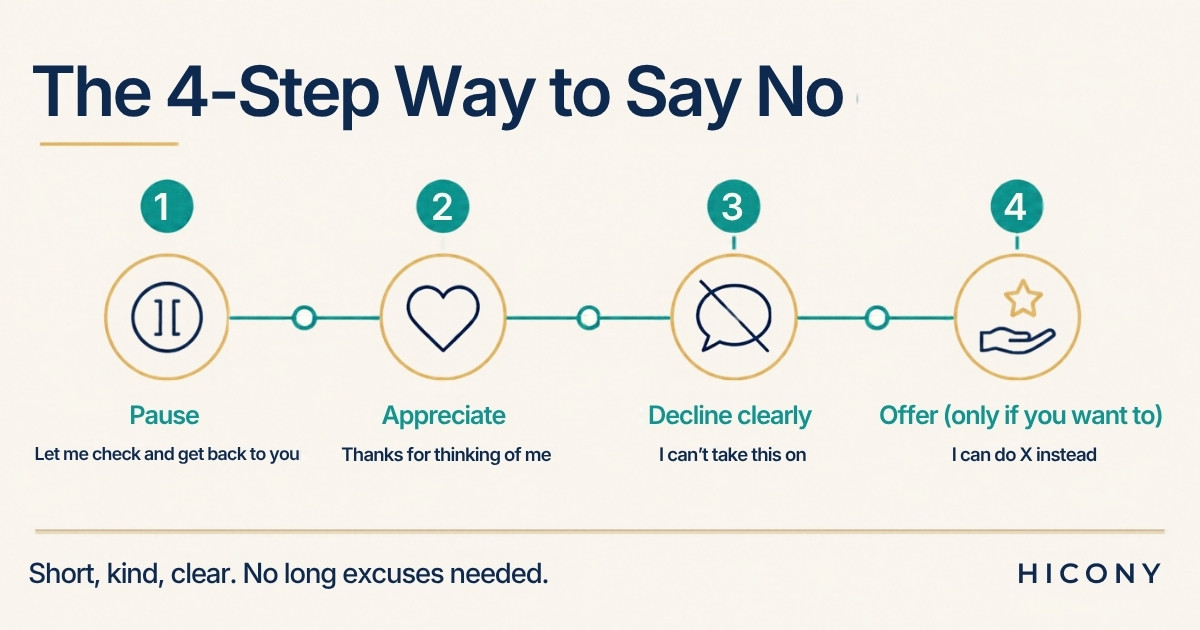
Everything else in this article is about making those four steps feel natural.
Why Saying No Feels So Hard
Saying no feels risky because we are social creatures. We worry that a refusal will disappoint someone, damage a relationship or make us look selfish. A few common patterns make it worse:
- People-pleasing. You feel responsible for other people’s happiness, so a no feels like a failure on your part.
- Fear of conflict. Agreeing feels easier in the moment, even if it costs you later.
- Wanting to be seen as helpful or reliable. This is common at work, especially with a boss or in a new job.
- Not knowing what to say. Many people simply have not practised a clean way to decline.
- Family or cultural expectations. In some families and communities, refusing an elder or a relative can feel disrespectful.
The cost of always saying yes is real. The Mayo Clinic notes that a passive style, where you routinely say yes when you want to say no, can lead to stress, resentment and doubting your own judgment, and that being assertive can help reduce stress, especially if you tend to take on too many responsibilities. You can read their overview here: Being assertive: Reduce stress, communicate better.
Is the Guilt Telling You Something? A Quick Check
Guilt is an uncomfortable feeling, but it is not always a signal that you are doing something wrong. Sometimes it simply means you are disappointing someone, which is different from harming them. Before you say yes out of guilt, ask yourself:
- Do I actually have the time, energy or money for this?
- Is this really mine to do, or am I rescuing someone from a problem they can solve?
- Will I resent this later? If yes, a kind no now is better than a bitter yes later.
- What will I be saying no to if I say yes? Every yes takes time from something else.
- Is it an emergency or a real obligation? If someone truly needs help and you can give it, saying yes may be right. That is a choice, not guilt.
If you tend to judge yourself harshly after any refusal, our guide to stopping negative self-talk can help you answer that inner critic.
How to Say No Without Feeling Guilty: The 4 Steps in Detail
Step 1: Pause before you answer
Most automatic yeses happen in the first few seconds, when someone is looking at you hopefully. A short pause breaks that reflex. You can say:
- “Let me check my calendar and get back to you.”
- “I need to think about that. Can I answer tomorrow?”
- “I will have to see what else is on my plate.”
Be honest, though. Only use “let me think” if you will genuinely think. If you already know it is a no, say so, because a drawn-out maybe is unkind to the other person.
Step 2: Appreciate the request
A little warmth softens the message without weakening it. Keep it genuine:
- “Thanks for thinking of me.”
- “I am glad you asked.”
- “That sounds like a great event.”
Step 3: Decline clearly
This is the heart of the message. Use simple words and avoid hedges such as “I guess”, “maybe” or “I will try”. The Mayo Clinic advises using “I” statements, which lets you share your position without sounding accusatory. For example:
- “I can’t take that on.”
- “That doesn’t work for me this time.”
- “I’m not able to help with that.”
You do not have to give a reason. If you do, keep it brief and true. Long explanations invite negotiation, because each reason can be argued with.
Step 4: Offer an alternative, only if you want to
An alternative can keep the relationship warm, but it is optional. Never offer something you do not want to do just to feel better about the no.
- “I can’t do the whole project, but I can review the first draft.”
- “Not this weekend, but I would love to meet next month.”
- “I am not the right person for this, but Sam might be.”
Say This, Not That
The difference between a clear no and a messy one is often just the wording.
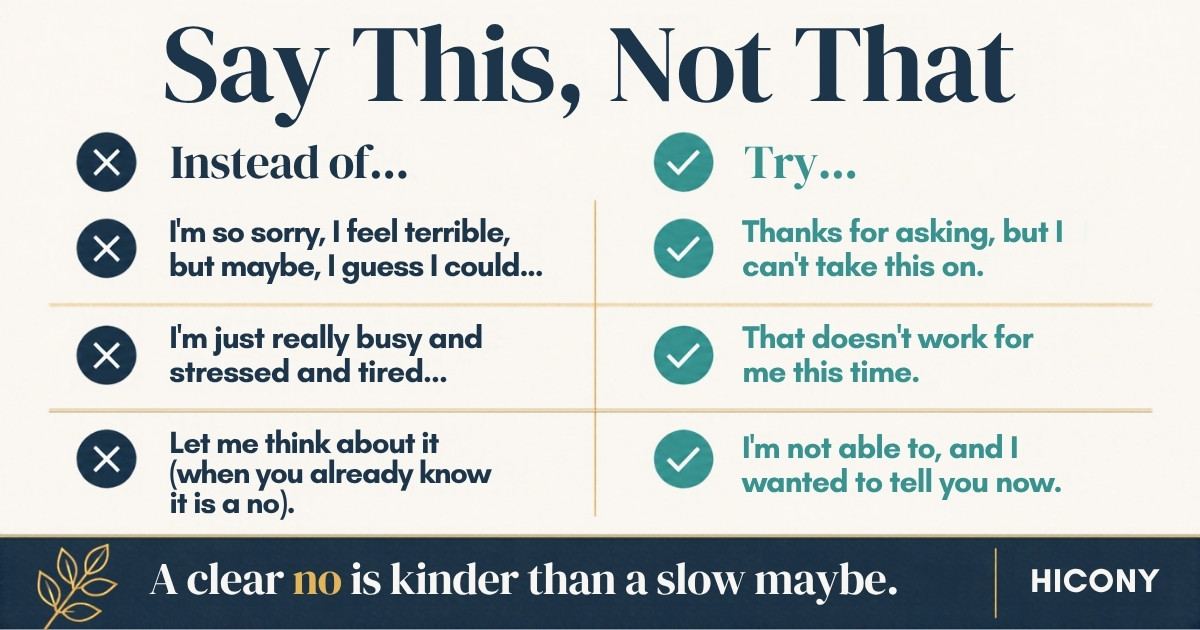
| Instead of this | Try this |
|---|---|
| “I am so sorry, I feel terrible, but maybe I could try…” | “Thanks for asking, but I can’t take this on.” |
| “I’m just really busy, stressed and tired right now…” | “That doesn’t work for me this time.” |
| “Let me think about it” (when you already know) | “I’ve thought about it, and I’m going to pass.” |
| “I guess I might be free, but I will see.” | “I’m not able to make it, but thank you for the invite.” |
| Ignoring the message and hoping it goes away | A short, kind reply as soon as you know |
A clear no is kinder than a slow maybe. It lets the other person find another solution quickly.
“I Don’t” or “I Can’t”? What Research Says About Wording
Researchers Vanessa Patrick and Henrik Hagtvedt studied how the words we use when refusing something affect us. In their work on resisting temptation, people who said “I don’t” (for example, “I don’t eat sweets”) reported feeling more in control and kept up their goals better than those who said “I can’t”. A follow-up paper found that “I don’t” was also more persuasive when refusing someone else, because it signals conviction. You can read the original study here: “I Don’t” versus “I Can’t”: When Empowered Refusal Motivates Goal-Directed Behavior.
How can you use this? “I don’t” works best for standing rules and values: “I don’t check work email in the evenings.” “I don’t lend money to friends.” For a one-off, honest “I can’t” is often more natural and true: “I can’t make Saturday.” Use whichever is accurate. The point is to speak with calm conviction rather than apology.
45 Scripts for Saying No in Real Life
Copy them, change a few words and make them sound like you.
At work: saying no to your manager
- “I want to do this well. To take it on, I would need to move X. Which would you like me to prioritise?”
- “I am at capacity this week. I can start on it Monday, or we could reassign something.”
- “I can’t take this on and still meet the deadline for Y. What matters most?”
- “I can help with part of this. I can do A, but not B.”
- “Thanks for trusting me with this. I need to pass this time so I can give my current projects the attention they need.”
With a boss, a flat no can feel risky. A “trade-off” reply shows you are committed while being honest about limits.
At work: saying no to colleagues
- “I can’t help with this one, but you could try asking [name].”
- “I’m heads-down on a deadline today. Could we look at it tomorrow?”
- “That’s outside my area. The right person to ask is [name].”
- “I can’t take on the extra project, but I can share how I did it last time.”
- “I’ll have to skip this meeting. Please send me the notes and I’ll reply in writing.”
At work: extra hours, favours and scope creep
- “I’m not available after 6 pm. I can have it ready first thing in the morning.”
- “That’s beyond what we agreed. I can add it for an extra fee or at a later date.”
- “I’d love to help, but I can’t commit to more right now.”
- “I don’t take on unpaid work outside my role, but I can point you to resources.”
- “I can do this by Friday if we drop X. Which do you prefer?”
Friends and social invitations
- “Thanks for the invite. I can’t make it, but I hope you have a great time.”
- “I’m taking a quiet weekend. Could we catch up next week?”
- “I’m not up for a big night, but I would love a coffee.”
- “I can’t come to the wedding, but I am thinking of you both.”
- “I’m trying not to overbook myself, so I’m going to pass this time.”
Family and relatives
- “I love you, and I can’t host this year. Could we do something smaller?”
- “Thank you for thinking of me. I won’t be able to attend, but I will call you that evening.”
- “I understand it’s important to you. This is my decision, and I’ve made it.”
- “I can’t lend money, but I can help you look at other options.”
- “I’m not going to discuss that, but I would love to hear about your week.”
If refusing an elder or relative feels disrespectful in your family or culture, you can keep the tone warm and respectful while still being clear: “I truly appreciate you asking me, and I wish I could help, but I am not able to this time. I would like to visit you on Sunday instead.” Courtesy and clarity can go together.
Partner and close relationships
- “I need some time to myself tonight. I’m looking forward to being together tomorrow.”
- “I’m not comfortable with that. Can we find another way?”
- “I can’t take on that responsibility right now. Can we share it differently?”
- “I hear that this matters to you. I still need to say no.”
- “I love spending time with you, and I also need rest. Let’s plan for Saturday.”
Requests from acquaintances, neighbours and community groups
- “Thanks for asking. I’m not able to volunteer this time.”
- “I’m not taking on new commitments right now.”
- “I can donate, but I can’t give my time.”
- “I don’t sign up for things on the spot, so I’ll say no for now.”
- “I’m focusing on a few priorities this year, and this isn’t one of them.”
Texts and emails: short templates
- Text: “Thanks so much for the invite! I can’t make it this time, but I hope it’s a great day.”
- Text: “I’m not able to help with that, sorry. Hope you find someone soon.”
- Email: “Thank you for thinking of me for this project. After looking at my workload, I’m not able to take it on. I wish you the best with it.”
- Email: “I appreciate the opportunity. Unfortunately, it isn’t the right fit for me right now. Please keep me in mind for the future.”
- Email (client): “Thank you for the request. This falls outside our agreed scope. I would be happy to send a quote.”
Standing rules (“I don’t…”)
- “I don’t take calls after 7 pm, but I’ll call you tomorrow morning.”
- “I don’t lend money. I hope you understand.”
- “I don’t commit on the spot. I will let you know by Friday.”
- “I don’t check email on weekends.”
- “I don’t do favours that need more than an hour, but I can help for a short time.”
How to Handle Pushback
Some people accept a no right away. Others test it. That is not a sign you did something wrong. It is a sign you need a calm, repeatable response. Use the “calm repeat”:
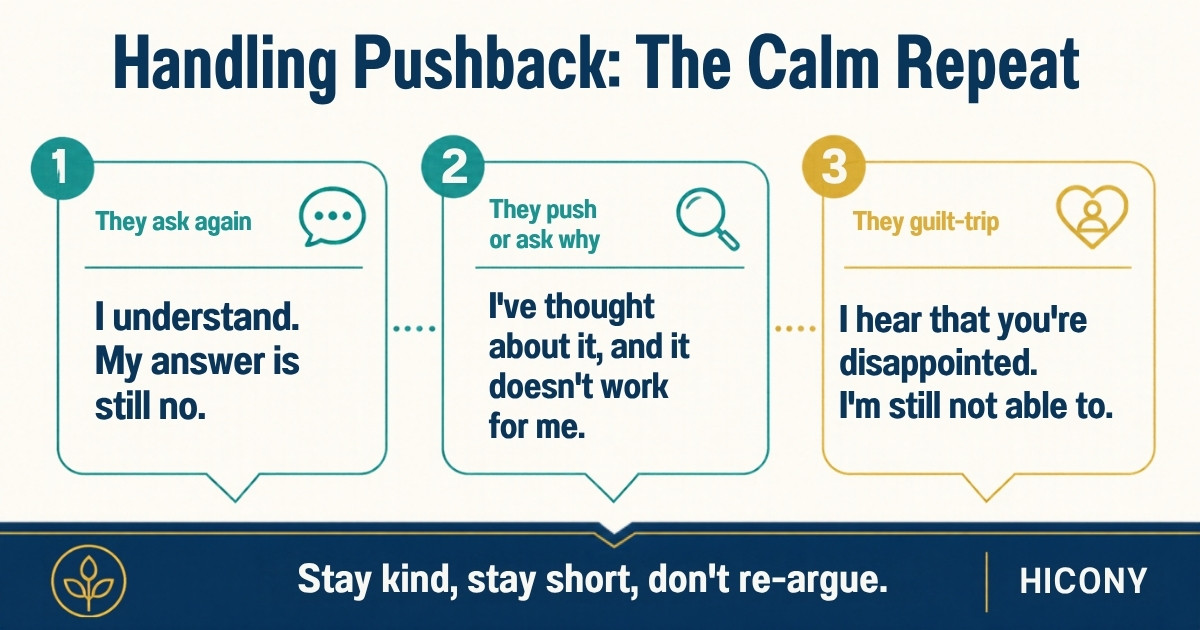
- They ask again: “I understand. My answer is still no.”
- They ask why: “I’ve thought about it, and it doesn’t work for me.”
- They guilt-trip you: “I can hear that you’re disappointed. I’m still not able to.”
- They get angry: “I’d like to continue this when we’ve both had a chance to calm down.”
Stay kind, stay short and do not re-argue. Each new explanation gives them something new to challenge.
What to Do When the Guilt Shows Up Anyway
Even with the right words, you may still feel a pang afterwards. That is normal. Here is how to handle it:
- Name it. “I feel guilty because I disappointed someone.” Naming a feeling often reduces its pull.
- Separate guilt from wrongdoing. Ask: did I harm anyone, or did I just let someone down a little? Disappointment is not damage.
- Do not reopen the decision. Going back to say “actually, I can” usually leads to the same resentment you wanted to avoid.
- Write it out. A short journal entry can help you see the reasoning. Our beginner’s guide to journaling includes prompts for hard feelings.
- Give it 24 hours. Guilt is often loudest straight after the conversation and fades quickly if you leave it alone.
- Do one small kind thing if you want to, such as a friendly message, without taking the no back.
If you keep asking yourself whether you made the right call, you may also find our article on how to stop second-guessing yourself useful.
A 7-Day Plan to Build Your “No” Muscle
Saying no is a skill. Start small and work up.
| Day | Practice |
|---|---|
| 1 | Notice every time you say yes automatically. Just observe. Do not change anything yet. |
| 2 | Say “Let me check and get back to you” to one request. |
| 3 | Decline one very low-stakes ask, such as a survey or a store loyalty card. |
| 4 | Decline one invitation you do not want, using a script above. |
| 5 | Write your own go-to “no” sentences for work, friends and family. |
| 6 | Practise saying them out loud, as Mayo Clinic advises, or with a friend. |
| 7 | Review the week. What went better than you expected? Keep what worked. |
Start with people and situations where the stakes are low. The more you practise, the less dramatic a no will feel. Rehearsing out loud before a difficult conversation is also a technique the Mayo Clinic recommends.
When Saying No Is Not Just a Skill Problem
For most people, saying no is a skill that improves with practice. But sometimes it is tied to something deeper:
- If you feel intense fear or anxiety about refusing, even small things, it may help to speak with a counsellor or therapist. Mayo Clinic suggests talking to a mental health provider if anxiety or fear gets in the way of becoming more assertive.
- If a person punishes, threatens or controls you when you say no, that is not a communication problem. It may be an unsafe relationship, and you deserve support from a trusted person or a local support service.
- If you are overloaded at work and a no is not possible, consider what you can negotiate: deadlines, priorities or help. If you struggle to ask, our article on asking for help without feeling like a burden may help.
Frequently Asked Questions About Saying No
How do I say no politely?
Pause, thank the person, say your no in plain words and, if you wish, offer an alternative. “Thanks for thinking of me. I can’t take this on, but I hope it goes well.”
Do I have to give a reason when I say no?
No. A reason can help if it is simple and true, but you are allowed to decline without one. “That doesn’t work for me” is a complete answer.
How do I say no to my boss without getting in trouble?
Use a trade-off. Show that you care about results while being honest about your capacity: “I can take this on if we move X. Which is the priority?”
How can I stop feeling guilty after saying no?
Name the feeling, remind yourself that disappointment is not harm, do not take the no back and give it a day. The guilt usually fades with practice.
Is it selfish to say no?
Not by default. Protecting your time and energy means you can show up better for the people and commitments that matter most.
How do I say no to family without causing a fight?
Lead with warmth, keep the message short and offer a different way to connect. Avoid debating the reasons. A calm repeat works well if they push back.
What if I say yes and then regret it?
You can often still change your mind. Do it quickly and honestly: “I thought about it again and realise I overcommitted. I’m sorry, but I need to step back.”
Why am I so afraid of saying no?
Common reasons include people-pleasing, fear of conflict, wanting to be liked and a lack of practice. It is a learnable skill, and if the fear is intense or constant, speaking to a professional can help.
Your Next Step
Pick one request you are likely to face this week, such as an invitation, a favour or a work task. Write your no in one sentence, using the steps above. Then say it out loud once. That is the whole assignment. The next time you need it, the words will already be there.
For more practical guides on communication and personal growth, explore our Communication category, or learn how to build self-awareness so you can notice your limits sooner.
Sources and Further Reading
- Mayo Clinic Staff: Being assertive: Reduce stress, communicate better
- Patrick, V. M. and Hagtvedt, H. (2012). “I Don’t” versus “I Can’t”: When Empowered Refusal Motivates Goal-Directed Behavior. Journal of Consumer Research, 39(2), 371 to 381.