
It is your second week in a new job. Someone says “great work” on a presentation, and instead of feeling proud, you think, “They just have not noticed yet how little I know.” Sound familiar? You are not alone, and you are not a fraud. What you are describing has a name: imposter syndrome.
Imposter syndrome at work is the persistent feeling that you do not deserve your role, that your success was luck, and that sooner or later someone will “find you out”, even when the evidence says you are doing well. It tends to hit hardest when something is new: a new job, a promotion, a new team or a new industry.
This guide explains what imposter syndrome is (and what research says about it), how to tell it apart from a genuine skill gap or an unhealthy workplace, and a practical 90-day plan to build real confidence. You will also get word-for-word scripts for asking questions, handling mistakes and accepting praise.
This article is general information, not mental health advice. If self-doubt is overwhelming or affecting your health, please speak with a doctor or therapist.
What Is Imposter Syndrome?
The idea was introduced in 1978 by psychologists Pauline Clance and Suzanne Imes, who described the “impostor phenomenon” as an internal experience of intellectual phoniness, which they first observed in a group of high-achieving women. Since then, researchers have found these feelings in people of every gender and background, from students to senior professionals. (You will see both “imposter” and “impostor” in print. They mean the same thing.)
A few important points are worth knowing:
- It is a pattern of thinking, not a formal diagnosis. A 2020 systematic review in the Journal of General Internal Medicine, covering 62 studies, noted that impostor syndrome is not an officially recognised clinical condition, despite how often it appears in the media.
- It is very common, but the numbers vary. The same review found prevalence estimates ranging from 9% to 82%, depending largely on the questionnaire and cut-off used. In other words, nobody knows the exact figure, but plenty of capable people feel this way.
- It often travels with anxiety and low mood. The review found impostor feelings are frequently linked with depression and anxiety, and with lower job satisfaction and higher burnout.
- Research on treatment is thin. The authors found little formal evidence on specific treatments, which is why the strategies in this article are best treated as sensible, low-risk habits rather than a proven cure.
You can read the full paper here: Prevalence, Predictors, and Treatment of Impostor Syndrome: a Systematic Review.
Common Signs of Imposter Syndrome at Work
See how many of these sound like you:
- You put your success down to luck, timing or “people being nice”.
- You feel you must work twice as hard as everyone else to avoid being exposed.
- You struggle to accept praise, or you dismiss it straight away.
- You avoid asking questions because you fear looking incompetent.
- You over-prepare, or procrastinate because “it won’t be good enough”.
- You compare your behind-the-scenes struggle with other people’s polished results.
- You turn down opportunities because you feel you are not ready.
Having some of these thoughts now and then is normal, especially when you are learning something new. It becomes a problem when the thoughts are constant, hold you back or make you miserable.
Feelings Are Not Facts
The single most useful habit for dealing with imposter syndrome is learning to separate what you feel from what you can show. Feelings are real, but they are not always accurate.
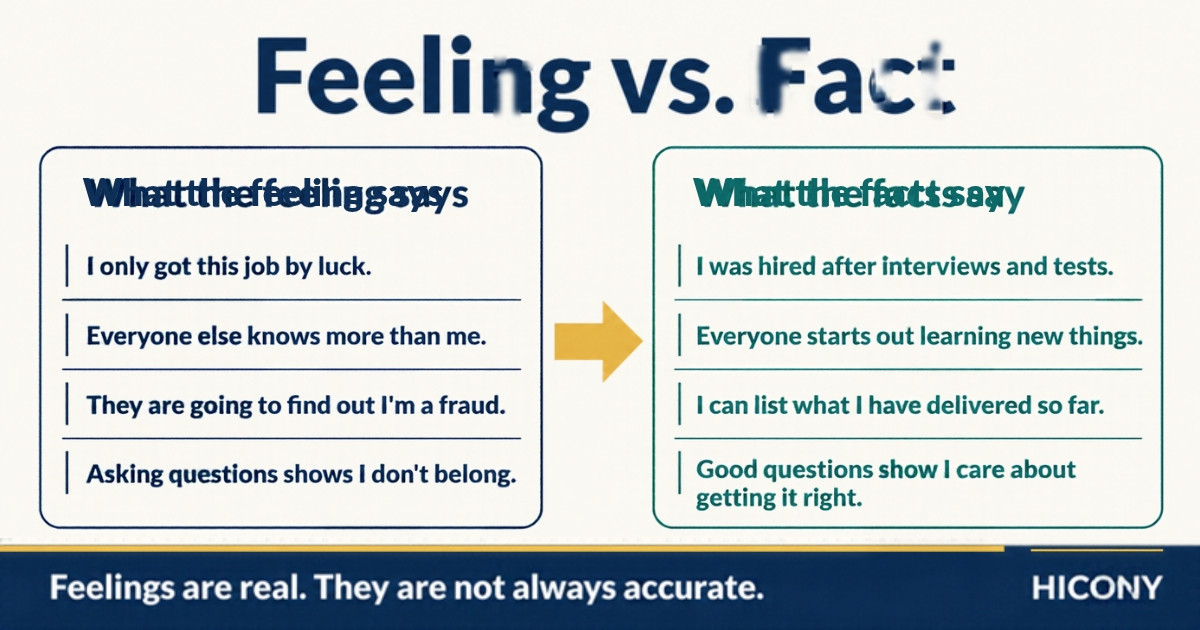
| What the feeling says | What the facts say |
|---|---|
| “I only got this job by luck.” | I was hired after interviews, references and tests. |
| “Everyone else knows more than me.” | Everyone is learning something. I only see their finished work. |
| “They are going to find out I’m a fraud.” | I can list what I have delivered so far. |
| “Asking questions shows I don’t belong.” | Good questions show I care about getting it right. |
Is It Imposter Syndrome, a Skill Gap or a Tough Workplace?
Here is the part many articles skip. Not every wave of doubt is “imposter syndrome”. Sometimes your doubt is pointing at something real, and you will deal with it better if you know which one you are facing.
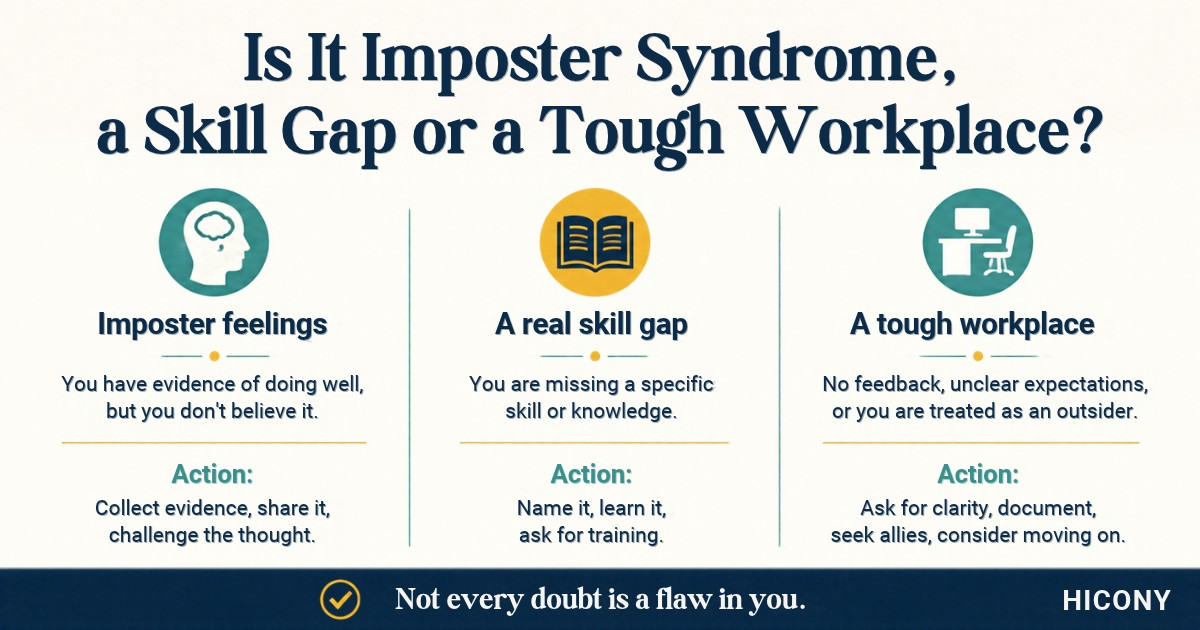
| What is going on | How it shows up | What helps |
|---|---|---|
| Imposter feelings | You have evidence of doing well, but you do not believe it. | Build an evidence file, challenge the thought, talk to someone. |
| A real skill gap | You are missing a specific skill or piece of knowledge. | Name it, learn it, ask for training or a mentor. |
| A tough workplace | No feedback, unclear expectations, or you are treated as an outsider. | Ask for clarity, keep records, find allies, and consider whether this job is right for you. |
This distinction matters. In a widely read Harvard Business Review article, Ruchika Tulshyan and Jodi-Ann Burey argued that labelling self-doubt as a personal flaw can put the focus on “fixing” individuals instead of fixing workplaces that are biased or unwelcoming, especially for women and people of colour. You can read it here: Stop Telling Women They Have Imposter Syndrome. If you often feel like an outsider because of how you are treated, it is reasonable to ask whether the problem sits with the environment, not with you.
Your First 90 Days: A Confidence Roadmap
Starting a new job is the perfect storm for imposter feelings, because you are surrounded by unfamiliar things and everyone around you seems to know what they are doing. A simple plan helps you replace vague worry with action.
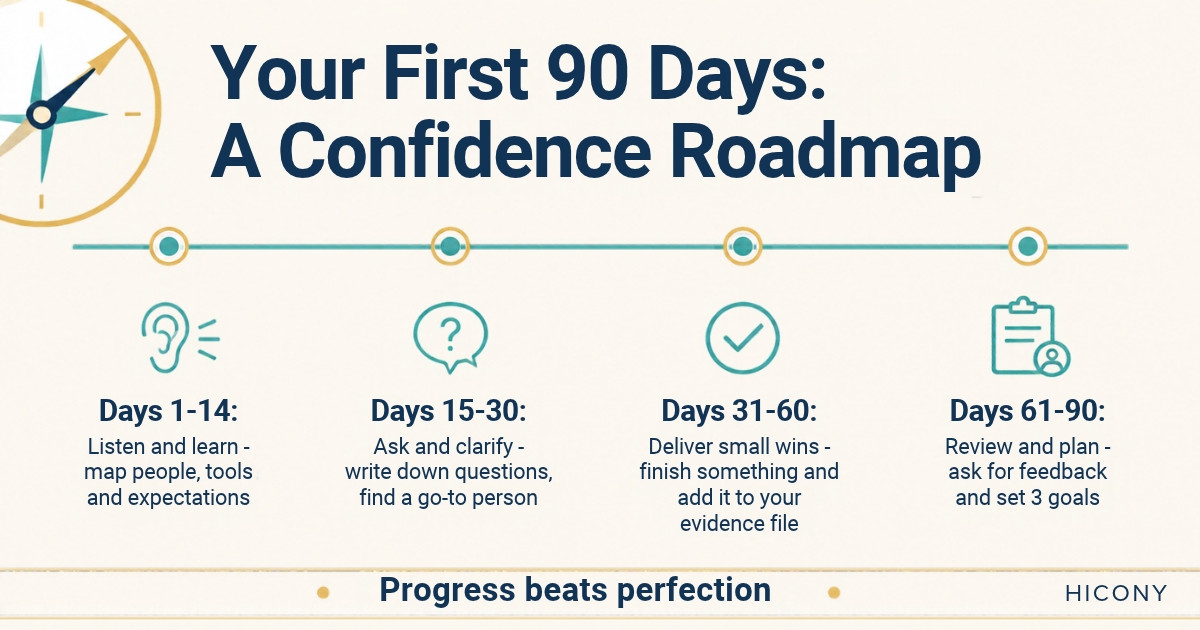
Days 1 to 14: Listen and learn
- Make a simple map of the people you work with and what each of them does.
- Ask your manager what a good first month looks like. Write the answer down.
- Keep a “things I don’t know yet” list. It turns vague anxiety into a to-do list.
- Remind yourself that being new means not knowing things. That is the job description of week one.
Days 15 to 30: Ask and clarify
- Collect your questions and ask them in batches, so you do not interrupt people all day.
- Find a go-to person: a friendly colleague who can answer small questions.
- Start your evidence file (see below).
Days 31 to 60: Deliver small wins
- Pick one or two tasks you can finish properly and finish them.
- Ask for specific feedback: “What is one thing I could do better on this?”
- Write each completed task in your evidence file.
Days 61 to 90: Review and plan
- Look back through your evidence file. You will probably be surprised.
- Book a check-in with your manager to review progress and expectations.
- Set three goals for the next quarter: one skill, one relationship and one result.
10 Practical Ways to Handle Imposter Syndrome at Work
1. Keep an evidence file
Imposter feelings run on selective memory: you remember mistakes and forget wins. Keep a simple running list (a note on your phone is enough) with three columns:
| Date | What I did | Result or feedback |
|---|---|---|
| 12 March | Presented the monthly report to the team | Manager said the charts made the numbers clear |
| 19 March | Fixed the recurring invoice error | Saved the finance team about two hours a week |
| 28 March | Trained a new colleague on the scheduling tool | She thanked me by email |
Also save kind emails, messages and feedback in one folder. Reread it when your inner critic gets loud.
2. Name the thought
Instead of “I’m a fraud”, try “I’m having the thought that I’m a fraud.” This small shift creates distance between you and the thought. Then ask: what is the evidence for it, and what is the evidence against it? If you tend to be harsh on yourself, our guide to stopping negative self-talk offers a step-by-step approach.
3. Ask questions on purpose
Asking questions does not make you look incompetent. It makes you look engaged. Make it easier with a simple format: say what you have tried, then ask a specific question. For example: “I’ve checked the handbook and tried version two. Can you tell me where the approval step happens?”
4. Share what you are feeling with someone you trust
Imposter feelings grow in secret. A mentor, friend or colleague may well say, “I feel exactly the same.” If asking feels hard, read our article on asking for help without feeling like a burden.
5. Redefine “good enough”
Perfectionism often sits underneath imposter syndrome. Ask: what does “good enough” look like for this task? A routine email does not need to be a masterpiece. Save your full effort for the work that matters most.
6. Treat mistakes as information
Everyone makes mistakes at work, especially in a new role. When one happens, ask three questions: what happened, what will I do differently, and who needs to know? Then move on. A calm response often builds more trust than a perfect record.
7. Learn to accept praise
When someone compliments your work, resist the urge to deflect. Try a simple “Thank you, I’m glad that was helpful.” You can add context if you like, but do not cancel the compliment out.
8. Focus on learning, not on being the expert
You are not supposed to know everything on day one. Shift from “I should already know this” to “What can I learn from this?” Keep a short list of skills you are building, and tick off progress.
9. Look after the basics
Tiredness and stress make self-doubt louder. Prioritise sleep, breaks and movement. If your nights are rough, our guide on how to fall asleep faster can help.
10. Write it out
A few minutes of journaling can turn swirling doubt into something you can look at. Try a prompt like “What went well today, and what did I learn?” Our beginner’s guide to journaling has prompts and a simple template.
Word-for-Word Scripts for Common Situations
Asking a question without feeling foolish
- “I want to make sure I get this right. Could you walk me through the approval steps?”
- “I’ve tried A and B. What am I missing?”
- “Is there a document or example I could look at first?”
Asking for feedback
- “What is one thing I could do differently next time?”
- “How am I doing against what you expected at this stage?”
- “Is there anything you would like me to focus on in the next month?”
Admitting a mistake
- “I made an error in the report. I’ve corrected it, and I’ve added a check so it doesn’t happen again.”
- “I misunderstood the deadline. Here is my plan to catch up.”
Accepting praise
- “Thank you, I appreciate that.”
- “Thanks, I worked hard on that section, so it’s good to hear it landed.”
Setting a limit when you are overloaded
- “I want to do this well. If I take it on, I would need to move X. Which is the priority?”
That last script comes from our guide on how to say no without feeling guilty, which includes 45 more scripts for work.
What Not to Do
- Do not overwork to “prove yourself”. It feeds the belief that you only succeed through exhausting effort.
- Do not avoid new challenges. Avoidance protects you from discomfort today but confirms your doubts tomorrow.
- Do not compare your inside to everyone’s outside. You see your doubt, but only their results.
- Do not wait until you feel confident to act. Confidence usually follows action, not the other way around.
- Do not suffer in silence. Talking helps more than you expect.
If You Manage People: How to Reduce Imposter Feelings in Your Team
Managers can make a big difference by doing a few simple things: setting clear expectations in the first weeks, giving specific feedback (not just “good job”), normalising questions, sharing their own learning moments and making sure every person gets credit for their work. As the HBR authors point out, a fair, welcoming workplace removes many triggers for self-doubt in the first place.
When to Get Professional Support
Consider talking to a therapist, counsellor or doctor if:
- Self-doubt is constant, intense or affecting your sleep, appetite or relationships.
- You are avoiding work, calling in sick or considering quitting because of fear of being “found out”.
- You also feel persistently low, anxious or hopeless. The systematic review above found impostor feelings often occur alongside depression and anxiety, and these can be treated.
- You experience panic attacks or thoughts of harming yourself. In that case, please contact a local emergency or crisis service straight away.
Asking for help is a strength, and a good professional can help you work out what is imposter thinking and what is a reaction to a difficult environment.
Frequently Asked Questions About Imposter Syndrome at Work
Is imposter syndrome a mental illness?
No. It is not an official diagnosis. It is a pattern of thoughts and feelings that can occur alongside anxiety or depression, so if it feels overwhelming, it is worth talking to a professional.
Why do I feel like a fraud at my new job?
New roles bring unfamiliar tasks, unclear expectations and constant comparison with colleagues who already know the ropes. Feeling out of your depth is a normal part of learning, not proof that you do not belong.
How long does imposter syndrome last?
It varies. For many people it eases as skills, relationships and evidence of success build up over the first few months. Some people notice it returns at big transitions, such as a promotion. The tools above still work each time.
Does imposter syndrome ever go away?
For some people it fades; for others it comes and goes. The goal is not to never feel doubt, but to stop letting it make decisions for you.
Is imposter syndrome a sign I am actually not good enough?
Not by itself. Imposter feelings tend to appear in people who are performing well. If you do have a real skill gap, name it and plan to close it. That is an ordinary part of growing in any job.
How do I talk to my boss about imposter syndrome?
You do not have to use the term. You can say, “I’m still getting up to speed and would value regular feedback so I know I’m on the right track.” Most managers appreciate that.
Can imposter syndrome affect my performance?
It can. Research linked impostor feelings with lower job satisfaction and higher burnout in some groups. Over-preparing, avoiding opportunities and not asking for help can all get in the way.
What is the quickest thing I can do today?
Write down three things you did well this week, with one detail each. It takes two minutes and starts your evidence file.
Your Next Step
You do not have to feel confident to start acting confident. Today, open a note on your phone, call it “Evidence file”, and add three things you have done well recently. Tomorrow, ask one question you have been holding back. Small, repeated actions build real confidence far more reliably than waiting for the feeling to arrive.
For more practical guidance on self-doubt and personal growth, browse our Confidence category, or read about the two types of self-awareness to understand how you see yourself and how others see you.
Sources and Further Reading
- Bravata, D. M. et al. (2020). Prevalence, Predictors, and Treatment of Impostor Syndrome: a Systematic Review. Journal of General Internal Medicine, 35(4), 1252 to 1275.
- Tulshyan, R. and Burey, J. (2021). Stop Telling Women They Have Imposter Syndrome. Harvard Business Review.
- Clance, P. R. and Imes, S. A. (1978). The impostor phenomenon in high achieving women: Dynamics and therapeutic intervention. Psychotherapy: Theory, Research and Practice, 15(3), 241 to 247.