
A difficult conversation at work can begin with something small: a deadline that keeps slipping, a colleague who interrupts you, a manager whose feedback feels unfair, or a boundary that is repeatedly ignored. If you are wondering how to have difficult conversations at work, start by making the issue specific rather than rehearsing every possible reaction. You may know the issue needs to be discussed, yet still find yourself postponing it or imagining the worst possible outcome.
The aim is not to become fearless or to find a perfect sentence. It is to make the conversation clearer, fairer and more useful. This guide gives you a practical five-step method, realistic scripts for common workplace situations, and a way to decide when a conversation should move into a formal process instead.

In brief: prepare around observable facts, explain the impact without attacking the person, invite their perspective, agree on a specific next step and record what was decided. If the issue involves harassment, discrimination, threats, serious misconduct or a formal grievance, follow the relevant workplace procedure and seek appropriate support rather than trying to resolve everything informally.
Table of contents
- Why difficult conversations feel so difficult
- The 5-step method: prepare and talk
- 12 scripts for common workplace conversations
- How to listen without surrendering your point
- When not to handle it as an informal conversation
- What to do after the conversation
- Mistakes that make conversations worse
- Frequently asked questions
Why difficult conversations feel so difficult
These conversations carry more than information. They can involve status, trust, money, reputation, belonging and the fear of damaging a working relationship. You may also be uncertain about the other person’s intentions or how much authority you have to raise the issue.
A common trap is to treat the conversation as a contest: one person must be right and the other must accept it. A more productive aim is to understand what happened, explain why it matters and decide what should happen next. That does not mean every disagreement can be solved, or that you must accept behaviour that is unfair or unsafe.
Two well-known public guides are worth knowing about, although both are written mainly for managers and supervisors. Acas, the UK’s workplace relations service, has a guide on challenging conversations and how to manage them. It stresses staying in control of the situation, your emotions and the action you plan to take, and it asks the question “Am I the right person?” before you begin. The US Office of Personnel Management’s Difficult Conversations for Supervisors course similarly covers setting up the conversation and its different phases. The principles are useful for employees too, even where your workplace is not in the UK or US. Local employment rules and your organisation’s policies still take priority.
The 5-step method: prepare and talk
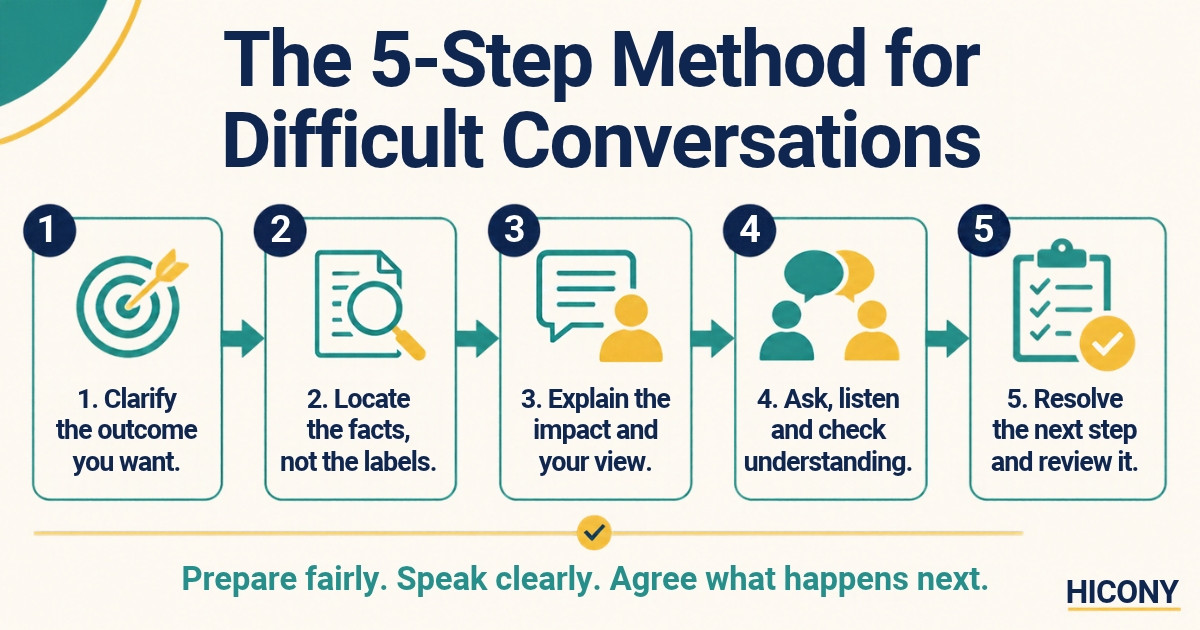
Use these five steps as a practical memory aid. It is a HICONY method, not a clinical or formally validated assessment tool.
Step 1: Clarify the outcome you want
Before you speak, complete this sentence: “After this conversation, I would like us to…” Be specific. You might want a clearer deadline, an agreed division of work, a correction to inaccurate information, a boundary around after-hours messages, or a plan for addressing repeated behaviour. Writing it down helps, and our beginner’s guide to journaling has a simple 10-minute template for sorting your thoughts first.
Do not make “make them understand how awful they were” the goal. You cannot control whether someone agrees with your interpretation. You can control how clearly you explain the issue and what request you make.
Step 2: Locate the facts, not the labels
Write down what you directly observed, when it happened and what evidence or examples you can fairly share. Separate facts from assumptions.
| Less useful wording | More useful wording |
|---|---|
| “You are careless.” | “The last two reports arrived after the agreed deadline.” |
| “You never listen.” | “I was interrupted twice while explaining the client change.” |
| “You are trying to undermine me.” | “The project update was sent without the revised figures I shared on Tuesday.” |
| “You don’t respect my time.” | “The meeting ran 25 minutes over, although I had flagged another commitment.” |
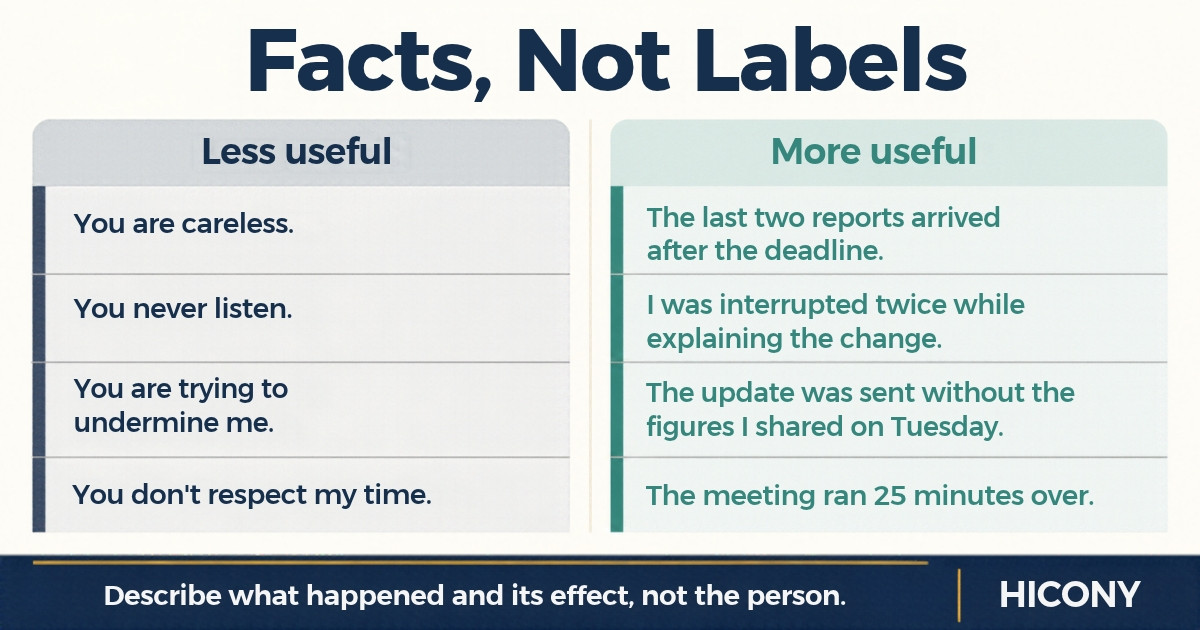
Describe behaviour and impact rather than diagnosing someone’s character or motive. If you are unsure what happened, say so and ask before drawing a conclusion.
Step 3: Explain the impact and your perspective
Use a short sequence: When [specific event] happened, the effect was [work-related impact]. I felt or was concerned about [your perspective], and I would like [clear request]. Keep the explanation proportionate. One example is usually easier to discuss than a long list of every frustration from the past year.
For example: “When the final figures changed after the report was approved, I had to redo the client summary and missed the internal review window. I am concerned that we do not have a reliable version-control step. Could we agree who confirms the final figures before sign-off?”
Step 4: Ask, listen and check your understanding
After explaining your concern, stop talking long enough for the other person to respond. Ask open, neutral questions such as “How did you see it?”, “What was happening from your side?” or “What information might I be missing?”
Listening does not mean agreeing. You can acknowledge their explanation while still holding your boundary: “I understand that the deadline changed unexpectedly. We still need a reliable way to alert the rest of the team when that happens.”
Step 5: Resolve the next step and review it
Finish with an action, an owner and a time. “We will communicate changes in the project channel” is clearer than “Let’s communicate better.” Ask the other person to confirm what they understood. If the issue is ongoing, agree when you will review whether the change is working.
12 scripts for common workplace conversations
These are starting points, not lines to recite mechanically. Adjust the language to your role, culture and relationship. Be direct without being hostile, and do not promise confidentiality or outcomes that you cannot guarantee.
1. Raising a missed deadline
Try: “Can we look at the timeline for the report? The last two deadlines moved, and that left too little time for review. What is getting in the way, and what delivery date can we realistically commit to now?”
Why it helps: it names a pattern, explains the work impact and invites problem-solving without assuming laziness or bad intent.
2. Addressing repeated interruptions
Try: “I want to hear your view, and I also need to finish explaining the point. Could you let me complete it, then I will come to you?”
3. Setting a boundary around after-hours messages
Try: “I can respond to routine requests during my working hours. If something is genuinely urgent outside those hours, please use the agreed urgent channel. Otherwise, I will pick it up the next working day.”
If your role has on-call or shift responsibilities, adapt this to the actual agreement rather than assuming everyone has the same availability. For more ways to hold a boundary, see our guide on how to say no without feeling guilty.
4. Disagreeing with your manager
Try: “I understand the outcome you are aiming for. I see one risk with the current approach: [specific risk]. Could I show you an alternative that may protect the deadline while addressing that risk?”
5. Responding to criticism that feels unfair
Try: “I want to understand the concern. Could you point me to a specific example and explain what you expected instead? I may see part of it differently, but I would like to respond to the actual issue.”
For more on receiving feedback and managing your reaction, read HICONY’s guide to emotional intelligence at work and guide to handling criticism without taking it personally.
6. Giving constructive feedback to a colleague
Try: “Could I share one observation about the handover? The client details were missing from the last two notes, so the next person had to contact the client again. A short checklist before sending might prevent that. What do you think?”
7. Asking for clearer responsibilities
Try: “I think we have different assumptions about who owns the final check. Could we list the steps and name one person responsible for each? That should help us avoid duplicated work and missed tasks.”
8. Raising a concern about workload
Try: “I can complete A and B by Friday, but taking on C as well would put the quality or timing at risk. Which item should take priority, or what can be moved to a later date?”
This is more useful than saying only “I’m overwhelmed” because it gives the other person a concrete decision to make. If overload is persistent, HICONY’s burnout versus stress guide may help you recognise when the issue needs more than a one-off conversation.
9. Repairing tension after a disagreement
Try: “I have been thinking about our conversation yesterday. I was sharper than I intended, and I am sorry for that. I still think we need to resolve [specific issue]. Can we return to it and work out the next step?”
10. Telling someone their behaviour is affecting you
Try: “When jokes are made about my accent in meetings, I find it difficult to contribute. I want that to stop. I am raising it directly because I want to be able to work together respectfully.”
If the behaviour may be discriminatory, harassing or part of a repeated pattern, consider recording the incidents and using the appropriate reporting route. You do not have to manage serious misconduct through a private conversation alone.
11. Asking for a change in how work is communicated
Try: “I am missing important changes when they are spread across several private messages. Could we keep project decisions in the shared channel and use direct messages only for sensitive matters?”
12. Ending a conversation that is becoming unproductive
Try: “I want us to resolve this, but we are repeating the same points and the tone is getting less helpful. Let’s pause and agree when we will return to it. I will write down the questions we still need to answer.”
How to listen without surrendering your point
People sometimes hear “listen carefully” as “give in”. They are not the same. You can listen, check facts and still disagree with the conclusion or refuse a request that crosses a reasonable boundary.
| What the other person says | A balanced response |
|---|---|
| “That wasn’t my intention.” | “I understand. I am explaining the effect it had, so we can avoid it happening again.” |
| “Everyone does it.” | “Perhaps, but we still need a process that works reliably.” |
| “You’re overreacting.” | “We may see the seriousness differently. Can we return to the specific event and its impact?” |
| “I don’t have time for this.” | “I understand you’re busy. When would be a realistic time to discuss it properly?” |
| “So you’re blaming me?” | “I am not trying to label you. I am raising a specific problem and asking how we can address it.” |
If emotions rise, slow the pace. You can ask for a short break, return to the facts, or arrange another meeting. If you feel threatened, prioritise safety and use the appropriate support or reporting process.
When not to handle it as an informal conversation
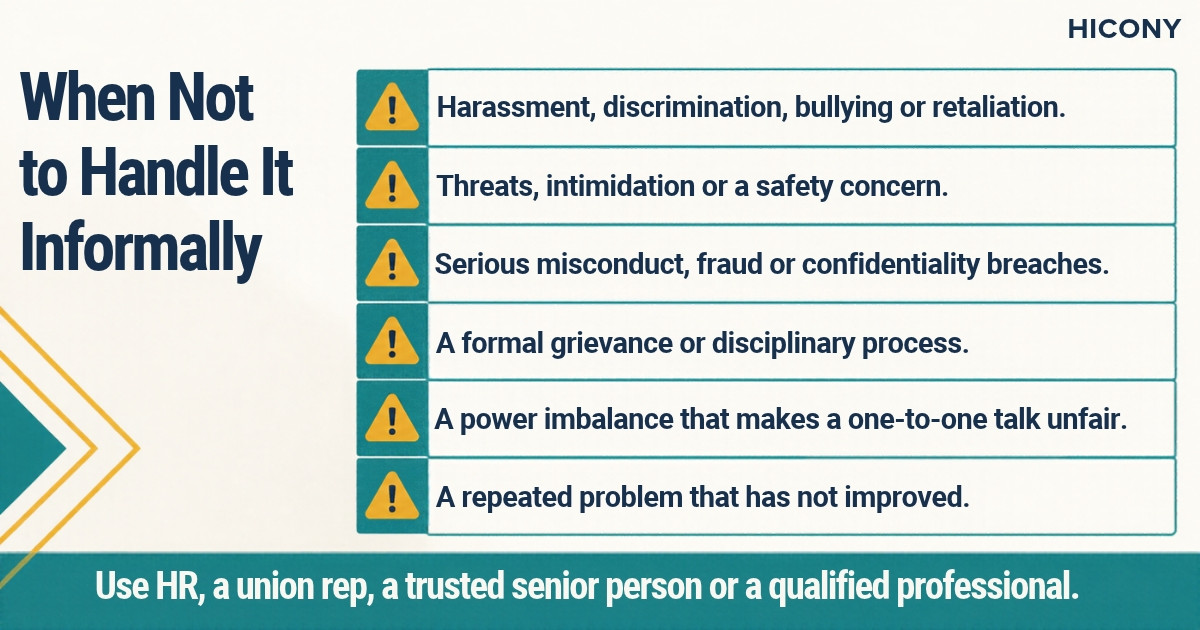
Not every workplace problem is suitable for a private, informal discussion. Consider using a formal channel or getting advice from HR, a union representative, a trusted senior person or an appropriate professional when the issue involves:
- Harassment, discrimination, bullying or retaliation.
- Threats, intimidation, violence or an immediate safety concern.
- Serious misconduct, fraud, safeguarding or confidentiality breaches.
- A formal grievance, disciplinary process or performance procedure.
- A substantial power imbalance that makes a one-to-one discussion unsafe or unfair.
- A repeated problem that has not improved despite reasonable attempts to address it.
Do not investigate serious allegations yourself or promise an outcome you cannot control. Keep factual notes, preserve relevant records in line with policy, and follow the applicable procedure. The Acas and OPM materials linked above are useful workplace guidance, but they are not a substitute for the law, policy or professional advice that applies in your location.
What to do after the conversation
A conversation can feel productive in the moment and still change nothing if nobody knows what happens next. Within a reasonable time, send a short neutral summary where appropriate. Keep it factual and avoid turning it into a transcript of every emotion or disagreement.
| Follow-up item | What to record | Example |
|---|---|---|
| Issue | The specific matter discussed | Late changes to the client report |
| Agreement | What will be done differently | Final figures confirmed in the project channel |
| Owner | Who is responsible | Project lead confirms figures |
| Timing | When it will happen | Before the next review meeting |
| Review | When to check progress | At the end of the next project cycle |
For sensitive or formal matters, follow your organisation’s record-keeping and confidentiality rules. Do not store personal or employment information in an unauthorised app or shared document.
If you find yourself replaying the conversation in bed afterwards, our guide on how to stop overthinking at night has a simple wind-down you can use.
Mistakes that make conversations worse
- Starting with a verdict. “You’re unprofessional” invites an argument about identity. Start with the event and its effect.
- Collecting grievances like evidence in a trial. Focus on the issue that needs solving now. Raise a wider pattern only when it is relevant and you can describe it fairly.
- Choosing the wrong setting. Sensitive feedback is rarely best delivered in a public channel or in front of an audience.
- Demanding an immediate emotional response. Some people need time to process information. Agree when you will return to the discussion.
- Confusing calmness with weakness. A respectful tone can still carry a firm request and a clear boundary.
- Leaving without an agreed next step. If no action, owner or review point is clear, the conversation may simply repeat.
- Trying to solve a formal or unsafe issue alone. Use the right process and support when the circumstances call for it.
Frequently asked questions
How do I start a difficult conversation at work?
Ask for a private, appropriate time, explain the topic briefly and state that you want to find a constructive way forward. For example: “Could we set aside 20 minutes to discuss the handover process? I would like us to agree on a clearer approach.”
How do I have a difficult conversation with my boss?
Prepare specific examples, explain the work impact and make a practical request. If you disagree with a decision, describe the risk and offer an alternative. If you fear retaliation or the issue involves misconduct, consider getting advice or support before raising it alone.
What if the other person gets defensive or angry?
Keep your voice steady, return to the specific issue and avoid matching their tone. You can acknowledge their reaction without abandoning your concern. If the conversation becomes threatening or unsafe, stop and use the appropriate support route.
Should I put a difficult conversation in writing?
For a routine issue, a short written summary of agreed actions can prevent misunderstanding. For formal complaints, performance matters or sensitive information, follow your workplace policy and keep records only in approved systems.
How soon should I have the conversation?
Raise a manageable issue when you have enough facts and can speak privately without being rushed. Do not delay a safety concern or serious misconduct issue while waiting for a perfect moment; use the relevant reporting procedure promptly.
What if the conversation does not solve the problem?
Review what was agreed, whether it happened and what remains unresolved. If the issue continues, use the next appropriate step in your organisation’s process rather than repeating the same informal conversation indefinitely.
A difficult conversation is a skill, not a personality type
You do not need to be naturally confident, unusually persuasive or completely calm to speak about a problem at work. You need to prepare fairly, describe what happened, explain why it matters, listen to the other perspective and make a clear request. The five-step method gives you a simple structure to practise.
Start with one conversation that is important but manageable. Write down the outcome you want, the facts you can support and the next step you are asking for. A respectful conversation will not guarantee agreement, but it gives both people a better chance of understanding the issue and deciding what should happen next.
For more practical guides on communication, explore our Communication articles.
Further reading and sources
- Acas: Challenging conversations and how to manage them: preparation, communication and managing workplace discussions, written mainly for managers.
- US Office of Personnel Management: Difficult Conversations for Supervisors: setting up the conversation and its phases.
- Atlassian: 17 scripts for difficult conversations at work: further examples for boundaries and workplace communication.
Related HICONY guides: Emotional Intelligence at Work · How to Say No Without Feeling Guilty · Imposter Syndrome at Work · Burnout vs Stress.
Editorial note: This article offers general educational information about workplace communication. It is not legal, HR or employment advice, and employment rules differ by country, employer and contract. For serious issues, or where your rights or job may be affected, please speak to HR, a union representative or a qualified professional.