
Finding freelance clients is rarely about sending more messages to more strangers. It is about making a clear offer to a well-defined group of people, showing credible proof that you can help, and starting useful conversations with the right prospects.
If you are wondering how to find freelance clients—especially when you are new, have a small portfolio or cannot afford paid ads—this guide gives you a practical system you can start using this week. You do not need thousands of followers, an expensive website or a profile on every marketplace. You need a focused service, a few relevant examples, a repeatable way to identify potential buyers and a respectful follow-up process.
The aim is not to pressure people into hiring you. It is to help the right client recognise that you understand a problem they already want solved. If you are also exploring AI tools in your freelance work, HICONY’s guide to starting freelancing with AI pairs well with this one.
Table of contents
- 1. Start with a service clients can understand
- 2. Choose the right people to approach
- 3. Build proof before you pitch
- 4. What usually wastes time
- 5. Use six practical ways to find clients
- 6. Write outreach that earns a reply
- 7. Follow up without becoming annoying
- 8. Turn interest into a clear paid project
- 9. A realistic 30-day plan for your first clients
- 10. Mistakes that make client acquisition harder
- 11. Protect yourself from freelance scams
- Frequently asked questions
- Sources and further reading
1. Start with a service clients can understand
“I can do graphic design, writing, websites, marketing and admin work” sounds flexible, but it leaves a potential client with the work of deciding what to buy. A specific offer makes that decision easier.
Describe your service using this simple sentence:
I help [a particular type of client] achieve [a useful outcome] by providing [a clearly defined service].
For example:
- “I help independent restaurants keep their websites and menus up to date.”
- “I help small online shops turn product information into clear, useful product descriptions.”
- “I help busy consultants prepare and format client-ready presentations.”
- “I help local service businesses organise their email enquiries and follow-up process.”
Notice the difference between a skill and an offer. “I know WordPress” describes you. “I set up a simple five-page WordPress website for a local service business” describes something a buyer can evaluate.
Package the first service into a manageable outcome
For your first offer, avoid promising to solve everything. Define:
- Deliverable: What exactly will the client receive?
- Scope: What is included and what is not?
- Time: What is a realistic delivery window?
- Inputs: What must the client provide?
- Revision: How many reasonable rounds of changes are included?
A small, well-bounded starter project is easier to explain and safer to price than an open-ended promise to “help with marketing”. You can expand the relationship after you understand the client’s needs. Knowing how to say no without feeling guilty also helps once you start getting requests that do not fit your offer.
2. Choose the right people to approach
Do not begin by messaging every business you can find. First describe the kind of client who is likely to need your service, have the ability to pay and value the result.
Build a simple ideal-client profile around four questions:
- Who? What type of person or organisation benefits most from the service?
- What problem? What visible difficulty or recurring task could you help with?
- What trigger? What event suggests they may need help now—launching a website, hiring staff, opening a new location, publishing regularly or struggling to keep up with enquiries?
- Where can you reach them? Which professional networks, directories, local groups, marketplaces or events do they already use?
For example, a freelance presentation designer might focus on small consultancies that regularly pitch to corporate customers. A freelance bookkeeper might focus on independent retailers whose owners are still managing records manually. These are starting hypotheses; speak to real prospects and refine them rather than assuming every business has the same problem.
Use a prospect-fit checklist
| Question | Good sign | Warning sign |
|---|---|---|
| Is the problem relevant? | You can point to a specific need your service addresses. | You are guessing that they might need something. |
| Can you reach a decision-maker? | You have a legitimate business contact route. | You are scraping personal details or bypassing stated contact preferences. |
| Can you show proof? | You have a relevant sample, process or experience to share. | You would need to exaggerate your experience. |
| Is the project realistic? | The scope, timing and budget could reasonably fit. | The prospect expects extensive unpaid work or guaranteed results. |
3. Build proof before you pitch
Clients are not only buying your time. They are taking a risk that you will understand the brief, communicate reliably and deliver what you promised. Relevant proof reduces that uncertainty.
If you have completed paid work, select two or three examples that match the type of client you want. Explain the situation, your contribution and the outcome without disclosing confidential information or claiming results you cannot substantiate.
If you have no clients yet, create honest demonstration projects. Choose a realistic brief, label it clearly as a sample or concept project, and show how you approached it. You can also offer a small, clearly scoped pilot at a fair introductory price. Do not pretend that a practice project was commissioned by a real company. Imposter feelings are common here—HICONY’s guide on imposter syndrome at work can help you separate normal nerves from a real skill gap.
Make a one-page proof pack
- A clear headline explaining who you help and what you do.
- Two or three relevant work samples or demonstrations.
- A short explanation of your process.
- A simple list of deliverables and the type of project you accept.
- A professional way to contact you.
A basic portfolio page, a tidy PDF or a well-organised profile can be enough to start. If you use a marketplace, Upwork’s help centre has a guide to building a freelancer profile that covers the essentials of presenting your skills and experience. Read Upwork’s freelancer profile guidance.
4. What usually wastes time
Before you pour energy into outreach, it helps to know which habits burn hours without building a pipeline:
- Polishing a website for weeks before talking to anyone — A simple, clear page is enough to start. Conversations teach you more than another redesign.
- Applying to every marketplace job — Generic proposals rarely win. Targeted ones that match your offer do better.
- Collecting contacts without a fit filter — A long list of unrelated businesses creates busywork, not replies.
- Waiting until you feel “ready” — Confidence often follows a few honest samples and real conversations, not the other way around.
- Treating every silence as failure — Many good prospects are busy. Track process metrics (messages sent, replies, calls) instead of only closed deals.
5. Use six practical ways to find clients
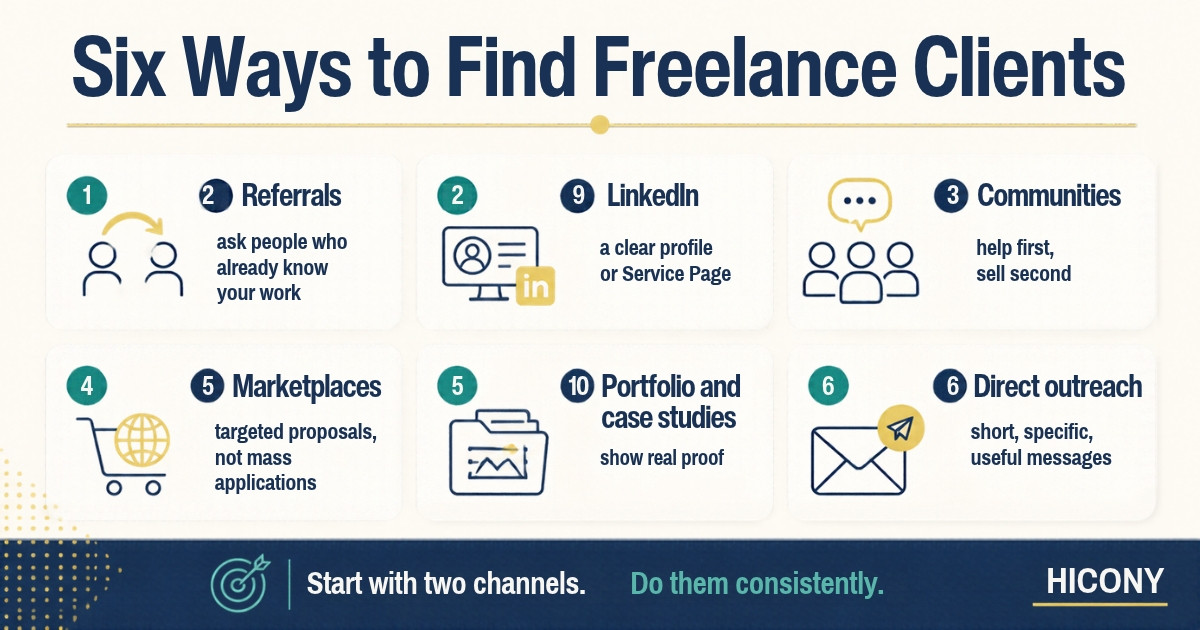
You do not need to use all six channels at once. Choose two that fit your service and your personality, work them consistently for a month, and review the quality of conversations they produce. This is the core of learning how to find freelance clients in a sustainable way.
Method 1: Start with people who already know your work
Former colleagues, past customers, professional contacts, friends who understand your skills and people you have helped before may know someone who needs your service. A referral request should be specific, easy to forward and free of pressure.
Message example:
Hi [Name], I’m now offering [specific service] for [type of client]. I’m looking to work with a few [business/person type] who need help with [problem]. If someone comes to mind, would you feel comfortable introducing us? No worries if not. Here is a short example of the work: [link].
Do not ask everyone to “send me work”. Help them understand what kind of introduction would actually be useful.
Method 2: Use LinkedIn as a relationship and discovery channel
Make your profile understandable before you start sending connection requests. Your headline should say what you do and who you help. Your About section should explain the problem you solve, show relevant evidence and make the next step clear.
Search for businesses, founders, managers and professional communities that match your target-client profile. Pay attention to public posts where someone describes a problem you can genuinely help with. Add a thoughtful comment when you have something useful to contribute. Avoid generic connection requests followed immediately by a sales pitch.
LinkedIn offers Service Pages, a free way for freelancers and small businesses to showcase the services they provide. Availability and feature details can change, so check LinkedIn’s current help page before relying on a particular feature: LinkedIn Service Pages help.
Method 3: Participate in relevant communities
Professional associations, local business groups, industry forums, creator communities and carefully chosen online groups can reveal real problems before they become formal job listings. Be useful first: answer a question, share a practical resource or explain a common mistake. Follow each community’s rules about promotion and private messages.
A useful contribution builds familiarity. Repeatedly dropping your portfolio link into unrelated conversations does the opposite.
Method 4: Use freelance marketplaces selectively
Platforms such as Upwork and other reputable marketplaces can help you discover buyers who are already looking for a service. The trade-off is competition, platform rules and fees. Choose projects that closely match your skills instead of applying to everything.
Before submitting a proposal, identify the client’s actual request, answer any questions they included, explain your approach and show one relevant example. Read each platform’s rules on communication and payments before you start. Upwork’s beginner guide explains how the platform works for freelancers.
Method 5: Build a small, useful online presence
A website or public portfolio can help prospects verify that you are real and understand your service. You do not need to publish every day. Create a few useful pages that answer the questions buyers ask before hiring:
- What problem do you solve?
- What is included in the service?
- What does your process look like?
- What examples can you show?
- How can a prospect request a quote?
Publish practical examples, short case studies, checklists or explanations for your target market. Search visibility usually takes time and is not guaranteed, so treat content as a long-term asset rather than an immediate source of leads.
Method 6: Contact a carefully selected business directly
Direct outreach can work when it is relevant, respectful and based on a real observation. Identify a business that appears to fit your client profile. Look for a public, appropriate contact channel. Mention one specific issue you noticed, explain why it matters and offer a useful next step.
Do not mass-scrape addresses, send deceptive messages or keep contacting someone who has declined. Respect privacy, anti-spam rules and the recipient’s stated preferences in the country where you operate. A tidy inbox helps you manage replies—see how to organise your email inbox if follow-ups are getting lost.
6. Write outreach that earns a reply
A good first message is short enough to read quickly and specific enough to prove that it was not sent to hundreds of people. It should not try to close a large project in the first sentence.
A simple four-part outreach structure
- Context: Explain why you are contacting this person or business.
- Observation: Mention one relevant, accurate detail.
- Possible help: State what you could do and the likely deliverable.
- Low-pressure next step: Ask whether they would like a short example, a few ideas or a brief conversation.
Template: personalised first contact
Subject: A small idea for [business/project]
Hi [Name], I came across [specific page, project or public update] and noticed [relevant observation]. I help [type of client] with [service/outcome]. One possible improvement would be [specific, useful suggestion]. If this is something you are considering, I can send a short outline of how I would approach it. Would that be useful?
Only mention an observation you have actually checked. Do not manufacture urgency or criticise the prospect’s work to create fear.
Template: responding to a public request for help
Hi [Name], I saw your post about needing help with [specific task]. I work on [relevant service] and have experience with [relevant example or skill]. My suggested first step would be [one-sentence approach]. Here is a relevant sample: [link]. If you are still looking, I would be happy to ask a couple of questions and confirm whether I am a good fit.
Template: asking for a referral after a successful project
Thank you for working with me on [project]. I’m glad we were able to complete [specific deliverable]. If you know another [type of person/business] who may need help with [service], I would appreciate an introduction. I can send a short description you can forward if that makes it easier.
7. Follow up without becoming annoying
People miss messages, become busy or need time to decide. One polite follow-up can be reasonable when the original contact was appropriate. Repeated messages after silence or a clear refusal are not a client-acquisition strategy.
A simple follow-up might say:
Hi [Name], just following up on my note about [specific project or issue]. If it is useful, I can send a short outline of the approach. If the timing is not right, no problem—thank you for considering it.
For a prospect who replies with interest, ask a few discovery questions before quoting:
- What result would make this project worthwhile?
- What is happening now, and what have you already tried?
- What is included in the work—and what is outside the scope?
- Who will approve the work and provide feedback?
- Is there a deadline or event driving the timing?
- Has a budget range been set?
When conversations get sensitive—scope cuts, delayed payment, unclear feedback—skills from difficult conversations at work and emotional intelligence at work can keep things professional and calm.
8. Turn interest into a clear paid project
Do not send a price based only on a vague message such as “How much for a website?” First understand the scope. Then send a short written proposal that records the agreement.
| Proposal section | What to include |
|---|---|
| Client need | Your understanding of the problem and intended result. |
| Deliverables | Specific files, pages, sessions, tasks or outcomes included. |
| Exclusions | Work that is not included, to prevent misunderstandings. |
| Timeline | Milestones, review dates and what the client must supply. |
| Price and payment | Currency, deposit or milestone schedule, due dates and any approved expenses. |
| Changes | Included revisions and how additional work will be approved and charged. |
| Acceptance | How the client confirms the proposal and starts the project. |
For a first project, a small paid pilot can reduce risk for both sides. Keep it genuinely useful, define the limits and avoid doing a complete project for free as an “audition”. For larger projects, use a written agreement and an appropriate deposit or milestone arrangement. Check local tax, consumer and contract requirements for your location. Irregular income is easier to handle with a basic budget and a small emergency fund.
9. A realistic 30-day plan for your first clients
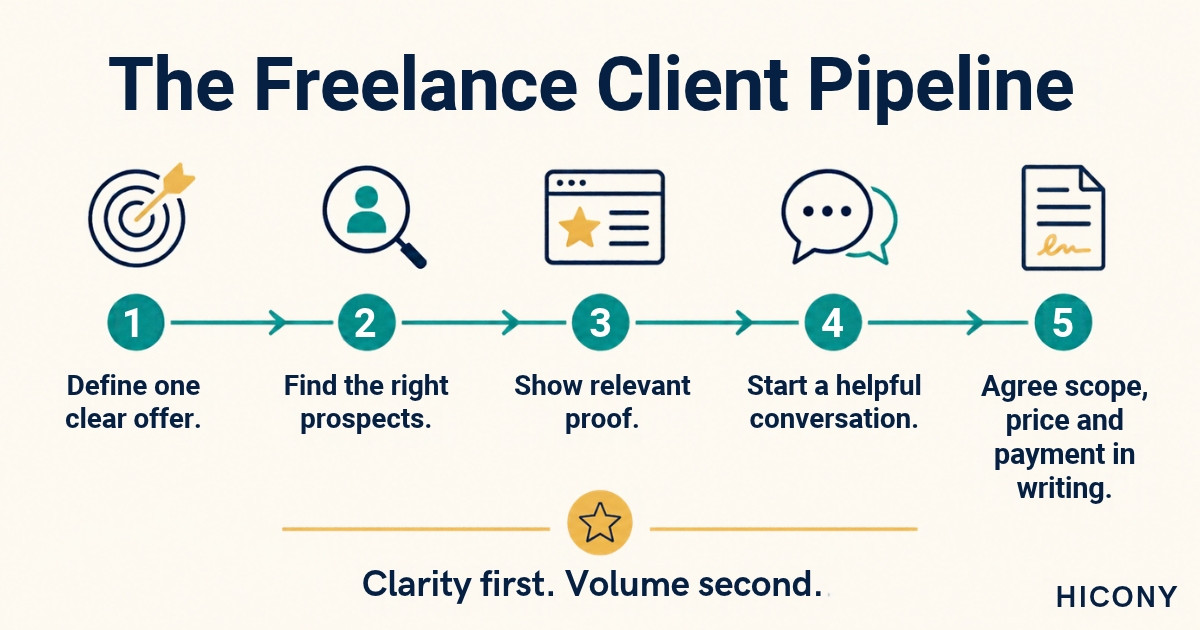
This plan is designed to build a repeatable process, not promise a client within a fixed number of days. The numbers below are activity targets you can adjust to your available time and market—not industry benchmarks or guaranteed conversion rates.
| Week | Main task | Practical output |
|---|---|---|
| 1. Focus | Choose one service and one client type. Speak to a few people who understand that market. | A one-sentence offer, scope checklist and list of 20 relevant prospects. |
| 2. Proof | Create two strong samples or case studies. Improve your profile and contact page. | A one-page portfolio and a clear service description. |
| 3. Conversations | Ask for relevant introductions, contribute to communities and send a small number of personalised messages. | A prospect tracker with contact date, context and next action. |
| 4. Improve | Follow up appropriately, hold discovery calls and review which channel produced useful conversations. | One refined offer, improved outreach and a proposal template. |
Track the process, not just the money
A basic spreadsheet can record:
- Prospect name and business
- Why the prospect is a good fit
- Where you found them
- Date and type of first contact
- Whether they replied
- Next agreed action and date
- Proposal status and outcome
After a few weeks, look for patterns. If people reply but do not book calls, your next step may be unclear. If calls happen but proposals are rejected, revisit your discovery questions, scope or pricing explanation. If no one replies, check whether you are reaching the right people and whether your message is genuinely relevant before simply increasing volume.
10. Mistakes that make client acquisition harder
- Offering everything: A broad list of skills makes it difficult for buyers to understand what to hire you for.
- Sending generic pitches: A message that could be sent to any business gives the recipient little reason to respond.
- Competing only on low price: A low quote does not compensate for unclear scope, weak proof or unreliable communication.
- Waiting for a perfect portfolio: Build a small, honest set of relevant samples and improve it as you work.
- Depending on one platform: Marketplaces can change their rules, fees and visibility. Build professional relationships and a portfolio you control.
- Ignoring follow-up: Record agreed next steps so interested prospects do not disappear through disorganisation.
- Promising outcomes you cannot control: Promise the work you will deliver, not guaranteed sales, rankings or revenue.
- Working without clear terms: Agree deliverables, deadlines, payment and revisions in writing before you start major work.
- Taking every “yes” without capacity: Overloading yourself early can damage quality and referrals—see how to take on more clients without burning out.
11. Protect yourself from freelance scams
Most legitimate clients will not ask you to pay for the privilege of working, send money via gift cards or process cheques that “accidentally” overpay you. Treat high-pressure, vague or unusually high-paying offers with caution.
- Verify the company and contact independently when something feels off.
- Keep early communication and files inside the marketplace until a contract is active, if you are using one.
- Never pay upfront fees to “unlock” a job.
- Be wary of requests for sensitive personal or banking details before a clear agreement exists.
- Read current consumer guidance, such as the FTC advice on work-from-home job scams.
If you use AI tools while preparing proposals or samples, protect client and personal data—see what not to paste into AI tools.
Frequently asked questions
How do I find freelance clients with no experience?
Choose a narrow service, create honest sample projects, explain your process and approach people who are likely to need that specific result. You can begin with a small paid pilot or a limited project, but be transparent that your samples are demonstrations rather than client work.
How can I find freelance clients for free?
Start with referrals, professional communities, useful LinkedIn participation, direct research using public business contact channels and a simple portfolio page. These methods cost time rather than advertising money, but they still require consistency and respectful communication.
Is LinkedIn useful for finding freelance clients?
It can be useful when your target clients or referral partners are active there. Make your profile specific, contribute to relevant conversations and consider a LinkedIn Service Page if it fits your service. Do not assume that creating a profile alone will generate enquiries.
Should I use Upwork or find clients directly?
They serve different purposes. A marketplace can provide access to people already looking for help. Direct channels and referrals help you build relationships outside one platform. You can test one marketplace alongside one relationship-based channel and compare the quality of the leads, fees and time required.
How many messages should I send each day?
There is no universal number. Prioritise relevance and quality over volume. A few carefully researched messages that address a real need are more useful than a large batch of generic pitches. Follow the law and platform rules that apply to your location and channel.
What should I say when a potential client asks for my price?
Ask enough questions to understand the deliverables, complexity, deadline and responsibilities first. Then provide a written estimate that explains what is included, what is excluded, the payment schedule and how extra work will be handled.
How long does it take to get a freelance client?
It varies with your service, experience, portfolio, market, pricing and how consistently you reach suitable prospects. A 30-day plan can help you build a pipeline and learn which approaches work, but it cannot guarantee a paying client within that period.
How do I know if a freelance job offer is a scam?
Be suspicious of vague high-paying offers, pressure to act immediately, requests to pay money to get work, fake-check arrangements, gift-card payments or requests for sensitive information without a valid reason. Verify the client independently and use secure payment arrangements.
Sources and further reading
- Upwork Help: How to build your freelancer profile
- Upwork: How to use Upwork as a freelancer
- LinkedIn Help: Service Pages
- Federal Trade Commission: How to avoid work-from-home job scams
- Related HICONY guides: Freelancing with AI, AI privacy checklist, Take on more clients without burning out, Organise your email inbox.
Editorial note: This guide provides general business and career information, not legal, tax or financial advice. Platform features and terms can change; check the current rules before using a marketplace or social network. Adapt processes to your local regulations and the needs of your clients.