
It is Sunday evening, and you are already tired. Not “long week” tired, but the kind of tired that sleep does not seem to fix. You open your laptop and feel nothing: no worry, no motivation, just a heavy sort of flatness. You tell yourself you are just stressed. But is that really it?
The words get mixed up all the time, but burnout vs stress is not a small difference. They feel different, they have different causes, and they need different solutions. Treating burnout like ordinary stress (with a weekend off and a few deep breaths) often leaves people feeling worse and wondering what is wrong with them.
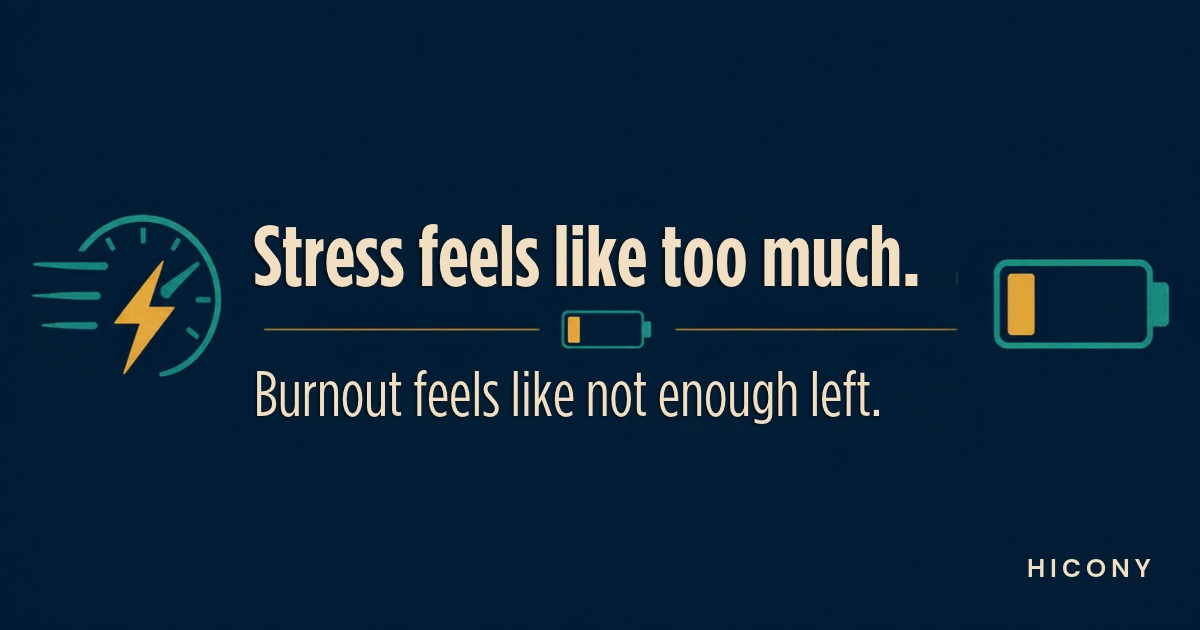
This guide will help you work out which one you are dealing with. You will get a simple self-check, a side-by-side comparison, a realistic 30-day recovery plan, scripts for talking to your manager, and a clear idea of when to ask a professional for help.
This article is general information, not medical advice. If you are struggling, please speak to a doctor or mental health professional. If you ever feel unsafe or think about harming yourself, contact your local emergency or crisis service right away.
Burnout vs Stress: The Short Answer
- Stress is usually a response to too much pressure. You feel wired, tense and overwhelmed, but you still care, and you can imagine feeling better once things calm down.
- Burnout is what can happen when work stress goes on for too long without enough support or recovery. You feel drained, detached and less effective, and rest alone does not seem to help much.
A simple question can help: “Am I revved up, or emptied out?” Revved up points to stress. Emptied out points to burnout.
What Burnout Actually Is
“Burnout” gets used for everything from a bad Monday to a full collapse. The World Health Organization is more specific. In its International Classification of Diseases (ICD-11), it describes burnout as a syndrome that results from chronic workplace stress that has not been successfully managed. It says burnout has three dimensions:
- Exhaustion: feelings of energy depletion.
- Distance: increased mental distance from your job, or feelings of negativity or cynicism about it.
- Reduced effectiveness: feeling less able to do your work well.
The WHO also makes two important points. Burnout is classed as an “occupational phenomenon”, not a medical condition, and the term is meant for work contexts rather than every area of life. You can read the full statement here: WHO: Burn-out an “occupational phenomenon”.
In practice, people also report burnout related to caring for family, studying or other long-term demands. You do not need an official label to take your exhaustion seriously.
Stress vs Burnout: Side by Side
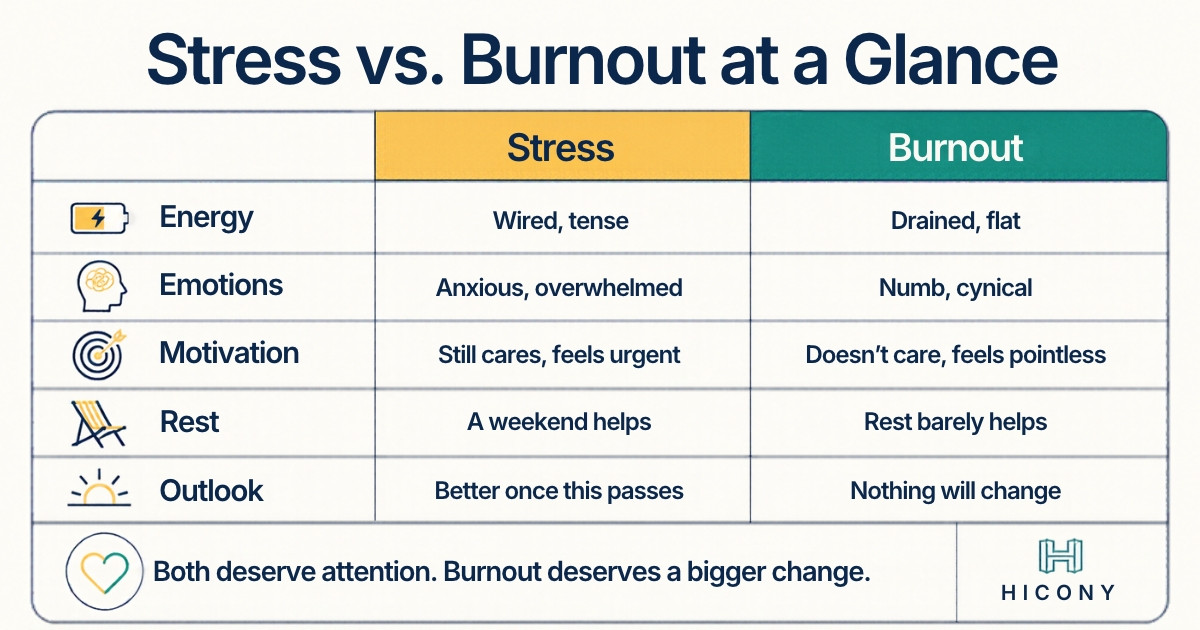
| Area | Stress | Burnout |
|---|---|---|
| Energy | Wired, tense, restless | Drained, flat, empty |
| Emotions | Anxious, irritable, overwhelmed | Numb, cynical, detached |
| Motivation | You still care, and it feels urgent | You stop caring, and things feel pointless |
| Rest | A weekend or holiday helps | Rest barely helps, or the relief fades fast |
| Outlook | “I’ll feel better when this is over.” | “Nothing is going to change.” |
| Sleep | Trouble switching off | Sleeping a lot yet still exhausted, or poor sleep |
| Main risk | Anxiety, tension, overload | Withdrawal, cynicism, loss of confidence |
These are patterns, not rules. Many people experience both at once. Chronic stress is one of the main roads that can lead to burnout.
A 2-Minute Self-Check
Read each statement and note how many sound like you over the last few weeks. This is not a diagnosis. It is just a way to see your pattern more clearly.
- I feel exhausted even after sleep or a day off.
- I dread starting work, or I have trouble getting going.
- I have become more cynical or critical about my job or colleagues.
- I feel little satisfaction from what I achieve.
- I doubt whether my work matters.
- I find it hard to concentrate or make decisions.
- I feel more irritable or emotionally flat than usual.
- I have more headaches, stomach upsets or other physical complaints.
If several of these fit, burnout is worth taking seriously. The Mayo Clinic offers a similar set of questions and notes that if several answers are “yes”, you may have job burnout and should think about talking to a health care professional, since these symptoms can also be linked to conditions such as depression. See their guide: Job burnout: How to spot it and take action.
What Causes Burnout?
Burnout is not a sign you are weak or lack resilience. According to the Mayo Clinic, common contributors include:
- Lack of control: little say over your schedule, workload or assignments, or not having the resources you need.
- Unclear expectations: not knowing what your manager or others expect.
- Too much or too little to do: constant overload, or monotony that takes effort to push through.
- Poor work-life balance: work taking so much time and energy that nothing is left for family, friends or rest.
- Lack of support: feeling isolated at work or in life.
- Heavy giving roles: working in a helping profession that involves a lot of giving to others.
This matters because it shows burnout is often about the situation as much as the person. You can look after yourself brilliantly and still burn out if the workload or environment stays unsustainable.
Why Burnout Is Worth Taking Seriously
Ignoring burnout does not make it go away. The Mayo Clinic notes that unaddressed job burnout can contribute to ongoing fatigue, insomnia, sadness, anger or irritability, and increased alcohol or substance use. It also lists links with conditions such as heart disease, high blood pressure and type 2 diabetes, and being more likely to get sick. That does not mean burnout will cause these in everyone. It means long-term depletion is a health issue, not just a mood.
Burnout vs Depression: What to Know
Burnout and depression can look similar: low energy, trouble concentrating, loss of enjoyment. Burnout is tied mainly to work or a specific demand, while depression usually affects many areas of life and can include persistent low mood, hopelessness, changes in appetite or sleep, and in some cases thoughts of self-harm. You can have both. Only a qualified professional can tell them apart, so if your low mood is lasting or spreading beyond work, please see a doctor or therapist.
Your 30-Day Burnout Recovery Plan
Real recovery usually needs changes to the load, not just more self-care. This plan is gentle and realistic. Go at the pace your energy allows.
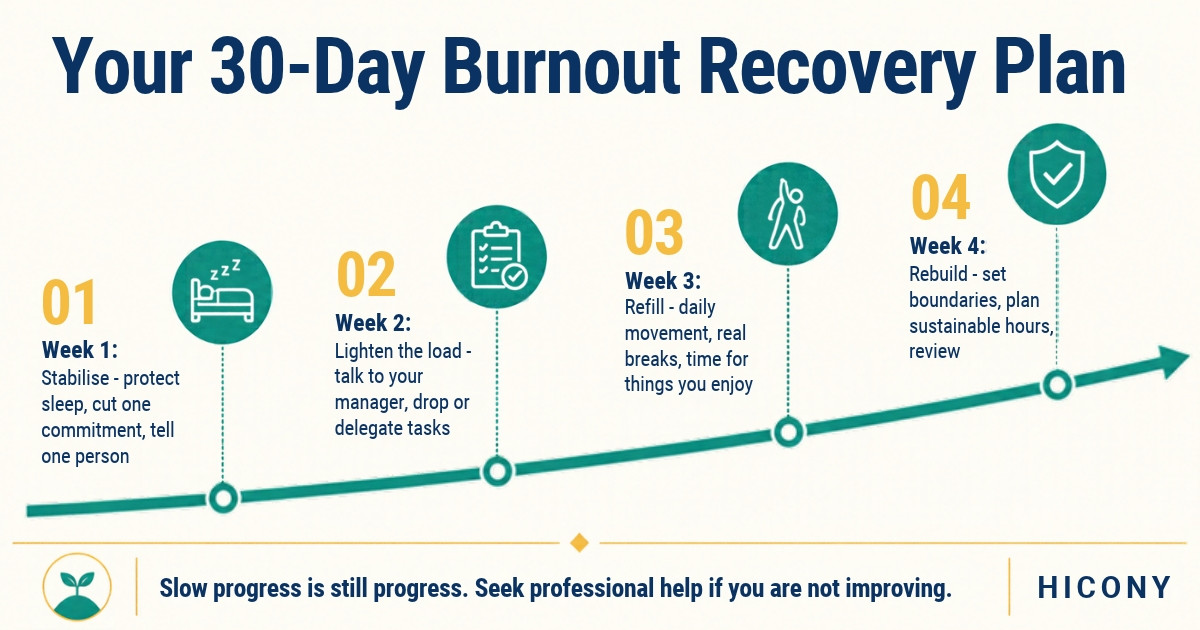
Week 1: Stabilise
- Protect your sleep. Aim for a regular wake time and a calm wind-down. Our guide to how to fall asleep faster has a 14-day plan.
- Drop one non-essential commitment. Just one. Practise using one of the scripts in our guide on how to say no without feeling guilty.
- Tell one person. A friend, partner or colleague. Burnout grows in silence.
- Start an energy ledger (see below).
Week 2: Lighten the load
- Look at what is draining you most. Use your ledger to find the top two or three drains.
- Talk to your manager about workload, priorities or deadlines (scripts below).
- Delegate, delay or delete at least one recurring task.
- Take real breaks. Step away from your desk at lunch, and take short pauses between tasks.
Week 3: Refill
- Move your body daily. A walk is enough. The Mayo Clinic notes regular physical activity can help you cope with stress and take your mind off work.
- Do one thing each day just because you enjoy it. Not to be productive.
- Reduce mental clutter. Our guide to clearing mental clutter shows how to close open loops.
- Consider a gentle digital break. See our guide to digital detox if your phone keeps work in your pocket.
Week 4: Rebuild
- Set boundaries you can keep: a finish time, a no-email window, or one protected evening.
- Plan your week around energy, not just time. Our article on the 90-minute rule shows how to work in focused blocks with real breaks.
- Review what changed. Which drains are gone or smaller? What needs more attention?
- Decide the next step: keep the changes, negotiate more, or consider whether this job is sustainable (see the decision section below).
Most people will not be fully recovered after 30 days, and that is fine. Recovery can take longer, particularly if the cause at work does not change. If you are not improving, please talk to a professional.
The Energy Ledger: A Simple Daily Tracker
If you feel drained but cannot say why, try an energy ledger for one week. At the end of each day, write down what drained you and what fuelled you. Patterns appear faster than you expect.
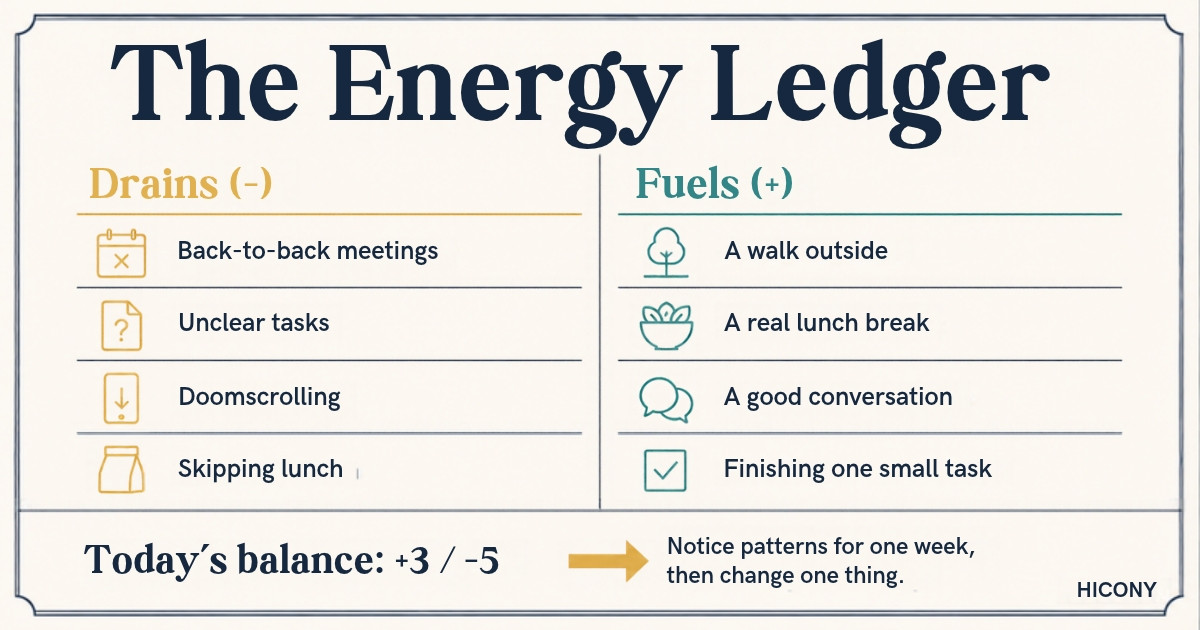
| Drains (minus) | Fuels (plus) |
|---|---|
| Back-to-back meetings | A walk outside |
| Unclear tasks | A real lunch break |
| Doomscrolling | A good conversation |
| Skipping lunch | Finishing one small task |
After a week, pick one drain to reduce and one fuel to add. Small changes build momentum when your energy is low.
How to Talk to Your Manager (With Scripts)
Talking about burnout at work can feel risky. You do not need to share more than you want to. Focus on the workload, the impact and a solution.
Raising workload
- “I want to keep delivering good work, and my current workload is not sustainable. Can we look at priorities together?”
- “I have X, Y and Z due this month. Which should come first?”
Asking for a specific change
- “Could I move the deadline for this to next week?”
- “Could we share this project, or bring in extra help?”
- “I would like to protect two hours of focus time a day. Would that work?”
Asking for time off
- “I have been running at full capacity for a long time and I need a proper break. I would like to take leave from [date] to [date].”
If you need to say more
- “I have been feeling very drained, and I am talking to my doctor about it. I would like to work out a plan with you to manage my workload.”
If asking for help feels hard, our guide on asking for help without feeling like a burden may make it easier. Check your workplace’s employee assistance programme too, if it has one.
What If the Job Itself Is the Problem?
Sometimes you can lighten the load and recover where you are. Sometimes the job, manager or culture is the main cause and does not change. Ask yourself:
- Have I raised the problem clearly, and has anything changed?
- Is the workload fixed, or is there room to negotiate?
- Do I have any control over my schedule and tasks?
- Do I feel supported, or isolated?
- Does this role still fit my values and strengths?
- Can I sustain this for the next year?
If your honest answer to most is “no”, it may be time to explore other options: a different team, role or employer. Do not make a big decision when you are at your most exhausted if you can avoid it. Stabilise first (week one), then decide. Our guide to making better decisions when overwhelmed can help. Write down your thoughts too, because a short journal entry often makes the right decision clearer. See our beginner’s guide to journaling.
How to Prevent Burnout From Coming Back
- Treat recovery as part of work, not a reward for finishing it.
- Protect your off-hours. Decide when you stop and stick to it where you can.
- Keep your ledger going once a month to spot early drains.
- Keep connection alive. The Mayo Clinic notes that feeling like you belong protects against burnout.
- Say no earlier. Small refusals now prevent big collapses later.
- Watch your early warning signs. Cynicism, dread and constant fatigue often show up before a crash.
If you use AI tools to speed up work, make sure they actually reduce your load, not just raise expectations. Our article on AI productivity without burnout covers 13 rules for this.
When to Get Professional Help
Please speak with a doctor, therapist or counsellor if:
- Your exhaustion or low mood has lasted several weeks and is not improving.
- You feel hopeless, worthless or numb most of the time.
- You are using alcohol or other substances to cope.
- Your sleep, appetite or physical health have changed noticeably.
- You are struggling to function at work or at home.
- You have thoughts of harming yourself. In this case, contact a local emergency or crisis service straight away.
Getting help is not a failure. A professional can check for conditions that look like burnout, such as depression, anxiety, thyroid problems or sleep disorders, and can help you plan recovery.
Frequently Asked Questions About Burnout vs Stress
What is the main difference between burnout and stress?
Stress is usually too much pressure, and you still feel engaged and able to imagine relief. Burnout is more like running on empty: exhaustion, detachment and reduced effectiveness that do not improve easily with rest.
Can stress turn into burnout?
Yes. Long-term, unmanaged stress with little recovery or support is one of the main routes to burnout. That is why it helps to act on stress early.
What are the first signs of burnout?
Common early signs include constant tiredness, dreading work, growing cynicism, trouble concentrating and a sense that nothing you do makes a difference.
How long does it take to recover from burnout?
It varies widely. Some people feel better within weeks once the load changes, while others need months, especially if the causes at work remain. Recovery is usually gradual, not a straight line.
Will a holiday fix burnout?
A holiday can give relief, but it rarely fixes burnout alone if you return to the same workload and conditions. Lasting recovery usually needs changes to the demands, boundaries and support around you.
Is burnout a mental illness?
The WHO classes burnout as an occupational phenomenon, not a medical condition. That said, it can affect your mental and physical health, and it can overlap with depression or anxiety, so it deserves attention.
Should I quit my job if I am burned out?
Not automatically. First stabilise: sleep, talk to someone and try to adjust your workload. If the cause is built into the job and nothing can change, leaving may be the healthiest choice, but try not to decide at your lowest point.
How do I know if it is burnout or depression?
They can look alike and can occur together. Burnout is tied mainly to work, while depression typically affects many areas of life. A doctor or mental health professional can assess you.
Your Next Step
You do not need to fix everything this week. Tonight, take the two-minute self-check above. Tomorrow, start your energy ledger and drop one non-essential task. Then tell one person how you are really doing. Those three small moves can start turning things around, and they show you that you are not stuck.
For more practical ideas on work, energy and well-being, explore our Stress Management articles, or read about imposter syndrome at work if self-doubt is part of the picture.
Sources and Further Reading
- World Health Organization (2019). Burn-out an “occupational phenomenon”: International Classification of Diseases.
- Mayo Clinic Staff. Job burnout: How to spot it and take action.