
You open an email at 8:47 on a Tuesday morning. It is short, a little sharp, and ends with “as I already said.” Your chest tightens. You can feel a reply forming, and it is not a kind one.
What happens next is a small test of emotional intelligence at work. Not because there is a right feeling to have, but because there is a choice about what to do with the one you have. Most workplace conflicts do not start with big events. They start with small moments like this one, handled well or handled badly.
This guide explains what emotional intelligence (often called EQ) really means in a job, what research does and does not show, and 15 real examples of what it looks like in meetings, messages, feedback and conflict. You will also get word-for-word scripts, a simple three-step pause for tense moments, and a 30-day plan you can start without anyone noticing.
This article is general information, not psychological or career advice. If work stress is affecting your health, please speak to a doctor or qualified professional.
What Is Emotional Intelligence at Work?
Emotional intelligence is the ability to notice and understand emotions, in yourself and in other people, and to use that understanding to guide what you do. The idea was introduced by psychologists Peter Salovey and John Mayer around 1990, and was later popularised for a wider audience by Daniel Goleman.
Goleman’s popular model breaks it into five skills:
- Self-awareness: knowing what you feel and why.
- Self-regulation: managing impulses and reactions.
- Motivation: staying driven by more than money or approval.
- Empathy: understanding how others feel.
- Social skills: communicating, influencing and resolving conflict.
At work, these show up in ordinary things: how you take feedback, how you disagree in a meeting, how you word a message, and how you behave when a deadline is slipping.
It helps to be clear about what emotional intelligence is not:
- It is not being nice all the time. You can be direct, firm and kind at once.
- It is not suppressing your feelings. It is understanding them, then choosing how to respond.
- It is not manipulation. The skills are the same ones that help you listen better and be more honest.
- It is not fixed. Many of the underlying habits can be practised.
If you are new to the idea, start with our simple guide to what emotional intelligence is, or the broader guide to building emotional intelligence.
What Does the Research Say?
It is worth being honest about the evidence, because emotional intelligence is sometimes oversold. A well-known 2011 meta-analysis in the Journal of Organizational Behavior, led by Ernest O’Boyle at Virginia Commonwealth University, looked across many studies and found that emotional intelligence was positively related to job performance, and that this held even when cognitive ability and personality were taken into account. You can read the university’s summary here: Study: emotional intelligence predicts job performance.
But the results come with caveats:
- The relationship was moderate, not dramatic. Emotional intelligence is one useful factor among many, not a magic key to success.
- Researchers use different definitions and tests, and they do not always agree on what is being measured.
- Skills alone cannot fix a poorly run team, an unrealistic workload or a toxic culture.
So think of emotional intelligence as a practical set of habits that tends to help you work with other people, not as a score that defines you.
Low vs High Emotional Intelligence at Work
The difference is rarely about feeling different emotions. It is about what you do next.
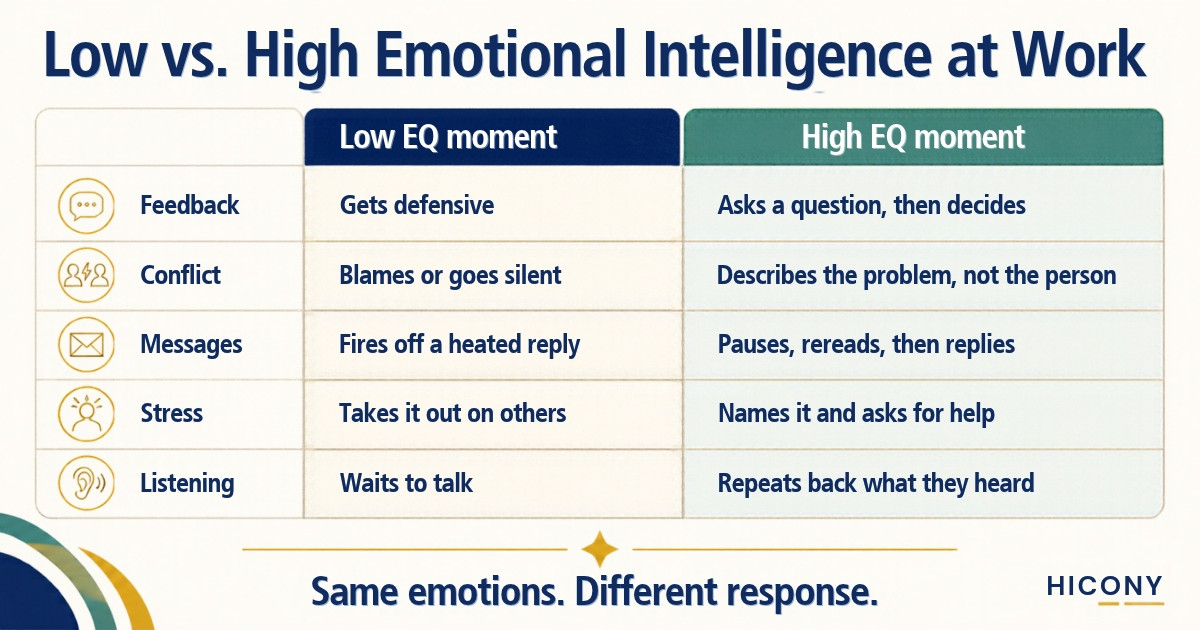
| Situation | Low EQ moment | High EQ moment |
|---|---|---|
| Feedback | Gets defensive or shuts down | Asks a question, then decides what to use |
| Conflict | Blames the person or goes silent | Describes the problem, not the person |
| Messages | Fires off a heated reply | Pauses, rereads, then replies |
| Stress | Takes it out on colleagues | Names it and asks for help or time |
| Listening | Waits for a turn to talk | Repeats back what they heard |
15 Real Examples of Emotional Intelligence at Work
Here are 15 everyday examples, each with something you could actually say. Change the words so they sound like you.
In meetings
1. Noticing the room. You see that a quiet colleague has not spoken. You say: “I’d like to hear from you on this, [name], if you have a view.”
2. Disagreeing without attacking. You disagree with a plan. Instead of “That won’t work,” you say: “I see the goal. My worry is X. Could we test it first?”
3. Handling being interrupted. Someone cuts you off. You stay calm and say: “I’d like to finish my point, then I’ll hear yours.”
4. Admitting you don’t know. You are asked a question you cannot answer. You say: “I don’t know yet. I’ll find out and get back to you by Thursday.”
With feedback
5. Receiving criticism. Your manager points out a mistake. Rather than defending yourself, you say: “Thanks for telling me. Can you show me what you’d like it to look like?” For more, see how to handle criticism without taking it personally.
6. Giving difficult feedback. You describe the behaviour and the impact: “In the last two meetings, the report arrived after the deadline, which held up the team. Can we talk about how to avoid that?”
7. Acknowledging good work. You specifically recognise someone’s effort: “The way you simplified that process saved us a lot of time.”
In messages and email
8. Pausing before replying. You get an irritating message and wait before responding. You return later with: “Thanks for the update. I have a couple of questions so I can get this right.”
9. Reading tone carefully. A short message feels cold. You do not assume the worst. You ask: “Just checking I’ve understood. Are you asking for X by Friday?”
10. Choosing the right channel. A sensitive topic is getting messy in a group chat. You move it: “This might be easier to talk through. Do you have 10 minutes this afternoon?”
Under pressure and in conflict
11. Naming your stress. You are overloaded. You say: “I want to do this properly, and I’m at capacity. Which of these should come first?” If saying no is hard, our guide on how to say no without feeling guilty has 45 scripts.
12. Repairing after a mistake. You snapped at a colleague. Later you say: “I was short with you earlier, and I’m sorry. It wasn’t about you.”
13. Staying curious in conflict. Two people disagree. You ask: “What would a good outcome look like for each of us?”
With yourself and your team
14. Asking for help. You are stuck and say so early: “I’ve tried A and B. Can you point me in the right direction?” It can help to read about asking for help without feeling like a burden.
15. Managing your own doubts. You feel like you do not belong in a new role, and you treat that as a feeling, not a fact. If that sounds familiar, read about imposter syndrome at work.
The 3-Check Pause: A Simple Tool for Tense Moments
When a message or comment triggers you, try this quick pause before you respond. It takes about a minute.
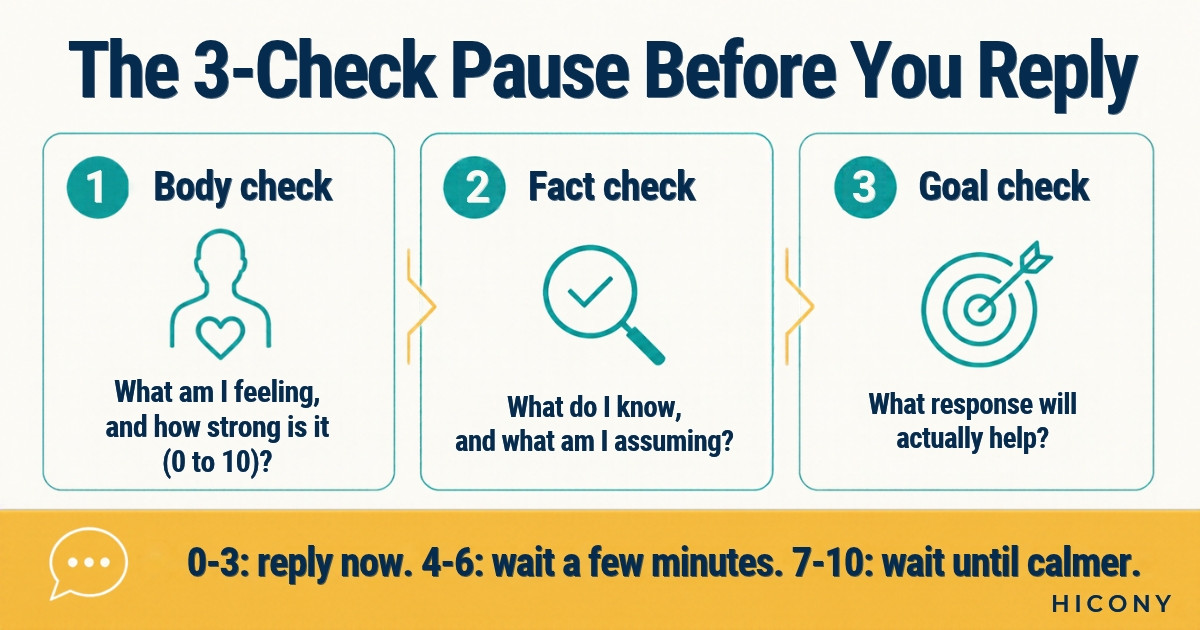
- Body check. What am I feeling, and how strong is it from 0 to 10? Notice where it sits in your body: tight chest, hot face, clenched jaw.
- Fact check. What do I actually know, and what am I assuming? “She ignored my email” is a fact. “She doesn’t respect me” is an assumption.
- Goal check. What response will actually help here?
Then use the intensity score as a guide:
| Intensity | What to do |
|---|---|
| 0 to 3 | Reply now. |
| 4 to 6 | Wait a few minutes, then reread before sending. |
| 7 to 10 | Do not reply yet. Take a walk or a break and come back when calmer. |
Separating feelings from facts is a skill you can build. Our guide to stopping negative self-talk uses the same idea.
Scripts for Tough Workplace Moments
Responding to a sharp email
- “Thanks for the update. I want to make sure I’ve understood. Is the main priority X?”
- “I may have missed something earlier. Could you point me to it?”
Disagreeing with your manager
- “I see why you want to do it this way. I have one concern, and I’d like your view on it.”
Giving feedback to a colleague
- “Can I share something that might help? When X happens, the effect is Y. What do you think?”
Apologising
- “I got that wrong, and I’m sorry. Here is what I’ll do to fix it.”
When you need a moment
- “I want to give that a proper answer. Can I come back to you after lunch?”
Emotional Intelligence in Remote and Chat Work
Text strips out tone, so small signals matter more.
- Assume a good intent first. Short messages are often just rushed.
- Be clear about what you need and by when. Vague messages cause worry.
- Use a few extra words of warmth. “Thanks” and “when you have a moment” cost almost nothing.
- Move heated topics to a call. Tone is hard to read in writing.
- Do not reply in the heat of the moment. Draft it, wait, then reread.
Your 30-Day Plan to Build Emotional Intelligence at Work
One habit a week is enough. Do not try to do everything at once.
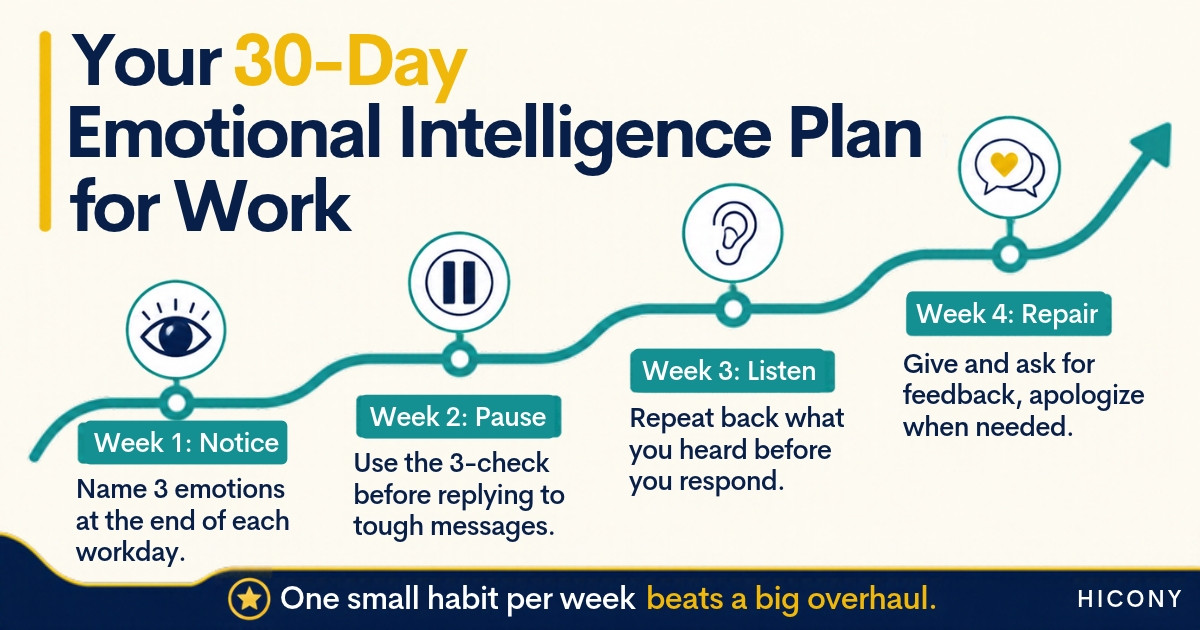
Week 1: Notice
At the end of each workday, name three emotions you felt. “Irritated in the meeting. Proud of the report. Worried about Friday.” Naming feelings precisely is easier than it sounds, and it is a skill in itself. Our article on emotional granularity explains why. Writing helps too, and our beginner’s guide to journaling has a simple 10-minute template.
Week 2: Pause
Use the 3-check pause before replying to any message that annoys you. You do not need to do it every time, only for the ones that spike above a 4.
Week 3: Listen
In conversations, repeat back what you heard before you respond: “So you’re saying the deadline moved and you need the draft first. Is that right?” It feels slow at first, and it prevents a lot of misunderstandings.
Week 4: Repair
Ask for feedback once: “What is one thing I could do differently?” Give one piece of specific appreciation. And if you got something wrong, apologise simply and move on.
Common Mistakes People Make
- Thinking EQ means never being upset. The aim is to respond well, not to feel nothing.
- Being “nice” instead of honest. Avoiding hard conversations is not emotional intelligence. It delays problems.
- Using empathy as a weapon. “I understand how you feel, but…” can sound dismissive. Say what you understood and mean it.
- Over-explaining. Long explanations invite argument. Keep it short and clear.
- Skipping the repair. Mistakes happen. What matters most is what you do afterwards.
If You Manage People
Managers shape the emotional climate of a team more than they realise. A few habits that help:
- Set clear expectations early, so people are not guessing.
- Give specific feedback, both positive and critical.
- Ask open questions and listen to the answer.
- Admit your own mistakes.
- Watch for signs that someone is overloaded. Our article on burnout vs stress explains the warning signs.
When Emotional Intelligence Is Not Enough
Emotional intelligence helps you handle difficult situations, but it cannot fix everything.
- If the workplace itself is the problem, such as bullying, discrimination, unreasonable workloads or no support, the answer is not to “be more emotionally intelligent”. It may involve HR, a union, a manager above, or leaving.
- If you are exhausted, skills will not replace rest. Read about burnout and consider speaking to a doctor.
- If strong emotions or low mood are getting in the way of daily life, a therapist or counsellor can help.
Rest also matters more than most people think. If your nights are rough, our guide on how to fall asleep faster has a 14-day plan.
Frequently Asked Questions About Emotional Intelligence at Work
What is emotional intelligence in the workplace?
It is the ability to recognise your own and others’ emotions and use that understanding to communicate, make decisions and handle conflict well at work.
What are examples of emotional intelligence at work?
Staying calm when you get critical feedback, pausing before replying to a heated email, listening without interrupting, asking for help early, and apologising when you get something wrong.
Why is emotional intelligence important at work?
Research suggests it is moderately linked to job performance, and in everyday terms it helps with teamwork, communication and handling stress. It is one important factor among many.
Can emotional intelligence be improved?
Many of the underlying habits, such as noticing emotions, pausing and listening, can be practised and improved over time.
How can I show emotional intelligence in a meeting?
Listen fully, invite quieter voices, disagree respectfully and admit when you do not know something.
What are signs of low emotional intelligence at work?
Frequent defensiveness, blaming others, interrupting, difficulty accepting feedback and reacting strongly to small problems. Everyone has some of these moments, so look for patterns, not single events.
Is emotional intelligence more important than IQ?
That is overstated. Both matter, and the right mix depends on the role. Emotional intelligence adds to cognitive ability rather than replacing it.
How long does it take to improve emotional intelligence?
There is no fixed timeline. Many people notice small changes within weeks of regular practice, but it is an ongoing habit, not a quick fix.
Your Next Step
Pick one situation from this week that is likely to be tense: a meeting, an email, a conversation. Decide in advance what you want to say, and use the 3-check pause if it gets heated. Then, at the end of the day, write down one sentence about how it went. Small, repeated moments like this build emotional intelligence faster than any big resolution.
For more practical guidance, explore our Emotional Intelligence articles, or read about improving emotional intelligence in relationships.
Sources and Further Reading
- O’Boyle, E. H. et al. (2011). The relation between emotional intelligence and job performance: A meta-analysis. Journal of Organizational Behavior, 32(5), 788 to 818. University summary: Virginia Commonwealth University news.
- Salovey, P. and Mayer, J. D. (1990). Emotional intelligence. Imagination, Cognition and Personality, 9(3), 185 to 211.
- Goleman, D. (1998). What makes a leader? Harvard Business Review.